

Ghost Ants in Margate, FL: Why September Rains Keep Infestations Going
Ghost Ants in Margate, FL: Why September Rains Keep Infestations Going
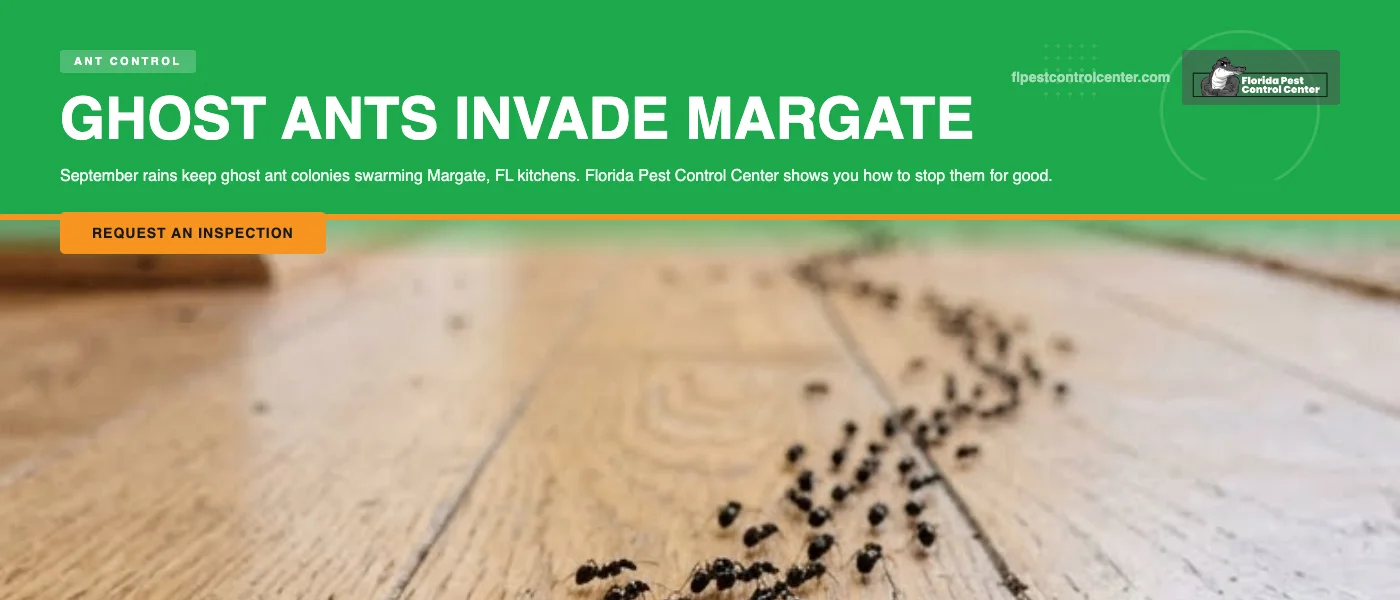
Late September in Margate, FL brings something Broward County homeowners know all too well: another surge of tropical rain, and with it, the tiny pale trails that appear along kitchen counters and bathroom sinks overnight. Ghost ants ride out our extended wet season by pushing indoors, and by early fall they are typically at their most aggressive. Our team at Florida Pest Control Center has treated ghost ant infestations across Broward County for years, and we consistently see the same story every September — a homeowner spots one line of tiny ants near the sugar bowl, and within a week the whole kitchen is a highway.
If you have already noticed nearly-transparent ants trailing across your counters, running along baseboards, or clustering around a potted plant, this guide is for you. We are going to walk through why ghost ants love South Florida homes this time of year, where they hide, what actually stops them, and why the wrong DIY approach can turn one small infestation into three or four. By the end you'll know exactly what to look for and how to shut the door on ghost ants — this season and next.
What Are Ghost Ants and Why Do They Love South Florida Homes?
Ghost ants — scientifically Tapinoma melanocephalum — are among the smallest household ants you will ever meet. Workers measure between 1.3 and 1.5 millimeters long, which is roughly the diameter of a grain of rice. They earn their common name from an almost translucent body: a dark head and thorax topped with a pale, milky abdomen and pale legs. Against a light countertop or a white grout line, they can genuinely be difficult to see. If you crush one, you may catch a faint coconut-like scent — a defensive chemical that experienced pest technicians often use to positively identify the species.
According to the University of Florida IFAS Featured Creatures profile, ghost ants are a tropical species that has thoroughly established itself throughout the state and was elevated from a nuisance to a major household pest across central and southern Florida decades ago. They breed year-round without a dormant season, which sets them apart from most temperate-climate ants. In Broward County, where warm humid conditions rarely break, that biology gives them a permanent home. Colonies are polygyne, meaning a single infestation can contain dozens or even hundreds of egg-laying queens. That reproductive redundancy is a large part of why ghost ants are so persistent and so difficult to eliminate with over-the-counter products.
Why Margate, FL Homes Are Especially Vulnerable to Ghost Ants
Margate sits in central Broward County, surrounded by dense residential neighborhoods, mature landscaping, and the network of canals that shape South Florida drainage. Every one of those features creates conditions ghost ants thrive in. Established shrubs and trees along foundations give colonies outdoor nesting sites within a few feet of your home, and irrigation-fed lawns provide the steady moisture ghost ants need to raise brood.
Our team has walked through hundreds of Margate homes and we regularly see the same physical entry pathways: weep holes in stucco, gaps around AC line penetrations, worn thresholds on sliding glass doors, and cracks where the slab meets the wall in older single-story ranch-style homes. Ghost ants only need a gap the width of a credit card edge to move a full trail indoors, and Margate's mix of 1970s and 1980s housing stock offers plenty of those openings. Newer builds are not immune either — landscape irrigation timers set to run every morning create the moist mulch beds ghost ants nest in, right up against the foundation.
How September Rains Drive Ghost Ant Colonies Indoors
South Florida's wet season runs June through October, and September is typically the peak. Margate averages roughly 21 rainy days during the month, with relative humidity holding between 70 and 80 percent for weeks at a stretch. For ghost ants, this creates two problems that push them toward your kitchen. First, saturated soil and pooled water flood the shallow ground-level and mulch-bed nests where colonies typically live. Second, aphid and scale-insect populations on ornamental plants — a primary honeydew food source for ghost ants — can be knocked back by heavy rain, leaving foragers scrambling for alternative sugar.
The result is a mass indoor migration. Ghost ants pour into wall voids, cabinet interiors, and any consistently warm dry space near a food source. We routinely get calls in mid-to-late September from Margate homeowners who noticed only a few ants around Labor Day and are now finding trails on three different counters. If you see ghost ant activity accelerating rather than fading during a rainy stretch, that is the pattern — not a coincidence.
Where Ghost Ants Hide in Margate Kitchens and Bathrooms
Ghost ants seek warmth, moisture, and food. In practice that means kitchens and bathrooms are ground zero. The most common hiding places we find during a Margate inspection include:
- Behind and beneath the dishwasher and refrigerator. Heat plus condensation from ice makers is a nearly perfect nesting environment.
- Under the kitchen sink. Plumbing penetrations through the cabinet base give ants a direct path from wall voids to your sponge and sugar bowl.
- Bathroom vanities and around toilet supply lines. Standing humidity plus a steady water source keeps a colony fed and hydrated indefinitely.
- Potted plants — indoors or on covered patios. Ghost ants happily nest in the moist soil of houseplants, and once established, they use the pot as a base to raid nearby food surfaces.
- Wall voids near electrical outlets and light switches. Warm, dry, and hidden — a classic satellite colony location.
Because ghost ants split their operations across several nests at once, seeing a trail in one spot almost never means the whole colony lives there. That is the single most important thing to understand before you reach for a spray bottle.
DIY Ant Control: What Works and What Makes Ghost Ants Worse
We understand the impulse — you see a line of ants and you want them gone right now. Unfortunately, the standard over-the-counter response is exactly the wrong move for ghost ants. Here is what our team sees most often in Margate homes:
Contact sprays make ghost ants worse. When ghost ants sense a repellent chemical, colonies fragment through a behavior called budding — a portion of workers and one or more queens simply splits off and starts a new nest a few feet away. Spraying a trail in your kitchen frequently turns a single infestation into three or four smaller ones spread through the walls. Two weeks later you are chasing trails you did not have before.
Homemade sugar-water traps rarely reach the queens. Because ghost ants have multiple reproductive queens, killing visible workers barely dents the population. Any sugar bait needs to be slow-acting enough that workers can carry it back and distribute it to brood and queens via trophallaxis — the ant-to-ant food sharing that makes bait control effective.
Vinegar and essential-oil sprays are essentially repellents. They drive foraging trails to relocate rather than eliminate the colony. Ants will vanish from one counter and reappear on another within days.
What actually helps at the DIY level: identifying and sealing entry points, storing food in tight-lidded containers, cleaning up spills promptly, and pulling mulch back at least six inches from the foundation. Those measures reduce pressure but rarely resolve an active infestation on their own.
Professional Ant Treatment Options for Margate, FL Properties
When homeowners in Margate call us for ant control, our approach is built around the ghost ant's specific biology rather than a one-spray-fits-all strategy. That means three coordinated steps.
Interior baiting with slow-acting non-repellent gels. We place small placements of non-repellent, slow-acting gel bait directly on active trails and near suspected nesting harborage. Workers feed and return to the colony to share the bait through trophallaxis, carrying active ingredient to queens and brood we cannot reach directly. Because the bait is non-repellent, it does not trigger the budding response that turns one nest into several.
Targeted exterior perimeter treatment. Landscape edges, foundation cracks, weep holes, and mulch beds get a treatment designed to interrupt the outdoor colony pressure driving ants indoors. This is where we knock down the source, not just the visible symptom on your counter.
Follow-up and monitoring. Ghost ant colonies rarely collapse in three days. Most Margate infestations show visible improvement within one to two weeks, and full elimination usually takes four to eight weeks of coordinated interior and exterior treatment. We schedule a follow-up visit to confirm that bait consumption has dropped and no new trails have appeared before we call an infestation resolved.
Preventing Future Ghost Ant Infestations Year-Round
Because Broward County ghost ant populations breed continuously, prevention is not a one-time task. The homeowners who stay ghost-ant-free treat prevention as an ongoing habit tied to South Florida's climate. A few core practices go a long way:
- Keep vegetation off the house. Trim shrubs, branches, and ornamentals so nothing touches your siding or roofline. Ghost ants use limbs and utility lines as highways from outdoor nests into your walls.
- Manage mulch and irrigation. Pull mulch back at least six inches from the foundation. Set irrigation timers to run less often and deeper rather than shallow-and-daily — you will starve nests of the constant surface moisture they need.
- Seal entry points before the rainy season peaks. Cover weep holes with mesh screening (never solid caulk — homes need weep holes to breathe), replace worn door sweeps, and check where utility lines penetrate walls.
- Store sugar, honey, and pet food in airtight containers. If ghost ants find no food reward inside, foraging pressure drops significantly.
- Schedule quarterly professional service. Regular exterior treatment keeps outdoor colony pressure low so a stray colony never has the chance to establish a full indoor network.
For a broader look at the pest challenges South Florida homeowners face year-round, visit Florida Pest Control Center — our team covers Margate and the surrounding Broward County communities with local, ongoing pest protection.
Frequently Asked Questions
Are ghost ants dangerous?
Ghost ants do not sting and rarely bite. The concern is contamination rather than injury — because these ants trail across sinks, bathrooms, and food surfaces, they can carry bacteria into places where you prepare meals. That is why we recommend addressing an infestation quickly rather than waiting to see whether it clears on its own.
How long does it take to get rid of ghost ants in a Margate home?
Most homes see visible improvement within one to two weeks of the first professional treatment, and full elimination typically takes four to eight weeks. The timeline reflects the colony's multi-queen structure — bait needs time to move through the entire nest network via worker-to-worker feeding.
Can I get rid of ghost ants myself?
Small, freshly-arrived trails sometimes respond to careful sealing and clean-up alone. Established infestations rarely do. Ghost ant colonies with multiple queens and budding behavior almost always require slow-acting non-repellent bait plus outdoor perimeter work — the tools most homeowners do not have on hand.
Why do ghost ants come back after I spray them?
Repellent sprays trigger budding — the colony fragments into new satellite nests to escape the chemical. A week later you often have more infestation points than before. Non-repellent baiting is the specific technique that avoids this outcome.
When should I call a professional for ghost ants?
If you have seen trails in more than one room, if you have already tried sprays and the ants keep returning, or if you notice ants coming from wall voids or potted plants, it is time to bring in professional help. Our team has treated ghost ants across Margate and Broward County for years and we know exactly how to shut them down without making the problem worse.