
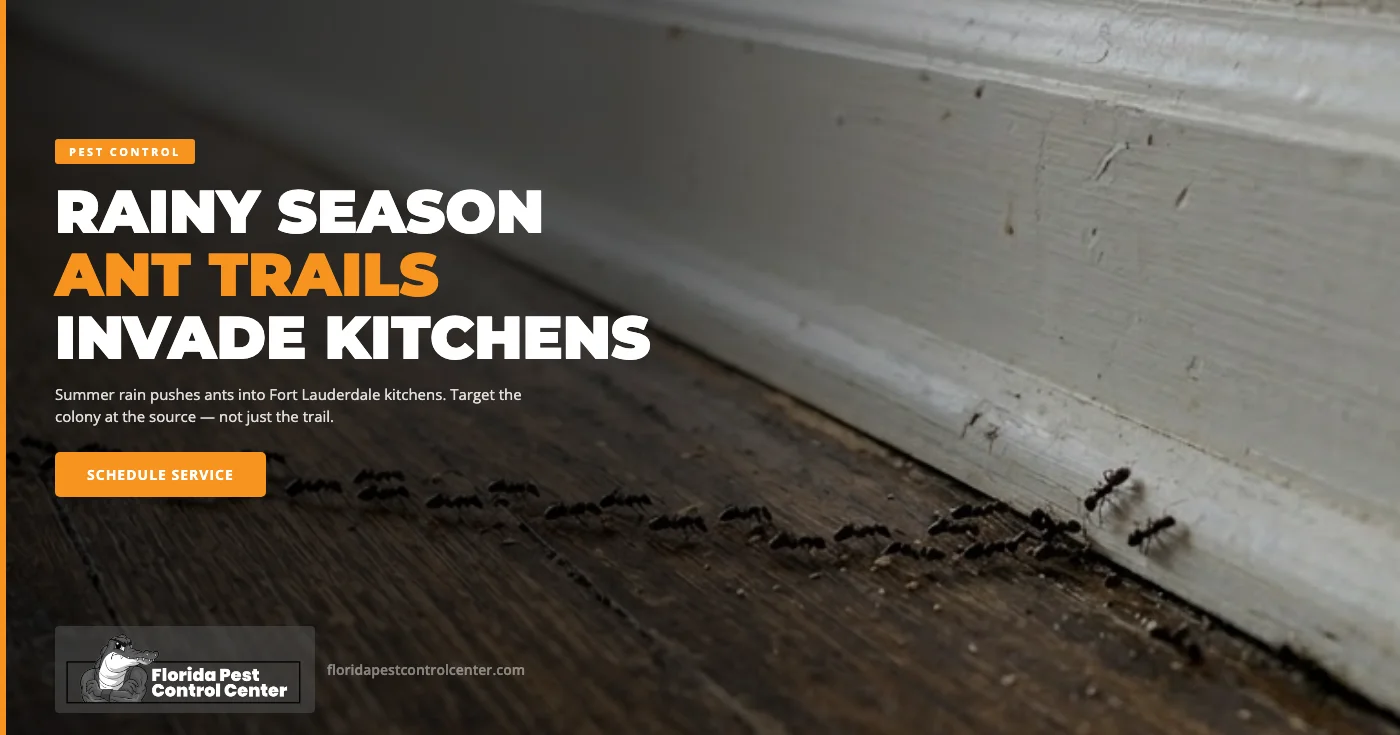
There's a predictable pattern that plays out across Fort Lauderdale every summer: the rainy season begins, the humidity climbs, the afternoon showers roll in from the Atlantic—and inside thousands of South Florida homes, ants start showing up in kitchens that were perfectly ant-free the week before. The timing is not coincidental. Understanding the connection between summer rain and ant activity is essential for Fort Lauderdale homeowners who want to stay ahead of one of the region's most persistent warm-weather pest problems.
South Florida's climate is uniquely suited to ant populations. The combination of heat, humidity, and an eight-month rainy season creates ideal conditions for numerous ant species to thrive outdoors—and periodically relocate indoors. Knowing which species are responsible, why they move inside when it rains, and how to make your kitchen less inviting is the foundation of effective ant management in Fort Lauderdale.
Why Fort Lauderdale Kitchens See More Ant Activity After Summer Rain
The short answer is flooding. Most ant species in South Florida build ground-level or below-ground colonies in moist soil—exactly the type of soil that exists in abundance throughout Broward County's landscaped neighborhoods. When summer rain saturates the ground, it doesn't just inconvenience the ants; it floods their tunnels, drowns their larvae, and threatens the viability of the entire colony.
Ants respond to this threat with a survival behavior that's been refined over tens of millions of years: they move. They follow pheromone trails that scout ants have already established to food and water sources, and they seek dry, elevated harborage. Your kitchen—dry, climate-controlled, and almost always containing accessible food and water—is exactly what they're looking for.
This migration isn't random. Ant colonies send scouts ahead of the main group, and those scouts leave chemical trails that other ants follow in large numbers. When you see a line of ants marching across your kitchen floor after a rain event, you're watching the tail end of a coordinated relocation effort that may have begun hours or days earlier. By the time the trail is visible, the colony may already be establishing itself inside your walls, under your flooring, or in the landscape immediately adjacent to your home.
The Ant Species Behind Fort Lauderdale's Summer Invasion
South Florida is home to dozens of ant species, but a handful account for the majority of residential problems during the rainy season.
Florida carpenter ants (Camponotus floridanus) are among the most commonly encountered species in Broward County homes. These large, red-and-black ants don't eat wood—they excavate it to build nesting galleries, preferring soft, moisture-damaged wood like that found around leaky window frames, damaged fascia boards, and water-compromised subflooring. Their association with rain is both direct (flooding drives them from outdoor nests) and indirect (the moisture damage they prefer is more common where drainage and waterproofing are inadequate).
Ghost ants (Tapinoma melanocephalum) are tiny, pale-colored ants that are nearly impossible to spot individually but appear in large numbers along trails. They're one of the most common kitchen invaders in South Florida and are particularly attracted to sweet foods. Ghost ants are highly adaptive and have developed resistance to many common consumer insecticides, which is one reason treating them with store-bought spray often makes the problem worse rather than better—the spray kills foragers but can cause the colony to "bud," splitting into multiple satellite colonies that are harder to locate and treat.
White-footed ants (Technomyrmex difficilis) are another South Florida signature species—small, dark brown to black ants that form enormous colonies and are remarkably difficult to control. They've established themselves throughout Broward County and tend to trail heavily after rain, particularly along exterior walls, utility lines, and tree branches that touch the house.
Fire ants (Solenopsis invicta) are a Broward County reality for any homeowner with a yard. Their mounds appear throughout neighborhoods in Fort Lauderdale and become especially active during and after rain. While fire ants rarely establish colonies inside homes, they do forage indoors, and their mounds near the foundation can create entry pressure during heavy rains.
How South Florida's Rainy Season Drives Ants Indoors
The South Florida rainy season typically runs from May through October, with its peak intensity in June and July. During this period, Fort Lauderdale receives an average of seven to nine inches of rain per month—enough to saturate soil consistently and create the flooding conditions that drive ant movement.
The timing of ant activity relative to rain events is instructive. Scout ants typically appear inside homes in the days immediately before and after significant rain, following the drop in barometric pressure and the changes in soil moisture that precede and follow storms. If you notice a few ants in your kitchen the evening before a heavy rain forecast, that's scout behavior—and treating it as an early warning sign is far more effective than waiting until the trail is fully established post-storm.
South Florida's year-round warmth also means that ant colonies never truly become dormant. While ant populations in northern states crash during winter and rebuild slowly in spring, Broward County colonies maintain active populations throughout the year. By the time rainy season arrives, these colonies are already at or near peak size—which means when flooding pressure arrives, they have large, organized workforces ready to relocate.
Common Entry Points Ants Use in Fort Lauderdale Homes
South Florida homes, particularly those built before 2000, have a number of structural characteristics that make them easier for ants to penetrate than homes in drier climates.
Gaps around exterior utility penetrations: Electrical conduit, water supply lines, irrigation control wiring, and cable TV lines all enter through the exterior wall, and gaps around these penetrations are almost universal in residential construction. These gaps—often only a quarter inch or less—are sufficient entry points for most ant species.
Weep holes in stucco: Many Fort Lauderdale homes are built with concrete block or stucco exteriors that include weep holes to allow moisture drainage behind the exterior shell. These holes are sized almost perfectly for ant entry and are extremely common across Broward County residential construction.
Door and window frames: Weather stripping degrades in South Florida's heat and humidity, and the expansion and contraction of frames with seasonal temperature changes creates gaps over time. Door thresholds in particular are common ant entry points, especially for ghost ants and white-footed ants that trail along the perimeter of structures.
Landscape contact: When trees, shrubs, or ground cover plants touch your home's exterior walls, they create ant bridges that bypass your exterior defenses entirely. South Florida's lush landscaping is beautiful but also a significant pest pressure factor—maintaining clearance between vegetation and your home's exterior is one of the most effective preventive steps available.
Roof edge and fascia: Carpenter ants in particular access homes via the roofline. Damaged or soft fascia boards, open soffit vents, and gaps where the roofing material meets the fascia are all entry points for larger ant species exploring for nesting sites.
Foods and Conditions That Attract Ants to Your Kitchen
Understanding why ants target kitchens specifically—rather than other rooms—helps explain why prevention strategies focus heavily on sanitation and food storage.
Ghost ants and white-footed ants, the two most common kitchen invaders in Fort Lauderdale, are primarily attracted to sugar-based food sources. Spilled juice, fruit left on the counter, open honey jars, pet food left out, and even the residue on unwashed dishes are all sufficient attractants to draw scout ants into a kitchen and establish pheromone trails.
Carpenter ants are less interested in your pantry and more interested in moisture. Leaky pipes under the kitchen sink, condensation around the refrigerator water line, or a poorly sealed dishwasher connection creates exactly the damp wood conditions that carpenter ants seek for nesting. If you're finding large, reddish-black ants in your kitchen, investigate moisture rather than food sources first.
Water itself is also a powerful attractant, especially during dry periods within the rainy season. A kitchen sink with even a slow drip, a pet water bowl left out overnight, or condensation pooling on the floor around the refrigerator can all serve as water sources that ants will trail to consistently.
Ant Prevention Tips for Fort Lauderdale Homeowners
Structural exclusion and sanitation work together as the foundation of ant prevention in South Florida. Neither alone is sufficient in a climate that puts such consistent outdoor pressure on residential structures.
Seal exterior gaps: Walk the perimeter of your home with caulk and check every utility penetration, weep hole (you can screen these without blocking drainage), door threshold, and window frame. Pay particular attention to the kitchen side of the home, since that's where ant scouts are most likely to enter.
Manage vegetation contact: Trim any plant material that touches your home's exterior, including tree branches that overhang the roof. A minimum of one to two feet of clearance between landscape plantings and your foundation is a good target for Broward County properties.
Eliminate indoor attractants: Store pantry items in airtight containers. Keep countertops clean and dry. Don't leave dishes in the sink overnight during rainy season. Clean the inside of appliances—particularly the crumb tray under your toaster and the area beneath your stove's burner grates—regularly.
Address moisture issues: Repair any leaking fixtures under the kitchen sink promptly. Check for condensation around the refrigerator water supply line. Ensure the dishwasher drain hose is sealed and functioning properly.
Treat the perimeter proactively: For Fort Lauderdale homeowners with a history of ant intrusion during rainy season, preventive perimeter treatment applied in late April or early May—before rainy season peak intensity—can create a barrier that disrupts trail formation before it begins.
When Should I Call a Fort Lauderdale Ant Control Expert?
Consumer-grade ant products are sometimes effective against small infestations of foraging ants, but they carry significant risks in South Florida's ant environment. Spraying ghost ant or white-footed ant trails with contact insecticide is one of the most common mistakes Fort Lauderdale homeowners make—it kills foragers but triggers budding, the colony behavior where a stressed colony splits into multiple satellite colonies. Instead of solving the problem, improper treatment can multiply it.
Professional ant control uses a different approach: baiting products that foragers carry back to the colony, distributing the active ingredient throughout the colony's population including the queen, and gradually collapsing the infestation from the inside. This approach takes longer to show visible results than a spray, but it produces lasting control rather than a temporary knockdown followed by a rebound.
For carpenter ant problems, which involve structural nesting rather than simple foraging, professional inspection is essential before any treatment. Identifying where the ants are nesting—which may be inside a wall void, in damaged wood around a window frame, or in an exterior tree that's being used as a satellite colony site—determines what treatment approach will be effective and what repairs may be needed to prevent reinfestation.
If you're seeing ant trails in your Fort Lauderdale kitchen after rain, particularly if the same spots are recurring season after season, a Fort Lauderdale ant control professional can identify the species, trace the entry points, and develop a treatment plan that addresses the problem at its source. Our team serves Fort Lauderdale and the surrounding Broward County communities and understands the specific ant pressure patterns common to South Florida's rainy season.
The rain isn't going away—it's one of the things that makes South Florida such a beautiful place to live. But with the right preparation and professional support, the annual invasion of your kitchen doesn't have to come with it. Contact Florida Pest Control Center to schedule a consultation and put a protection plan in place before the next summer storm rolls through.