

Spring Rodent Activity in Pompano Beach, FL: What Homeowners Need to Know
Spring Rodent Activity in Pompano Beach, FL: What Homeowners Need to Know
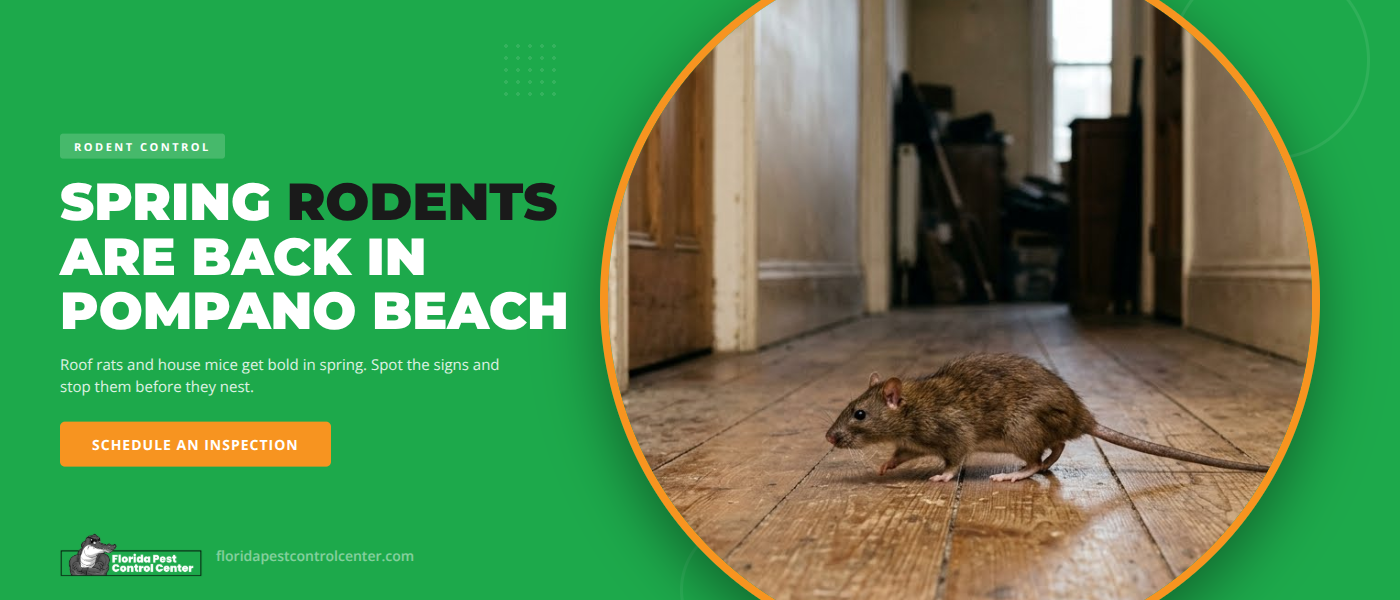
If you are hearing scratching in the attic or noticing droppings in the garage this spring, you are not alone. Spring is when rodent activity climbs across South Florida, and Pompano Beach is no exception. Warmer nights, longer days, and seasonal rainfall push rats and mice into local homes at a higher rate than any other time of year. At Florida Pest Control Center, we handle more rodent control Pompano Beach requests during spring than any other season. Knowing why this happens, what to look for, and when to bring in professional help keeps a small problem from becoming a structural and health issue.
Why Rodents Are More Active in Pompano Beach During Spring
Rodents in South Florida do not hibernate. Mild winters and humid coastal weather mean populations stay active year-round in Pompano Beach. What changes in spring is reproductive intensity. According to the University of Florida IFAS Extension, roof rat breeding peaks twice a year — in spring and again in fall — and a single breeding pair can produce dozens of offspring in a single season under our local climate.
Spring brings steady warmth, frequent afternoon storms, and rising humidity. Outdoor food sources — fruit trees, palm fronds, garden vegetation, and exposed garbage — become abundant. Rodents that made it through the cooler dry season ramp up activity to take advantage of the bounty. As outdoor habitats fill up, juvenile rats search for new territory, and that often means moving into local homes, garages, and outbuildings.
Pompano Beach's coastal geography adds another layer. Properties near canals, mangroves, and the Intracoastal Waterway face elevated rodent pressure each spring because waterfront landscapes give rats reliable shelter and water year-round. Older neighborhoods with mature tree canopies are especially attractive to roof rats, which prefer to travel above ground. Understanding the local seasonal pattern helps Pompano Beach homeowners act before a small issue becomes a major infestation.
Common Rodents in South Florida: Roof Rats, Norway Rats, and House Mice
Three rodent species cause the vast majority of issues we see in Pompano Beach, FL homes. Each has different habits, hiding spots, and entry preferences — which is why accurate identification matters before any treatment plan is built.
Roof Rat (Rattus rattus) — Far and away the most common rat in South Florida. Sleek, dark brown to black, with a body around 7 inches long and a tail longer than its body. Roof rats are agile climbers and prefer to travel along utility lines, tree branches, fences, and roof edges. They almost always enter homes from above — through soffit gaps, roof vents, attic vents, or where tree branches touch the structure.
Norway Rat (Rattus norvegicus) — Larger and heavier than the roof rat, with a blunt nose and a tail shorter than its body. Less common in Pompano Beach than the roof rat but still present, particularly near canals, sewer lines, and commercial alleys. Norway rats burrow at ground level and enter through foundation cracks, garage door gaps, and plumbing penetrations.
House Mouse (Mus musculus) — Small, light brown to gray, around 3 inches long with a thin tail roughly equal to its body length. House mice are extremely adaptable and squeeze through openings as small as a dime. They reproduce quickly — a female can produce 5 to 10 litters per year — and a small starting population grows fast in coastal homes with consistent food access.
Treatments that work for one species may be insufficient for another, which is why our Pompano Beach inspections always begin with positive species identification.
How Rodents Get Into Pompano Beach Homes
Rats and mice are remarkably good at finding entry points. A roof rat can squeeze through an opening the size of a quarter, and a house mouse needs only a dime-sized gap. In Pompano Beach, where homes range from coastal mid-century properties to newer construction, the most common entry points include:
Roof and attic level (roof rats):
- Soffit gaps and damaged or missing soffit panels
- Roof vents and turbine vents with torn screens
- Where tree branches contact the roof, fascia, or chimney
- Spanish tile gaps and damaged ridge vents
- AC line penetrations on exterior walls
Ground level (Norway rats and house mice):
- Worn or missing garage door seals and side weatherstripping
- Gaps where plumbing or electrical lines enter the foundation
- Foundation cracks and damaged exterior stucco
- Crawl space vents with torn screens
- Dryer vent openings without proper louver covers
Once inside, rodents travel through wall voids, ceiling spaces, and attic insulation, often using existing pipe and electrical chases as highways through the house. They typically nest where it is dark, warm, and undisturbed — attic insulation, behind appliances, inside wall voids, and in stored boxes. A thorough exclusion plan addresses entry points and indoor harborage at the same time. Otherwise, new rodents simply replace the ones removed.
Signs of a Rodent Infestation You Should Not Ignore
Rodents are nocturnal and skilled at staying out of sight, so most Pompano Beach homeowners do not see a live rat or mouse until the population has already grown. The warning signs almost always appear first.
- Droppings: Dark, rice-grain-sized pellets along baseboards, on countertops, in cabinets, in the garage, or in the attic. Roof rat droppings are pointed; Norway rat droppings are blunt; mouse droppings are smaller.
- Scratching or scurrying sounds: Especially at night, in the attic, ceiling, or wall voids. Roof rats typically generate noise overhead; Norway rats and mice are heard at floor or wall level.
- Greasy rub marks: Dark, oily smudges along baseboards, beams, or wall edges where rodents repeatedly travel.
- Gnaw marks: Damage on baseboards, door frames, food packaging, plastic storage bins, and electrical wiring. Wire damage is a fire hazard and a common cause of unexplained electrical issues.
- Nests: Shredded paper, insulation, or fabric tucked into out-of-the-way corners — closets, attic insulation, behind appliances, inside cardboard boxes.
- A musky odor: Often noticed near attic access points or in storage areas.
- Pet behavior: Dogs and cats fixating on a wall or ceiling area is often an early indicator.
If you are noticing any of these signs, do not wait. Rodent populations grow fast, and earlier action means less damage and faster resolution.
Health Risks Tied to Rodents in Coastal Homes
Rodents are more than a nuisance — they pose real risks to your household's well-being. The Centers for Disease Control and Prevention identifies rodents as carriers of more than 35 diseases, transmitted directly through contact with droppings, urine, or saliva, and indirectly through fleas, ticks, and mites that have fed on infected rodents.
Specific concerns for Pompano Beach families include:
- Hantavirus — A serious respiratory illness contracted by inhaling particles from dried rodent droppings or urine, typically when sweeping or vacuuming a contaminated attic or shed.
- Leptospirosis — A bacterial illness spread through contact with water or soil contaminated by rodent urine. Coastal yards with standing water after spring storms create elevated risk for both people and pets.
- Salmonellosis — Bacterial contamination of food and food preparation surfaces from rodents traveling through pantries and kitchens.
- Asthma and allergy triggers — Rodent droppings, dander, and urine all act as airborne allergens that can worsen asthma symptoms in children and seniors, especially in homes with attic-level activity.
Cleaning a rodent-contaminated space without proper precautions can release contaminated particles into the air. Professional remediation, performed after the population is eliminated, removes that risk.
Why Spring Is the Best Time to Schedule a Professional Inspection
Acting in spring gives you a major advantage. The same conditions that drive rodent activity also make problems easier to detect — fresh droppings, recent gnaw marks, and active travel paths all show up clearly during a thorough inspection. Catching an early-season infestation prevents the rapid summer population growth that follows.
A professional inspection in Pompano Beach typically includes:
- Complete exterior walk-around to identify entry points at the roof, soffits, foundation, and utility penetrations
- Full attic inspection for droppings, nests, gnawing, and insulation damage
- Garage, crawl space, and utility room evaluation
- Tree-line and landscaping assessment for travel paths and outdoor harborage
- Identification of the species present and the size of the active population
Spring inspections also catch the structural issues that allow rodents in to begin with — torn screens after winter wear, damaged soffits, worn garage door seals, and roof gaps from previous storm seasons. Fixing these in spring closes the door before the larger summer breeding wave arrives. Florida Pest Control Center has been performing seasonal inspections for Pompano Beach homeowners for years, and we have learned where to look first.
How Florida Pest Control Center Protects Pompano Beach Properties
Our approach to rodent control Pompano Beach homeowners trust is built around three pillars: identification, exclusion, and elimination. We start with a thorough inspection — interior, exterior, attic, and perimeter — to identify the species, locate entry points, and map active runways. Without that baseline, no treatment plan can work consistently.
Exclusion is the long-term fix. We seal roof and soffit gaps, repair damaged vent screens, install rodent-rated door sweeps, and close foundation penetrations using materials rodents cannot chew through. Trapping and bait stations, placed where the inspection identified active travel paths, eliminate the existing population. We avoid heavy interior baiting strategies that risk leaving carcasses inside walls — instead, our rodent control plan moves activity to controlled exterior stations whenever possible.
Follow-up service is the part most homeowners do not see from DIY efforts. We return to confirm the population is fully resolved, refresh stations, monitor exclusion work, and document the result. Our Florida Pest Control Center team serves Pompano Beach and the surrounding Broward County communities, including Fort Lauderdale, Hollywood, Plantation, and Lighthouse Point — bringing local experience that national chains cannot match.
Frequently Asked Questions About Rodent Control in Pompano Beach
Why are there so many rats in my Pompano Beach attic this spring?
Spring is the peak breeding season for roof rats in South Florida. Warm nights, abundant outdoor food, and rising humidity drive rats into local attics and wall voids in search of dark, undisturbed shelter. Roof rats almost always enter from above — through soffit gaps, roof vents, or branches that touch the home — so early-season signs typically show up overhead first.
How can I tell if I have rats or mice in my Pompano Beach home?
Droppings are the easiest indicator. Roof rat droppings are pointed and roughly the size of a long grain of rice; Norway rat droppings are blunt; mouse droppings are smaller and thinner. Sound is another clue — rats are heavier and more audible than mice, and roof rats typically move overhead while mice and Norway rats stay closer to the floor. A professional inspection identifies the exact species, which determines the right treatment plan.
Is DIY rodent control effective in coastal Florida homes?
Snap traps and store-bought bait can reduce a small problem temporarily, but coastal Florida homes face year-round pressure that almost always brings rodents back. Without exclusion — sealing the entry points rodents are using — the population simply rebounds. Professional rodent control combines population removal, exclusion repairs, and follow-up monitoring to deliver lasting results.
How long does professional rodent treatment take to resolve?
Most active populations are resolved within two to four weeks of professional trapping and exclusion work. Larger infestations or properties with significant entry points may need additional follow-up visits. Our team provides a realistic timeline after the initial inspection.
Take Action Against Spring Rodent Activity in Pompano Beach, FL
Spring rodent pressure in Pompano Beach is predictable, but a major infestation is not. The earlier you address signs of activity, the smaller the treatment and the less long-term damage to your home.
Florida Pest Control Center has helped Pompano Beach homeowners protect their properties season after season. When you need experienced rodent control in Pompano Beach, our team is ready to inspect, exclude, and resolve.
Contact us today to schedule your inspection and keep rodents out of your home this spring.