
Termite Swarm Season in Plantation, FL - What to Expect
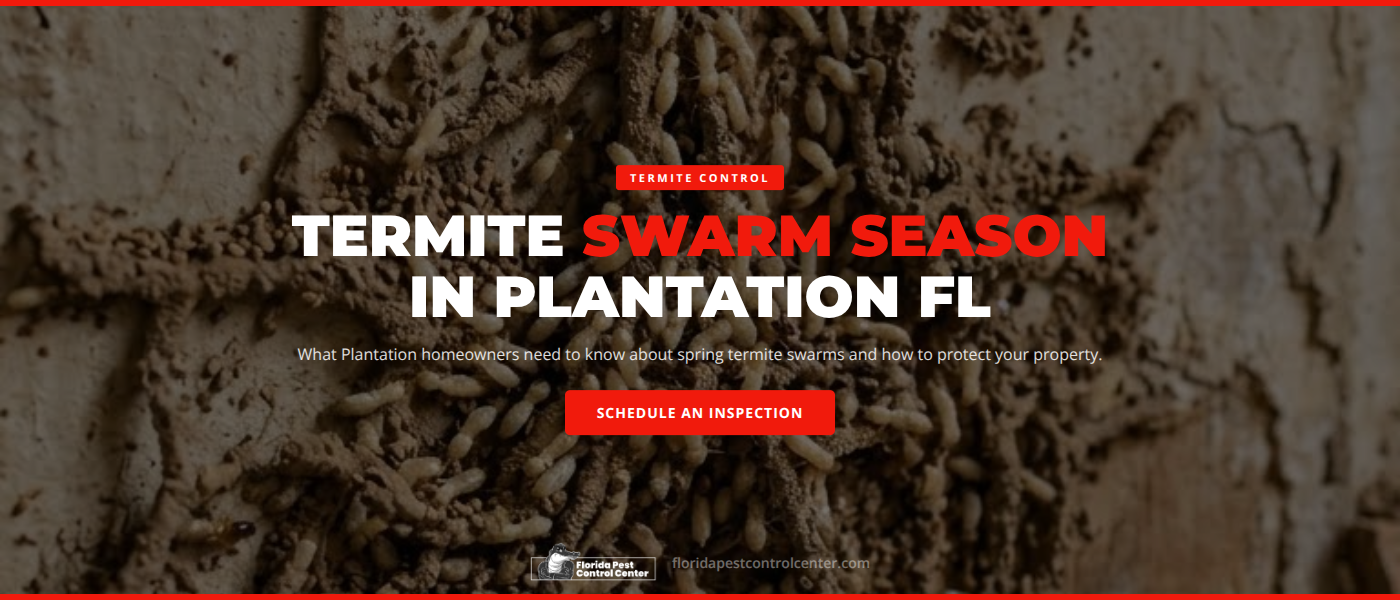
Termite Swarm Season in Plantation, FL - What to Expect
Spring has arrived in Plantation, FL, and with it comes one of the most alarming pest events South Florida homeowners face each year — termite swarm season. If you have ever stepped outside on a warm, humid evening after a rainstorm and noticed thousands of winged insects congregating around your porch lights or windows, you have likely witnessed a termite swarm firsthand. At Florida Pest Control Center, we help Plantation homeowners understand what these swarms mean, which termite species are responsible, and what steps you should take immediately to protect your property from costly structural damage.
Termite swarms are not just a nuisance. They are a direct signal that mature termite colonies are actively reproducing and expanding in your neighborhood. Every swarmer that lands on or near your Plantation home is a potential founder of a brand-new colony — one that could silently consume the wood framing, baseboards, and structural supports of your house for years before you notice any visible damage. Understanding swarm season timing, recognizing the warning signs, and acting quickly are the keys to protecting your biggest investment.
When Does Termite Swarm Season Start in Plantation, FL
In Plantation and across Broward County, termite swarm season typically begins in late February or early March and extends through June, with peak activity occurring in April and May. However, the warm and humid conditions that define South Florida's climate mean that termite swarms can occur outside of these typical windows, especially after periods of heavy rainfall followed by warm, still evenings.
Several factors determine exactly when a swarm will occur in your Plantation neighborhood:
- Temperature — Termites prefer to swarm when temperatures are consistently above 70 degrees Fahrenheit, which is essentially year-round in South Florida but peaks during spring
- Humidity — High humidity levels signal favorable conditions for new colony establishment. Plantation's proximity to the Everglades and coastal moisture sources creates ideal humidity for swarming
- Rainfall — Swarms frequently occur within 24 to 48 hours after a significant rain event. The combination of moist soil and warm air temperatures triggers the reproductive flight
- Time of day — Different species swarm at different times. Subterranean termites typically swarm during daylight hours, while Formosan termites swarm at dusk and into the evening, often attracted to artificial lights
We monitor swarm activity closely throughout the spring months so we can alert our Plantation customers and respond quickly when activity spikes in their area.
Termite Species That Swarm in Plantation and Broward County
Not all termites are the same, and Plantation homeowners face threats from multiple species, each with different swarming behaviors, nesting preferences, and damage potential. Understanding which species you are dealing with determines the treatment strategy we recommend.
Eastern Subterranean Termites
These are the most common termites in Plantation and throughout Florida. Eastern subterranean termites build their colonies underground in the soil and access your home through mud tubes — narrow, pencil-width tunnels that they construct along foundation walls, plumbing penetrations, and expansion joints. Their swarmers are dark brown to black with translucent wings and typically emerge during daytime hours in early spring. A single mature colony can contain hundreds of thousands of workers, all consuming the wood in your home around the clock.
Formosan Subterranean Termites
Formosan termites are sometimes called "super termites" because of the sheer size and destructiveness of their colonies. A single Formosan colony can contain several million individuals — compared to a few hundred thousand for Eastern subterranean termites — and can consume wood at a dramatically faster rate. Formosan swarmers are yellowish-brown and emerge at dusk, swarming in dense clouds around outdoor lights and illuminated windows. We see significant Formosan activity throughout Plantation, particularly in older neighborhoods with mature trees and established landscaping that provide ideal nesting conditions.
Drywood Termites
Unlike subterranean species, drywood termites do not need contact with soil. They establish colonies directly inside the wood they consume — in your attic framing, window frames, door frames, and furniture. Drywood termite swarmers are typically lighter in color and tend to swarm later in the season, from late spring through early fall. While their colonies are smaller than subterranean species, they can be difficult to detect because they leave very few external signs until damage is already significant. One telltale indicator is the presence of small, pellet-shaped frass that drywood termites push out of tiny kick-out holes in infested wood.
How to Tell if You Have Termite Swarmers in Your Plantation Home
Many Plantation homeowners confuse termite swarmers with flying ants, which also swarm during spring. Knowing the difference is critical because the response to each situation is very different.
Termite swarmers vs. flying ants:
- Wings — Termite swarmers have four wings of equal length that are nearly twice the length of their body. Flying ants have two pairs of wings where the front pair is noticeably larger than the rear pair
- Body shape — Termites have a broad, straight waist with no visible constriction between the thorax and abdomen. Ants have a distinctly pinched waist
- Antennae — Termite antennae are straight and beaded. Ant antennae are elbowed with a sharp bend
- Behavior after swarming — Termite swarmers shed their wings shortly after landing, so piles of discarded translucent wings on windowsills, near light fixtures, or along baseboards are a strong indicator of termite activity
If you find discarded wings inside your Plantation home — particularly near windows, doors, or in your bathroom or kitchen — it likely means termites have already entered the structure and are attempting to establish a new colony. This warrants an immediate professional inspection.
Warning Signs of Termite Damage in Plantation, FL Properties
Termite swarms are the most visible sign of termite activity, but they are far from the only indicator. We encourage Plantation homeowners to watch for these additional warning signs throughout the year:
- Mud tubes — Pencil-width tubes running along your foundation walls, in your garage, or along plumbing pipes indicate active subterranean termite activity. These tubes protect termites from exposure to air and predators as they travel between their underground colony and the wood in your home
- Hollow-sounding wood — Tap on baseboards, door frames, and window trim. If the wood sounds hollow or papery, termites may have consumed the interior while leaving the exterior surface intact
- Bubbling or peeling paint — Moisture produced by termite activity can cause paint to bubble, peel, or appear warped on walls and trim, mimicking water damage
- Frass piles — Small piles of wood-colored, pellet-shaped droppings near baseboards, windowsills, or in your attic indicate drywood termite activity
- Tight-fitting doors and windows — As termites consume wood framing, the structural shifts can cause doors and windows to stick or fit improperly in their frames
- Sagging floors or ceilings — In advanced infestations, structural wood damage can cause visible sagging in floors, ceilings, or roof lines
Many of these signs are subtle and easy to miss during everyday life. That is why we recommend annual termite inspections for every Plantation property — catching activity early can save thousands of dollars in repair costs.
How We Treat and Prevent Termite Infestations in Plantation
At Florida Pest Control Center, we use a multi-layered approach to termite control that addresses both active infestations and long-term prevention. Our treatment strategy is tailored to the specific species, the extent of the infestation, and the construction type of your Plantation home.
Liquid barrier treatments — We apply professional-grade termiticide to the soil around and beneath your home's foundation, creating a continuous chemical barrier that subterranean termites cannot cross without being eliminated. This treatment protects the entire perimeter of your property and remains effective for years.
Bait station systems — For ongoing monitoring and colony elimination, we install in-ground bait stations at strategic intervals around your Plantation property. Termites that encounter the bait carry it back to the colony, where it spreads through the population and eliminates the colony from within. We monitor these stations on a regular schedule and replace bait as needed.
Spot treatments for drywood termites — When we identify localized drywood termite infestations in attic framing, door frames, or other accessible wood, we apply targeted treatments directly to the infested areas. For widespread drywood infestations, we may recommend tent fumigation, which treats the entire structure simultaneously.
Pre-construction treatments — If you are building a new home or addition in Plantation, we apply termiticide to the soil before the concrete slab is poured, creating a protective barrier that prevents subterranean termites from ever reaching the wood framing above.
What to Do if You See a Termite Swarm at Your Plantation Home
Seeing a termite swarm at your property can be alarming, but taking the right steps immediately makes a significant difference in outcome. Here is what we recommend:
- Do not panic or spray — Swarmers themselves do not cause structural damage. Spraying them with household insecticide kills the visible swarmers but does nothing to address the colony that produced them
- Collect a sample — If possible, capture several swarmers in a plastic bag or jar. This helps our technicians identify the species quickly and determine the appropriate treatment approach
- Note the location — Record exactly where you observed the swarm — which window, door, light fixture, or area of your yard. This information helps us pinpoint likely entry points and colony locations during our inspection
- Check for discarded wings — After the swarm ends, look for piles of shed wings on windowsills, near doors, and around light fixtures. Wings found inside the home are especially significant
- Schedule an inspection promptly — A professional termite inspection will determine whether the swarm originated from a colony on your property or simply passed through your area. We use moisture meters, thermal imaging, and visual inspection techniques to assess the full scope of any activity
The faster you act after observing a swarm, the better your chances of catching an infestation before it causes significant structural damage.
Frequently Asked Questions About Termite Swarm Season in Plantation
How long does termite swarm season last in Plantation, FL?
Termite swarm season in Plantation typically runs from March through June, with peak activity in April and May. However, Formosan termites can swarm into July, and drywood termites may swarm from late spring through early fall. Because South Florida's climate is warm and humid year-round, occasional swarms can occur outside of these typical windows, especially after heavy rainfall events.
Does seeing a swarm outside my Plantation home mean I have termites?
Not necessarily. Termite swarms can originate from colonies in neighboring properties, nearby trees, or mulch beds and travel some distance before landing. However, a swarm near your home — especially one observed inside your house — is a strong reason to schedule an inspection. If the swarm originated from a colony on or under your property, professional treatment is needed promptly to prevent damage.
Can I prevent termite swarms from entering my Plantation home?
While you cannot prevent swarms from occurring in your area, you can reduce the likelihood that swarmers will enter your home. Keep exterior doors and windows closed during peak swarming hours. Turn off unnecessary outdoor lights during evening swarm events, as Formosan swarmers are strongly attracted to light. Ensure all window screens are intact and that weatherstripping around doors is in good condition. Most importantly, maintaining an active termite prevention plan with professional monitoring eliminates colonies before they reach the swarming stage.
What is the difference between a termite swarm and a termite infestation?
A swarm is the reproductive event where winged termites leave a mature colony to mate and establish new colonies. An infestation is an established colony that is actively consuming wood in or near your structure. A swarm is a warning sign that mature colonies exist in your area. An infestation may already be causing damage to your property without any visible swarmers. We treat both the immediate swarm-related concerns and the underlying colony activity during our inspections and treatments.
Protect Your Plantation Home This Termite Swarm Season — Contact Florida Pest Control Center
Termite swarm season in Plantation is not something to take lightly. The colonies producing those swarms may already be feeding on the wood in your home, and every week of delay gives them more time to cause damage that is expensive to repair. Our team at Florida Pest Control Center has the training, equipment, and experience to identify termite activity, determine the species involved, and implement a treatment plan that eliminates the colony and protects your property for the long term.
We proudly serve Plantation and communities throughout Broward County, including Fort Lauderdale, Davie, Sunrise, and Cooper City. Whether you have witnessed a swarm, found discarded wings, or simply want peace of mind heading into spring, we are here to help.
Contact us today to schedule your termite inspection and take the first step toward protecting your Plantation home. You can also learn more about our termite control services or explore our full range of pest control solutions for South Florida homeowners.