

Formosan Termite Swarms in Tamarac, FL
Formosan Termite Swarms in Tamarac, FL
Every June, porch lights along Tamarac's residential streets pull in a different kind of insect cloud — thousands of large, yellowish-brown winged termites pouring out at dusk on a calm, humid evening, sometimes from a stump in the swale, sometimes from a crack in a driveway, sometimes from a wall cavity behind the kitchen. This is the Formosan subterranean termite swarm, and in Broward County it lands right on schedule in the first weeks of June.
At Florida Pest Control Center, we treat Tamarac properties for this species every summer, and homeowners who catch the swarm early save themselves five-figure repair bills later. Knowing what to look for during the June flight window — and what an active colony looks like the rest of the year — is the difference between a routine termite control call and a structural repair.
Why Formosan Termites Are the Most Destructive Species in South Florida
The Formosan subterranean termite (Coptotermes formosanus) earned its nickname — the "super-termite" — by the math of its colony. A single mature colony averages 350,000 workers and can grow to several million. According to the University of Florida IFAS Extension, the queen produces more than 1,000 eggs per day, and a mature colony consumes roughly 13 ounces of wood every 24 hours — enough cellulose to compromise a load-bearing 2x4 in a few weeks.
The damage numbers track. The USDA estimates Formosan termite damage and control costs exceed $1 billion across the United States every year, and the Florida Department of Agriculture puts the average per-home repair bill in the $10,000 range — with severe cases requiring partial reconstruction. A 2016 UF projection found roughly half of all structures in urban South Florida — Broward County included — could be at risk by 2040. For Tamarac, the species is established: we find active colonies in mature trees along the C-13 and C-14 canal corridors and in slab cracks under older Mainlands-area homes.
When June Swarm Season Hits Tamarac and Broward County
Florida has three species of swarming subterranean termites, each on a predictable calendar. Eastern subterraneans swarm during the day in late winter. Asian subterraneans swarm at dusk from late February through April. Formosan subterraneans swarm at dusk from late April through July, with the peak window in Tamarac and Broward County falling between mid-May and the third week of June. Flights need specific weather: calm, humid evenings within 24–48 hours of a rain, temperatures in the high 70s to low 80s, and little to no wind. Peak flight runs 30 to 90 minutes after sundown, and swarmers are powerfully drawn to light. The University of Florida notes Formosan alates "are usually found near windows, light fixtures, window sills, and spider webs around well-lighted areas." A pile of identical, half-inch-long discarded wings on the kitchen counter or stuck to a porch fixture the morning after a June thunderstorm is almost always a Formosan flight from the night before.
Finding swarmers or shed wings inside your home is a different signal than finding them on the patio. Outdoor swarms blow in from the neighborhood; indoor swarms came from a colony already in the structure.
How to Tell Formosan from Subterranean and Drywood Termites
Tamarac homeowners deal with three termite groups, and the treatment for each is different. Telling them apart matters before any chemical or bait goes in the ground.
Formosan alates are the largest. Per UF IFAS, they measure 12 to 15 millimeters long (about half an inch) including the wings, are yellowish-brown to pale orange, and carry numerous small hairs on the wing membrane — a feature that distinguishes them from native easterns. Soldiers have an orange-brown, oval head with curved mandibles and secrete a milky white defensive fluid from the fontanel pore when disturbed.
Eastern subterranean alates are smaller (around 10 mm), nearly black, with translucent, hairless wings. They swarm during the day in February and March, which alone usually rules them out for a Tamarac June question.
Drywood termite alates are reddish-brown and swarm during the day in late spring. Drywood termites do not require soil contact, so the fecal pellets ("frass") below baseboards or on window sills are the classic drywood sign, not the mud tubes Formosans build. Collect a few wings or a soldier into a small jar and our technicians can confirm species during the inspection.
Warning Signs of an Active Formosan Colony
Indoor swarms are the most dramatic alarm, but waiting for one means the colony has been feeding for years. The early signs we look for during a Tamarac termite inspection:
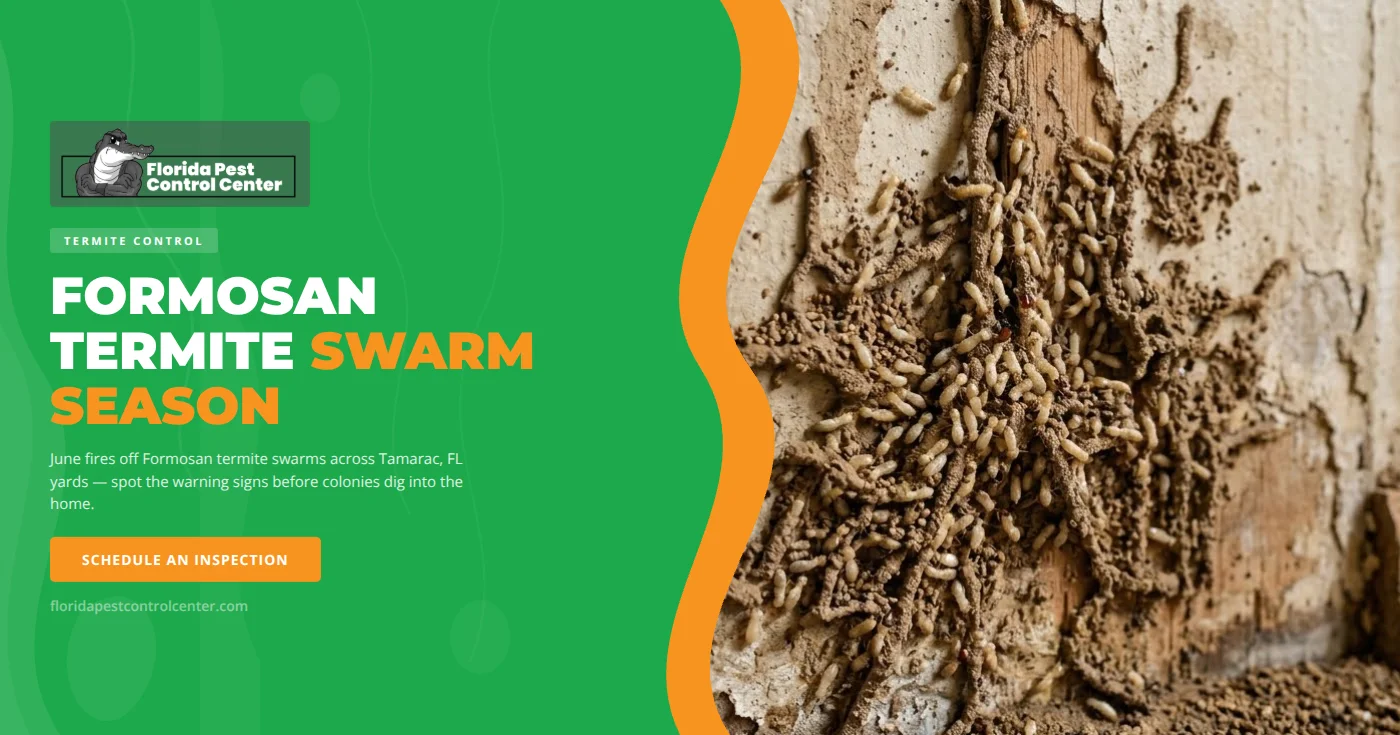
- Mud tubes — pencil-width tunnels of soil and saliva running up foundation walls, pier blocks, and garage corners. Formosans will tube across open concrete spans rather than reroute.
- Carton nests — irregular, papier-mâché masses inside wall voids, soffits, hollow trees, and utility chases. A Formosan signature; easterns rarely build them.
- Hollow-sounding or blistered wood in door frames, window casings, baseboards, and rafters. Severe galleries leave a paper-thin surface.
- Bulging walls, especially around bath plumbing where slow leaks attract foraging workers.
- Sagging floors over a slab in older Tamarac slab-on-grade homes where Formosans have been working through the wood plate and subfloor.
- Discarded wings in window tracks, sliding-door tracks, and along screened-lanai frames after a June rain.
- Mature yard trees. Live oaks, ficus, and slash pines along Tamarac's canal corridors are prime Formosan carton-nest habitat — we have opened plenty of "healthy-looking" trees to find football-sized carton nests inside.
How Tamarac's Climate Fuels Year-Round Termite Activity
Northern homeowners get a winter break from termite pressure. Tamarac homeowners do not. Soil temperatures here rarely drop below 65°F even in January, so foraging continues all winter and colonies expand instead of pausing. Around 60 inches of annual rainfall keeps soil moisture in the range Formosan workers need. Hurricane debris and storm-felled trees leave decomposing cellulose along canal banks — secondary food sources that grow colonies between attacks on structures. Slab-on-grade construction means continuous foundation-to-soil contact, and every plumbing or HVAC penetration is a potential entry point. Mulch against the foundation, planters touching siding, and irrigation at the slab create moist, dark corridors Formosan workers exploit aggressively. The practical upshot: a Tamarac property without active monitoring or treatment is not "termite-free." It is between detections.
What a Professional Termite Inspection Covers
A Florida Pest Control Center termite inspection in Tamarac is a top-to-bottom property walk, not a perimeter spray-and-go. Our technicians work through the exterior foundation (every linear foot of stem wall and slab edge, checking for mud tubes and carton spurs), the garage and utility room, plumbing access points under sinks and behind washing machines, the attic — rafters, ridge beams, and the perimeter top plate around any roof penetration that may have leaked — and the yard, with tap-and-sound testing on mature oaks, ficus, and pines for hollow signatures of carton nests.
We also survey wood-to-soil contact (fence posts, deck framing, planter walls, stored lumber), map moisture with pinless meters across baseboards and around AC condensate lines, verify any wings or termites the homeowner has saved to species, and leave a written report of findings, severity, and recommended treatment options. An initial inspection is no-cost; we quote treatment only after walking the property and identifying the species.
Treatment Options for Active Infestations
Once we confirm a Formosan colony, the treatment plan picks from three proven approaches, often combined.
In-ground baiting systems place a perimeter ring of stations every 8 to 12 feet to intercept foraging workers and deliver a chitin-synthesis-inhibitor bait back to the colony. Bait programs suit Tamarac slab-on-grade homes well — no trenching against the foundation, monitored quarterly.
Liquid soil termiticide uses a non-repellent product trenched at the slab edge to create a treated zone workers tunnel through and carry back before they detect it. Modern non-repellents like fipronil and chlorantraniliprole transfer between nestmates and produce colony decline within weeks — the right call when faster knockdown is needed.
Direct nest injection handles a located carton nest with foam or dust injected straight into the gallery. Single-treatment approaches rarely close out a Formosan colony — we usually pair direct injection on the known nest with a perimeter bait or liquid program covering the rest of the colony's foraging area.
Long-Term Prevention for Tamarac Homeowners
After treatment — or as the proactive plan if you have never had termites — the same property-level habits push the next colony away:
- Pull mulch back 6 to 12 inches from the foundation. Mulch against the slab is the most common conducive condition we cite in Tamarac inspections.
- Eliminate wood-to-soil contact. Fence posts on concrete footings, deck supports on metal bases, no scrap lumber against the house.
- Fix slow leaks fast. Drippy hose bibs, irrigation bleeding under the slab, and AC condensate puddling at the pad are Formosan recruiters.
- Clean and re-pitch gutters before the rainy season. Water sheeting down a foundation wall is exactly the moisture cue subterranean workers follow upward.
- Swap white porch bulbs for yellow LED "bug" bulbs in May and June — Formosan alates are strongly attracted to white light.
- Inspect mature yard trees yearly — especially oaks, ficus, and pines within 30 feet of the house.
- Keep an active monitoring program in place on any home that has ever had a confirmed colony.
Frequently Asked Questions About Formosan Termite Swarms in Tamarac, FL
When exactly do Formosan termites swarm in Tamarac, FL?
The Formosan swarm window in Tamarac and the rest of Broward County runs from late April through July, with the peak two to three weeks centered on the first half of June. Flights happen at dusk on calm, humid evenings within 24 to 48 hours of a rain, and an individual swarm lasts about an hour.
I found wings on my window sill — does that mean my house is infested?
Not necessarily, but it warrants an inspection. Wings on an outdoor sill or screen often come from a swarm pulled in by your porch light. Wings on an indoor sill or across a counter are a much stronger signal that swarmers emerged from inside the structure. Save the wings in a small jar and have a technician verify species and source.
How do I tell Formosan termites from drywood or eastern subterraneans?
Formosan alates are about half an inch long, yellowish-brown, with tiny hairs on the wings, and swarm at dusk from April through July. Eastern subterraneans are smaller, nearly black, swarm during the day in February and March, and have no wing hairs. Drywood termites are reddish-brown, swarm during the day in late spring, and leave sand-grain fecal pellets rather than mud tubes.
What does a termite inspection in Tamarac cost?
An initial inspection from Florida Pest Control Center is no-cost. We provide a written report with species ID, severity, and a treatment quote if anything is active. Treatment pricing depends on home size, foundation linear footage, and whether we recommend baiting, liquid termiticide, direct injection, or a combination.
How quickly can Formosan termites damage a Tamarac home?
A mature Formosan colony consumes up to 13 ounces of wood per day, and in a Tamarac home with warm soils and continuous foraging access, structural compromise can begin within three to six months. The University of Florida and the Florida Department of Agriculture both put average per-home damage costs in the $10,000 range. Early detection during the June swarm window is the highest-leverage moment a homeowner has.
Formosan swarm season in Tamarac is short, loud, and easy to miss. Homeowners who get a property walk on the books before wings stack up on window sills close out an infestation for a few thousand dollars instead of repairing structural failure for $20,000. If you are seeing winged termites around your porch lights this June or finding shed wings indoors, our team is ready to walk the property, confirm species, and build a plan tuned to your home. Learn more about our termite control program for Tamarac, FL or reach out to schedule an inspection.