

Ghost Ants in Wilton Manors, FL: Why Late-Summer Humidity Triggers Indoor Invasions
Ghost Ants in Wilton Manors, FL: Why Late-Summer Humidity Triggers Indoor Invasions
At Florida Pest Control Center, we field a consistent surge of ghost ant calls from Wilton Manors homeowners every August and early September. South Florida's late-summer humidity peaks during the same six-week window every year, and ghost ants (Tapinoma melanocephalum) respond by pushing indoors in numbers most Broward County homeowners have never seen from other ant species. Understanding why the invasion happens on this schedule — and why standard DIY sprays actually make ghost ant infestations worse — is the first step toward keeping them out of your Wilton Manors home.
What Are Ghost Ants and Why Are They So Common in South Florida?
Ghost ants get their name from their appearance: workers are extremely small (1.3 to 1.5 millimeters — about the thickness of a stack of two credit cards) with a deep dark brown head and thorax and a pale, translucent, milky-white abdomen and legs. On a light kitchen countertop, the pale sections effectively disappear, and homeowners often report seeing "tiny brown dots moving on their own" before realizing there is an entire ant trail crossing the surface.
According to the University of Florida IFAS Extension, ghost ants have been established in South Florida since well before 1988 and are now among the most common indoor ant species across Broward, Miami-Dade, and Palm Beach counties. Two colony characteristics make ghost ants exceptionally difficult to control. First, colonies are polygyne, meaning a single colony contains many reproducing queens — anywhere from a few dozen to several hundred. Second, colonies are polydomous, meaning one colony maintains multiple nesting sites simultaneously and moves workers and brood between them in response to conditions. A single Wilton Manors home can host nests in the wall void behind the kitchen sink, under the bathroom vanity, inside a potted plant on the lanai, and in the mulch bed against the foundation — all part of the same interconnected colony.
Why Late-Summer Humidity in Wilton Manors Creates the Perfect Ghost Ant Invasion
August and early September in Wilton Manors are the most humid weeks of the year in Broward County. Daytime highs hold in the low 90s Fahrenheit, overnight lows rarely drop below 78 degrees, and relative humidity stays above 85 percent through most days. Afternoon thunderstorms move through almost daily. For ghost ants, this combination creates three overlapping pressures that drive indoor movement.
Moisture-driven nest relocation. Ghost ant colonies require consistent moisture to keep brood viable. When outdoor nesting sites in mulch beds, potted plants, and leaf litter become waterlogged after routine storms, colonies bud off satellite nests into drier interior locations — wall voids near plumbing, cabinets under sinks, and moisture-holding areas around bathroom fixtures.
Prey and forage abundance. Ghost ants are primarily attracted to sweet substances (honeydew from aphids and mealybugs outdoors, sugary residues indoors) but will also take protein and grease. Late-summer humidity accelerates every organic residue in a Wilton Manors kitchen — a splash of juice, a crumb of pastry, condensation on a soda can — and ghost ants scout aggressively during the hottest weeks of the year.
Foraging trails become interior. During spring and early summer, most ghost ant foraging happens outdoors. By late August, the combination of saturated exterior habitat and abundant interior food and moisture flips the balance. Trails that were previously along foundation edges and patio slabs move up plumbing lines, along baseboards, and across countertops.
How to Spot a Ghost Ant Infestation Before It Spreads
Ghost ants are easy to miss until the population reaches a threshold where trails become visible during daylight. Because colonies are polydomous, the visible trail is almost never the only nest — spotting the early indicators lets Wilton Manors homeowners address the underlying colony before it fractures into additional interior sites.
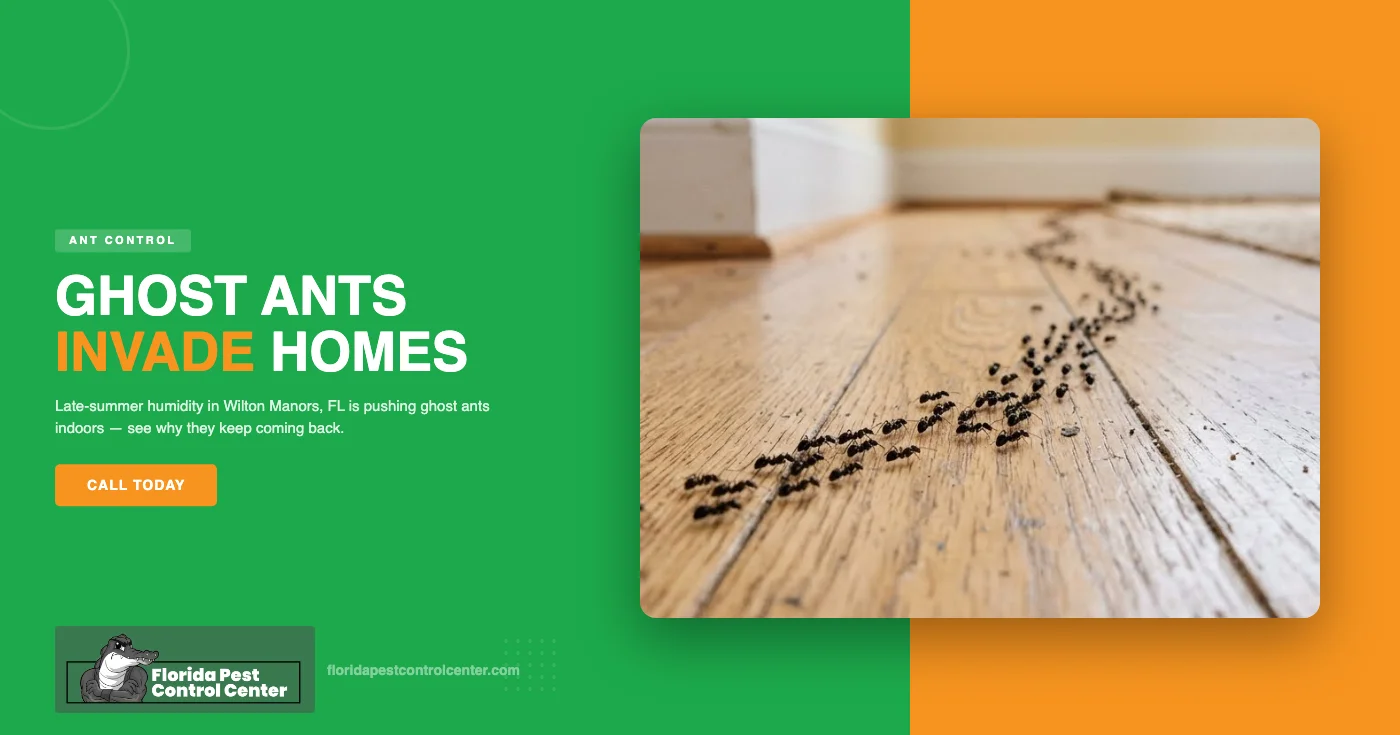
- Thin, moving lines on kitchen counters or bathroom vanities. A line of tiny dark specks that appears to move together — often around a sink, coffee maker, or fruit bowl — is a foraging trail. Individual workers are so small the trail itself is what draws the eye first.
- Sudden ant activity around plumbing penetrations. Ghost ants concentrate near moisture. Look for activity along the base of the dishwasher, around refrigerator water lines, at the shut-off valves under sinks, and where copper or PEX lines enter drywall.
- Ants inside a potted plant, then outside it. Ghost ant colonies frequently nest inside the root ball of an indoor potted plant, especially plants on lanais or near sliding glass doors. Watering the plant and seeing ants boil out of the soil is one of the clearest indicators of an established interior nest.
- Trailing across baseboards and up walls. Because ghost ants are so small, they use narrow gaps at baseboards, along cabinet edges, and around light switch and outlet covers as travel routes between hidden nests and interior food.
- Activity around bathroom drains and shower thresholds. Moisture-seeking ghost ants regularly forage around tub drains, shower thresholds, and the base of toilet fixtures — locations where sweet residues from soap, toothpaste, and body-care products accumulate.
- Repeat activity in the same area after cleaning. Wiping down a countertop temporarily removes the pheromone trail but does not affect the nest. Trails re-establishing in the same location within 24 to 48 hours indicate an active nearby nest, not a random wandering scout.
Where Ghost Ants Nest and Forage Inside Wilton Manors Homes
Because ghost ant colonies are polydomous, a Wilton Manors home with an active infestation almost always hosts more than one nest — often three to six interconnected sites. Understanding where ghost ants prefer to nest inside a South Florida home helps homeowners recognize the full scope of the problem before treatment.
Wall voids adjacent to plumbing. The most common interior nesting site. Ghost ants prefer the humid, temperature-stable environment behind kitchen and bathroom walls where hot and cold water lines create condensation. Nests are frequently located in the wall behind the kitchen sink, behind the dishwasher, and in the wall shared between a bathroom and an adjacent closet.
Under kitchen and bathroom sinks. The cabinet space under a sink combines everything ghost ants need: moisture from small plumbing leaks or condensation, darkness, warmth from adjacent pipes, and easy access to interior food through cabinet gaps.
Inside indoor potted plants. Ghost ants readily nest in the root ball and drainage layer of indoor plants, using the plant as a self-contained humid microenvironment. In Wilton Manors homes with numerous lanai or interior plants, ghost ants often move nests from plant to plant seasonally.
Behind refrigerators and dishwashers. The warm, humid space behind large appliances is ideal ghost ant habitat, and drip trays or condensate lines provide continuous moisture.
Inside electrical boxes and light fixtures. Wall-mounted electrical boxes and recessed light housings provide small, dark, temperature-stable cavities that ghost ants routinely use as satellite nesting sites.
Exterior mulch beds and foundation vegetation. The parent colony is almost always outdoors. Mulch beds against the foundation, plants growing directly against exterior walls, and vegetation touching soffits give ghost ants direct access to the wall envelope. Wilton Manors homes with dense foundation landscaping consistently face heavier ghost ant pressure.
Why DIY Treatments Rarely Eliminate Ghost Ant Colonies
The single most important fact for any Wilton Manors homeowner dealing with ghost ants: spraying a standard consumer ant killer on a ghost ant trail almost always makes the infestation worse. This is not an opinion — it is a documented behavioral response called colony budding, and it is why ghost ant infestations are notoriously resistant to DIY control.
Nearly every consumer-grade ant spray sold at hardware stores and grocery stores uses a repellent active ingredient. Repellent products kill the individual ants they contact directly, but they also signal the rest of the colony that the area is hostile. In response, ghost ant colonies bud — reproducing queens and portions of the worker population physically split from the nest and establish new, separate satellite colonies in new locations. Instead of one interior colony, the homeowner now has two, three, or four smaller colonies distributed across additional wall voids, cabinets, and appliance spaces. UF IFAS Extension specifically identifies colony budding as the primary reason ghost ant populations expand after homeowner treatment attempts.
What also does not work: perimeter dusting with diatomaceous earth (ghost ants readily route around it), essential oil sprays and vinegar (no measurable colony-level effect), ultrasonic pest repellers (independent university studies have found no measurable effect on ant activity), and total-release consumer foggers (which distribute pesticide across horizontal surfaces where ghost ants rarely walk).
The one DIY approach that can meaningfully reduce a small, early-stage ghost ant infestation is non-repellent sugar-based bait — but consumer bait stations frequently use formulations ghost ants ignore in favor of interior food sources, and even successful baiting requires eliminating all competing food and moisture for several weeks. In practice, by the time most Wilton Manors homeowners realize they have ghost ants, the colony is already too large and too distributed for effective DIY baiting.
How Florida Pest Control Center Eliminates Ghost Ant Infestations
Effective ghost ant control in Wilton Manors requires a colony-level approach, not a trail-level approach. Our ant control service starts with a licensed inspection to identify every active nesting site, every foraging trail, and every moisture and food condition supporting the colony. Because ghost ant colonies are polydomous, missing even one satellite nest means the colony rebuilds within weeks.
Treatment uses non-repellent products in the formulations UF IFAS Extension research supports for ghost ant control. Non-repellent gel and liquid baits are placed along active trails and near identified nesting sites. Ghost ants carry the bait back through the colony's shared food-sharing network (trophallaxis), and the active ingredient reaches queens and brood in every satellite nest. Non-repellent perimeter treatments in critical exterior harborage zones eliminate the outdoor parent colony without triggering budding.
Our technicians also address the underlying conditions that made your home hospitable to ghost ants in the first place: moisture sources at plumbing penetrations, gaps at exterior wall entry points, and vegetation touching the structure. Follow-up inspection confirms the colony has resolved and catches any new activity from a neighboring property before it establishes.
We serve Wilton Manors, Fort Lauderdale, Oakland Park, Lauderdale Lakes, Pompano Beach, and the surrounding Broward County area. Along with ghost ant control, our full range of residential pest services keeps Wilton Manors homes protected year-round.
Preventing Ghost Ants From Coming Back After Treatment
Ghost ant pressure in Wilton Manors is a seasonal reality — even a fully eliminated interior colony can be re-invaded from a neighboring property during peak late-summer humidity. Preventing re-infestation is a maintenance discipline, not a one-time fix.
- Fix moisture issues. Repair leaking supply lines under sinks, seal condensation drips at the dishwasher, and address any consistent moisture source inside the home. Ghost ants cannot maintain a colony without water access.
- Pull mulch and vegetation back from the foundation. Maintain a 12-to-18-inch clear band around the exterior of the home. Any plant touching the wall creates a direct highway for ghost ants into the wall envelope.
- Seal exterior entry points. Caulk gaps around plumbing and electrical penetrations, replace worn weatherstripping under exterior doors, and install door sweeps on the garage entry door.
- Manage interior food sources. Store sugar, syrup, honey, and fruit in sealed containers. Wipe down counters and sinks nightly, and empty compost or produce scraps daily during peak season.
- Inspect potted plants before bringing them indoors. Any lanai or exterior plant moved inside during the season can carry an entire satellite ghost ant nest with it.
- Schedule quarterly service during peak season. Continuous exterior perimeter maintenance is the most reliable way to keep a Wilton Manors home ghost-ant-free during August, September, and October.
Frequently Asked Questions About Ghost Ants in Wilton Manors, FL
Why do ghost ants keep coming back after I spray them?
Almost every consumer ant spray uses a repellent active ingredient, and ghost ant colonies respond to repellents by budding — splitting into multiple new satellite colonies in new locations. Every spray application typically expands the infestation rather than shrinking it. Non-repellent baits are the only reliable DIY approach, and even those require eliminating competing food and moisture and treating every foraging trail consistently for weeks. Professional non-repellent bait treatment eliminates the colony through the ants' own food-sharing network.
How can I tell ghost ants apart from other tiny ants in my Wilton Manors home?
Ghost ants are unmistakable at close range: a deep dark brown head and thorax with a completely pale, translucent, milky-white abdomen and legs. Workers are 1.3 to 1.5 millimeters long — smaller than sugar ants, smaller than pharaoh ants, smaller than crazy ants. On a light-colored countertop, the pale sections effectively disappear and the trail looks like a line of moving dark dots. If you see a very small ant with a two-tone body — dark front, ghost-pale back and legs — you have ghost ants.
Are ghost ants dangerous to people or pets in Wilton Manors?
Ghost ants do not sting, and their bite is too weak to break human skin. They do not carry the same disease risk as cockroaches or rodents. The primary concerns are food contamination — ghost ants readily forage across food-preparation surfaces and inside pantry containers — and the sheer nuisance of persistent trails across kitchens and bathrooms. A large colony inside a wall void can also draw other opportunistic pests to the same moisture and food conditions.
How long does professional ghost ant treatment take to work in Wilton Manors?
Homeowners typically see a visible reduction in trail activity within seven to ten days of the initial non-repellent bait application, with continued colony decline over three to four weeks as the active ingredient moves through every satellite nest. A single treatment addresses the current colony. Because Wilton Manors homes face continuous exterior ghost ant pressure from neighboring properties during peak season, most homes benefit from quarterly perimeter maintenance to prevent re-invasion.
Schedule Your Ghost Ant Inspection with Florida Pest Control Center
Wilton Manors homeowners who address ghost ants early — while the colony is still concentrated in one or two interior sites — face a fraction of the effort of those who wait until multiple satellite nests are established across the wall envelope. Late-summer humidity is the highest-pressure window of the year for ghost ants in Broward County, and the conditions driving indoor movement do not resolve on their own.
We serve Wilton Manors, Fort Lauderdale, Oakland Park, Lauderdale Lakes, Pompano Beach, and the surrounding Broward County area. Contact Florida Pest Control Center today to schedule your ghost ant inspection in Wilton Manors, FL.