

Heat vs. Chemical Bed Bug Treatment in Lauderhill, FL
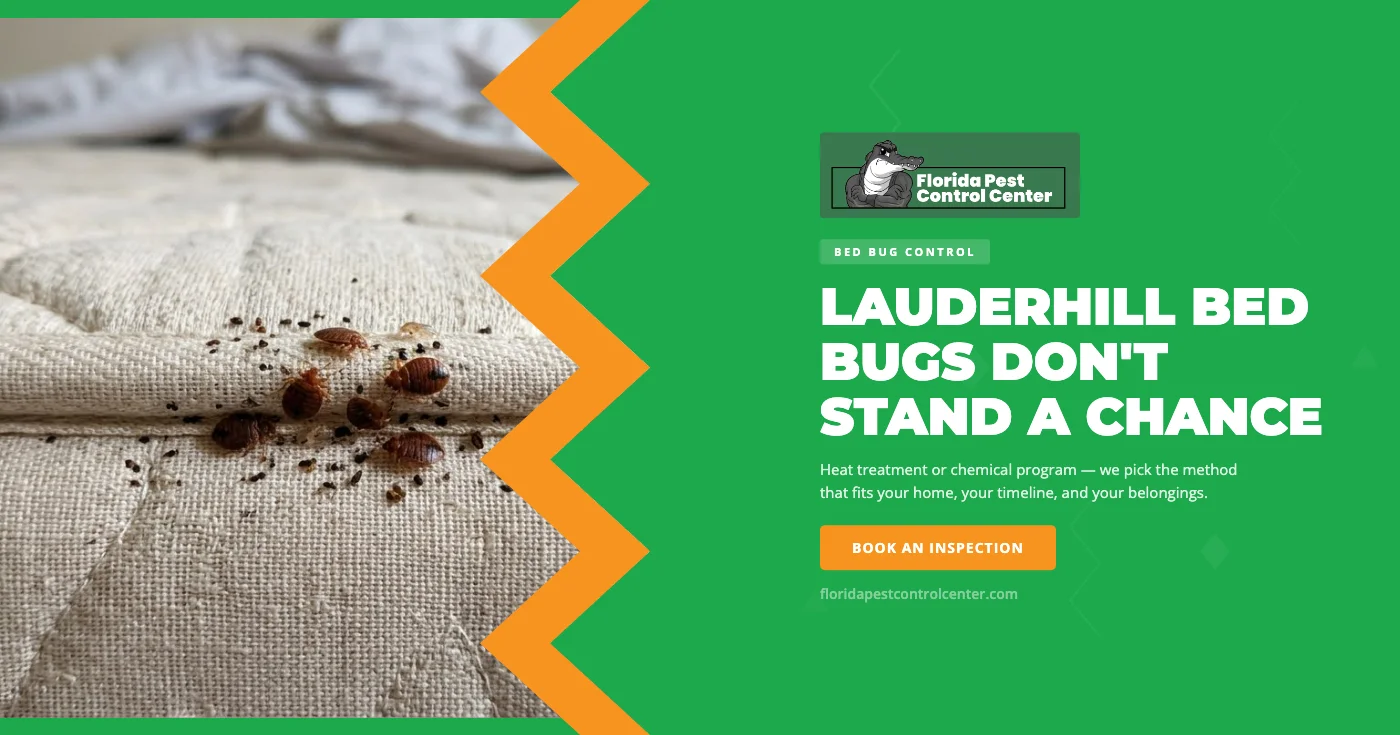
Heat vs. Chemical Bed Bug Treatment in Lauderhill, FL
When Lauderhill homeowners call us about bed bugs, the first question is almost always the same: heat or chemical? Bed bugs are among the hardest household pests to clear — they hide in mattress seams, screw holes, and wall voids the width of a credit card, and a treatment that misses one mated female restarts the whole infestation. In southeast Broward County, bed bug pressure has climbed steadily for the past several summers, driven by international travel through Fort Lauderdale–Hollywood International Airport, dense multifamily housing, and a humid subtropical climate that keeps the species feeding twelve months a year.
At Florida Pest Control Center, we run both heat and chemical bed bug treatment in Lauderhill, FL, and the right answer depends on the home, the severity of the infestation, and the household's calendar. This guide walks through how each method works, what they cost in time and money, and which fits which Lauderhill home best. If you have already spotted bites, blood spots on sheets, or live bugs in a seam, a bed bug inspection is the right first call.
Why Lauderhill, FL Homes Are Seeing More Bed Bug Calls This Summer
Bed bug pressure in Broward County rises every summer, and Lauderhill sits at the center of three reasons it is climbing again in 2026.
Travel. Lauderhill is fifteen minutes from Fort Lauderdale–Hollywood International Airport and twenty minutes from Port Everglades. Cruise turnover and tourist season pump millions of suitcases through the area each year, and bed bugs hitchhike in luggage seams.
Density. Lauderhill's mid-rise condos, garden apartments, and townhome communities along the State Road 7 and Oakland Park Boulevard corridors let a single unit's infestation spread through shared walls, electrical penetrations, and laundry rooms before the original tenant notices.
Climate. The University of Florida IFAS Extension classifies bed bugs as tropical insects that thrive in warm, humid environments — the conditions Lauderhill provides almost every month of the year. Colonies do not pause through winter, so we run a year-round caseload, with calls jumping every June after a busy travel season.
How Bed Bug Heat Treatment Works
Heat treatment, also called thermal remediation, kills bed bugs by raising the interior of a home above the species' thermal death point and holding it there long enough to reach every egg and harborage at the same time.
Our technicians position industrial electric heaters and high-output air movers throughout the home, deploy wireless sensors inside mattresses, behind headboards, in dresser drawers, and along baseboards, then bring ambient temperature to between 135 and 145°F. We hold that range for several hours so heat penetrates wall voids, furniture interiors, and the crevices where bugs would otherwise survive.
The thermal death point matters. Adults and nymphs die at sustained temperatures around 118°F, but eggs hold out longer and require sustained temperatures closer to 122°F. A treatment that hits the air-temperature target but misses a cold pocket leaves surviving eggs that hatch a week later — which is why our setup uses multiple sensors per room and air movers to push heat into hidden spaces rather than relying on one thermostat reading.
The biggest advantage of heat is that bed bugs cannot evolve resistance to it. The U.S. Environmental Protection Agency notes that professionals can use intensive methods — including whole-house heat — that homeowners cannot replicate with a thermostat or space heater. Heat uses no residual chemicals, no respraying, and typically no return visits if prep is done correctly.
How Chemical Bed Bug Treatment Works
Chemical bed bug treatment uses a combination of EPA-registered insecticides applied to the surfaces where bed bugs actually hide and travel. A modern Lauderhill chemical program is not one product sprayed across the room — it is a layered application designed around the way the species behaves.
A typical visit uses three product classes. A residual liquid insecticide is applied to cracks, crevices, baseboards, headboard frames, bed rails, and upholstered furniture seams, leaving a film that kills bugs walking across it for weeks. A non-repellent contact spray reaches bugs hiding in tufting. And a desiccant dust — typically diatomaceous earth or silica gel — is puffed into wall voids, outlet boxes, and under baseboards, drying the cuticle of any bug that crosses it.
The EPA highlights desiccant dusts because bed bugs cannot develop resistance to physical drying the way they have developed resistance to many liquid insecticides. The University of Florida IFAS Extension has documented widespread pyrethroid resistance in Florida bed bug populations — one reason single-product spray programs fail and modern Lauderhill protocols layer multiple classes instead.
Chemical programs in Lauderhill typically require two to three visits spaced 10 to 14 days apart. The follow-ups exist because residual products do not reliably kill eggs — the second visit catches nymphs hatching from any eggs the first treatment missed, and the third confirms the cycle is closed.
Heat vs. Chemical: Cost, Time, and Effectiveness Compared
The two approaches solve the same problem with different trade-offs. We walk Lauderhill homeowners through the comparison every week, and the differences usually come down to five points.
Time on site. A whole-home heat treatment runs eight to ten hours in a single day. A chemical program runs ninety minutes to three hours per visit, but is spread across two or three visits over four to six weeks.
Speed to a clear home. Heat finishes the kill in one day, including eggs. A chemical program needs the full multi-visit cycle to break the egg-to-adult timeline.
Resistance risk. Bed bugs cannot evolve resistance to heat. Field-collected Florida populations show measurable resistance to pyrethroids and reduced sensitivity to several other liquid classes, which is why proper chemical programs combine non-repellents, dusts, and aerosols rather than leaning on one product.
Cost. For a typical Lauderhill single-family home, a chemical program is usually the lower-cost option up front. Heat costs more because it requires generator power or dedicated 240-volt drops, multiple industrial heaters, hours of crew time, and certified technicians monitoring sensors throughout. The trade-off: a successful heat treatment is one event, while a chemical program asks the homeowner to commit to weeks of follow-ups.
Prep load. Heat asks the household to remove pets, plants, candles, pressurized cans, certain medications, and heat-sensitive electronics. Chemical asks the household to launder bedding hot, bag clothing, and avoid disturbing treated surfaces for two to three weeks. Both checklists are non-negotiable.
Which Bed Bug Treatment Fits Your Lauderhill Home Best
There is no universally better method — there are better fits for specific situations.
Heat is usually the right call for:
- Severe infestations spread to multiple rooms or into structural voids where a single-visit close-out matters.
- Cluttered storage, deep upholstery, or homes with many books and electronics where insecticide coverage would be uneven.
- Renters and homeowners with a hard deadline — a closing date, a move-in, severe reactions to bites, or an arriving houseguest.
- Cases where chemical programs have failed before, suggesting resistance or missed harborages.
Chemical programs are usually the right call for:
- Early, localized infestations in one bedroom where the bugs have not yet dispersed.
- Apartments and condos where heat would require neighbor coordination, HOA approval, or building-power availability.
- Budget-sensitive households where the lower up-front cost outweighs the longer treatment window.
- Properties with heat-sensitive items the household would rather not move.
In some Lauderhill cases the best answer is a hybrid: a heat treatment to clear the active population in one day, followed by a residual chemical barrier at baseboards, headboards, and entry points to catch any new bugs afterward. We build that combination case-by-case after the inspection.
What to Expect During and After Treatment
For heat treatment, you and any pets leave for the day. We arrive in the morning, set heaters and sensors, run the temperature curve, and verify with a written sensor log that every monitored point reached and held the required range. You return that evening — no residue, no smell, no waiting before sleeping in your bed.
For chemical treatment, the household leaves during application — typically two to four hours — and returns once treated surfaces have dried per the product label. We coach you through which surfaces to leave undisturbed so the residual stays effective. Light vacuuming is fine after dry time; deep cleaning of baseboards, bed rails, and headboard joints waits until we have finished the cycle.
After either program the most important habit is mattress encasements. We install bed-bug-rated encasements on every mattress and box spring in treated rooms. Encasements trap survivors against a smooth surface where they cannot feed, and let you see new evidence immediately if a reintroduction happens after a future trip.
Why a Professional Inspection Comes First
Treatment without confirmation wastes money. The first call should always be an inspection, not a treatment quote.
A Florida Pest Control Center bed bug inspection in Lauderhill is a methodical walk of every sleeping area, upholstered seating zone, and adjacent room. Our technicians pull back mattress seams and box-spring tape, inspect headboard joints, check behind framed art and outlet plates, and use a flashlight at low angle to spot live bugs, cast skins, fecal staining, and viable eggs. We confirm species, map the spread across rooms and adjacent units, identify entry points, and recommend heat, chemical, or a hybrid program based on what we find.
Saving the bugs you have already caught helps. A small jar with a live bug or shed skin lets us verify Cimex lectularius and rule out look-alikes like carpet beetle larvae and bat bugs. From the inspection we build a written plan and quote — and the inspection itself is no-cost.
Frequently Asked Questions About Bed Bug Treatment in Lauderhill, FL
Is heat or chemical bed bug treatment more effective in Lauderhill, FL?
Both can fully eliminate an infestation when applied correctly. Heat is more reliable in severe, dispersed, or cluttered Lauderhill homes because bed bugs cannot evolve resistance to temperature, and a single visit reaches every egg and harborage at once. Chemical programs work well on early, contained infestations when the technician layers multiple product classes and the household commits to the follow-ups.
How long does bed bug heat treatment take?
A whole-home heat treatment runs eight to ten hours from setup through monitored teardown. The household and pets leave for the day and return that evening. No residue and no wait before you can sleep in your bed.
How many chemical treatments are needed to kill bed bugs?
Most chemical programs need two to three visits spaced 10 to 14 days apart. Residual sprays do not reliably kill eggs, so the next visit catches the nymphs hatching in between. A single chemical visit almost never closes out a real infestation.
Can I stay in my Lauderhill home during bed bug treatment?
No. For heat, the home is brought to 135–145°F — far too hot for occupants and pets. For chemical visits, the household leaves during application and returns after products have dried per the EPA-registered label, typically two to four hours.
Does bed bug heat treatment damage furniture or electronics?
Modern heat systems hold the room within a controlled range, and most furniture, mattresses, clothing, and household electronics tolerate it without damage. Items to remove beforehand include candles, aerosol cans, pressurized lighters, plants, certain medications, and vinyl records — anything heat-sensitive the family flags during the pre-treatment walkthrough.
Bed bug treatment Lauderhill FL homeowners ask about usually ends one of two ways: a one-day close-out or a months-long battle. The difference comes down to which method, and how fast you start. Our team is ready to walk your home, confirm the infestation, and build a plan tuned to your situation. Learn more about our bed bug control program for Lauderhill, FL or reach out to schedule an inspection.