
Mosquito Control in Coral Springs FL
Mosquito Control in Coral Springs FL
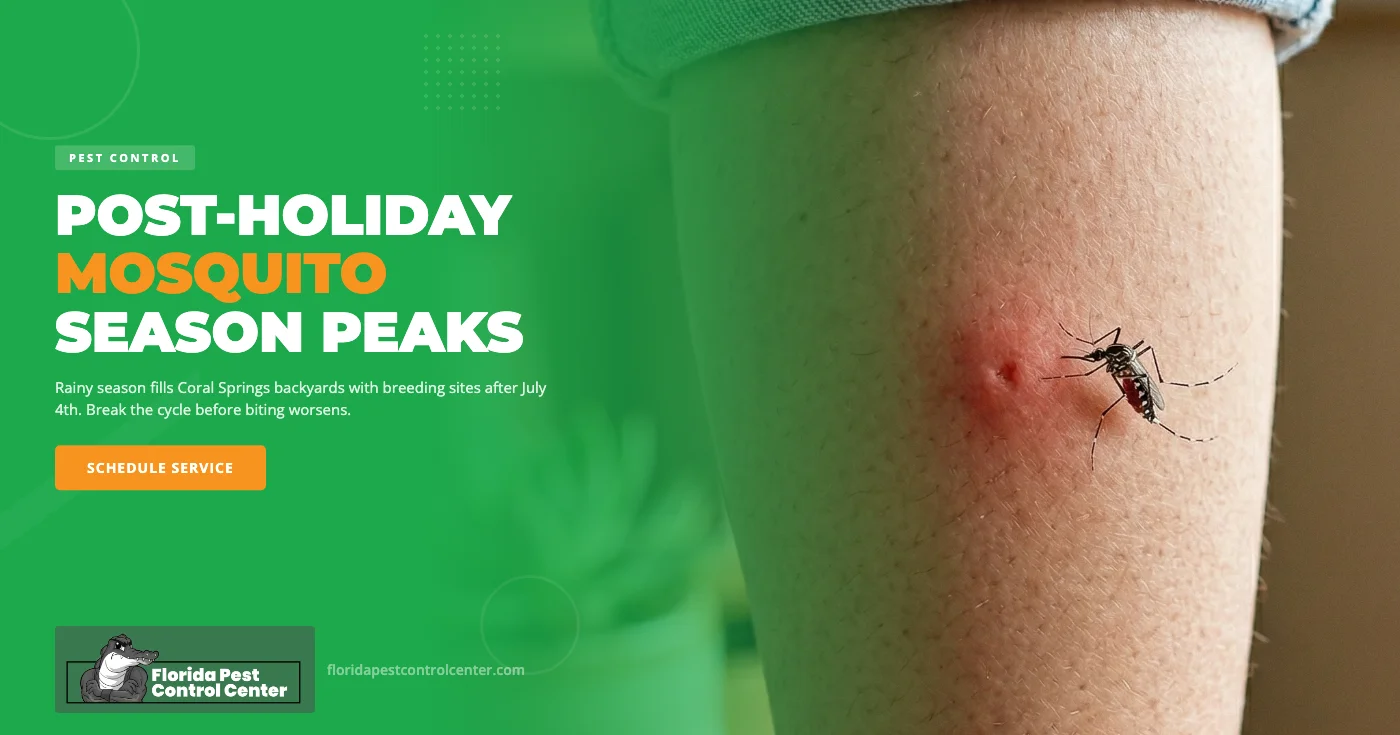
Every July, our phones start ringing off the hook with the same story from Coral Springs homeowners: the backyard was fine over Memorial Day, tolerable through June, and then almost overnight — usually the week after the Fourth of July — it turned into a mosquito minefield. If that sounds familiar, you're not imagining it, and you're not doing anything wrong. Effective mosquito control in Coral Springs FL is one of the toughest challenges we tackle all year, and mid-summer is exactly when the conditions stack against you. Between afternoon thunderstorms, standing pool water left behind by holiday guests, and the specific breeds of mosquitoes that thrive in Broward County, July is when a manageable yard becomes an unlivable one. In this guide, we'll walk you through why it happens, where the trouble spots hide, what actually works to stop it, and what to do when the problem is bigger than a citronella candle can handle.
Why July Is the Worst Month for Mosquitoes in Coral Springs, FL
Coral Springs sits right in the middle of Broward County's peak mosquito zone, and the calendar is not on our side. The county's rainy season officially runs from mid-May through mid-October, but July is the sweet spot where three factors collide: sustained daytime highs in the low nineties, overnight lows that rarely drop below the mid-seventies, and near-daily afternoon rainfall. Mosquitoes need warmth to speed up their life cycle and moisture to lay eggs, and Coral Springs delivers both in abundance during the summer months.
The species matter here. Southeast Florida is home to the yellow fever mosquito (Aedes aegypti) and the Asian tiger mosquito (Aedes albopictus), both of which are aggressive daytime biters and prolific container breeders. They don't need a swamp — they just need a bottle cap of water in a shady spot. When July temperatures push their egg-to-adult cycle down to seven or eight days, a single overlooked puddle can produce hundreds of biting adults inside of a week. That's the biological reality behind the sudden mid-July population explosion Coral Springs homeowners describe every year.
On top of that, Coral Springs has an unusually high concentration of canals, retention ponds, and thick landscape irrigation — features that homeowners love but that mosquitoes love even more. The combination of neighborhood-scale water features and lot-level breeding sites is what makes July especially punishing here, more so than in drier inland pockets of the state.
How July 4th Weekend Creates Prime Mosquito Breeding Conditions
Independence Day weekend is fun for us and a gift to the local mosquito population. Coral Springs neighborhoods fill up with pool floats, coolers, kids' toys, tarps, folding chairs, and half-empty drink cups — and most of them get left outside for at least a day or two before anyone circles back to tidy up. Meanwhile, the afternoon thunderstorms that roll through nearly every summer afternoon fill every single one of those objects with fresh rainwater. Mosquitoes lay eggs almost immediately in this fresh, still water, and by the time the holiday recovery ends, the eggs are already hatching.
The pattern we see year after year in our Coral Springs mosquito service calls is remarkably consistent. Homeowners report the first serious wave of bites during the second week of July, roughly seven to ten days after the holiday. That timing lines up almost exactly with the mid-summer larval-to-adult development window for Aedes mosquitoes. What looked like a manageable yard on July 5th becomes a swarm by July 12th, and by the third week of the month, your evenings on the patio are effectively over.
It's not just party debris either. Fireworks debris, deflated pool floats, kids' sand buckets, upside-down frisbees, kayak seats, and the folds of a rolled-up beach umbrella all collect water in ways homeowners never think to check. The Coral Springs summer landscape is essentially a series of little mosquito nurseries hiding in plain sight, and July 4th is the starting gun.
The Most Common Standing Water Hotspots in Coral Springs Yards
When our technicians do a first walkthrough of a Coral Springs property, we always find breeding sites the homeowner didn't know existed. Some are obvious, most are not. If you want to make a dent in your mosquito population before we ever show up, this is where to look:
- Bromeliads and other cupped landscape plants. Coral Springs yards are full of ornamental bromeliads, and every single leaf axil holds water. These are among the most productive backyard mosquito nurseries in South Florida. Flush them with a garden hose weekly during summer.
- Clogged gutters and downspouts. Palm fronds, oak leaves, and roof debris create dams that turn gutters into linear puddles. You can't see it from the ground, but a single clogged gutter run can produce thousands of mosquitoes over a summer.
- Screened pool cages and pool covers. Water pools on top of covers and inside the folds of cage screening. Even a well-chlorinated pool won't help you if the cover holds a quarter inch of rainwater for three days.
- Irrigation boxes and A/C condensate pans. The plastic housings around sprinkler valves and the drip trays under condensate lines collect water constantly, and both are perfectly shaded — an ideal mosquito nursery.
- Boats, trailers, and kayaks stored outside. Tarps sag, hulls fill, and drain plugs stay in place all summer. If it hasn't been tipped over since May, assume it's producing mosquitoes.
- Neighborhood retention ponds and canal edges. These are outside your property line but well within flight range. Adult female Aedes mosquitoes typically stay within 150 to 200 yards of their emergence site, so if you back up to a canal, you inherit its mosquito output.
Both the Florida Department of Health and the CDC boil down the yard-level prevention message to the same two words: drain and cover. Drain the water, cover the surfaces you can't drain, and repair torn screens on windows, doors, and lanais. That's the baseline. It won't solve a serious infestation, but skipping it will guarantee one.
Health Risks Coral Springs Families Should Know This Summer
Mosquitoes are more than a nuisance in South Florida — they're a public-health concern that Broward County takes seriously for good reason. The species that thrive in Coral Springs during summer are the same ones capable of transmitting West Nile virus, dengue, Zika, chikungunya, and Eastern equine encephalitis. Cases are rare in any given yard, but the risk isn't zero, and Broward has recorded locally-acquired dengue cases in recent years. Protecting your family's well-being starts with reducing bites, not just tolerating them.
Children and older adults are the two groups we worry about most. Kids playing in the yard at dusk are prime targets because they're active outdoors during the exact window when mosquito activity peaks — the CDC specifically flags dusk-to-dawn as the highest-risk period for West Nile transmission. Older adults are at higher risk of severe illness if they do contract a mosquito-borne virus, so keeping bite counts low is a form of protection that goes well beyond comfort.
Pet owners in Coral Springs have another concern: heartworm disease, which is spread by mosquitoes and endemic to South Florida. Even dogs and cats on year-round preventive medication benefit from a lower-mosquito yard, because the fewer bites they take, the less strain there is on the preventive to do its job. If you have a pool, a covered lanai, or an outdoor sitting area where pets spend time, that space deserves the same mosquito attention as your living room.
The Florida Department of Health's guidance for personal protection is straightforward: use an EPA-registered repellent containing DEET, picaridin, IR3535, or oil of lemon eucalyptus; wear long, loose clothing after dark; and keep window and door screens in good repair. That covers the person. Yard-level control is what covers the property.
DIY Reduction Steps vs. What Only a Professional Can Solve
There is real, meaningful work you can do yourself, and we always encourage Coral Springs homeowners to do it — because it makes our professional treatment work better. The problem is that the DIY ceiling is much lower than most people realize. Here's the honest breakdown.
What DIY does well: Eliminating standing water is the single most impactful thing a homeowner can do, and it's entirely a DIY task. Emptying containers weekly, flushing bromeliads, cleaning gutters, tipping over kids' toys, and repairing screens will meaningfully reduce your mosquito load. Personal repellents work for the person wearing them. Citronella candles and thermacell-style devices provide short-range, short-duration relief in a small radius — useful for a two-hour cookout, not for reclaiming a yard.
Where DIY hits a wall: Adult mosquitoes that are already flying, breeding sites you can't identify or reach, and resting sites in dense shrubs, under decks, and inside irrigation boxes. Store-bought yard sprays are typically weak, short-lived, and don't reach the shaded undersides of leaves where Aedes mosquitoes hide during the day. Bug zappers kill mostly harmless insects and virtually no mosquitoes. Ultrasonic devices don't work at all — that's been established in peer-reviewed literature for decades.
What professionals do differently: A trained technician approaches your yard the way a doctor approaches a patient — with a diagnostic pass first, then targeted treatment. We identify breeding sites you didn't know about, treat larvae directly with growth regulators or biological products, apply residual barrier treatments to the specific resting foliage where adult mosquitoes hide, and set a recurring schedule matched to the breed cycles that dominate your neighborhood. That combination is what actually reduces bite counts on a lasting basis, not just for the afternoon.
Professional Mosquito Control Options for Coral Springs Homeowners
When Coral Springs homeowners call us in mid-July, they usually want to know two things: what's involved, and how fast will it work. Here's how we approach it. Our Mosquito Control program starts with a full property inspection — every drainage feature, every landscape bed, every shaded resting site. We identify active breeding sources and treat them at the larval stage using products that are gentle around families and pets when applied by a trained technician. That larval work is the piece most DIY approaches miss entirely, and it's what breaks the reproductive cycle instead of just knocking down today's adults.
For the flying adults already on your property, we use targeted barrier treatments applied to the specific foliage where mosquitoes rest during the heat of the day — the undersides of hedge leaves, thick ornamental grasses, dense ground cover, and shaded corners near fences and structures. These barrier applications create a lasting residual that continues working between visits, so you're not depending on any single treatment day.
Professional mosquito control Coral Springs FL homeowners actually feel a difference from starts with that larval-plus-adult combination, and it's why a monthly service outperforms any one-off treatment. For homeowners dealing with heavier infestations or larger lots, we offer misting system options — permanently-installed nozzle networks around lanais, pool decks, and outdoor kitchens that release short bursts of treatment on a schedule you control. Misting systems are a bigger up-front investment, but for Coral Springs homes that use their outdoor space heavily from April through November, the daily quality-of-life difference is dramatic.
Most of our Coral Springs mosquito clients settle into a monthly service rhythm from March through November, with a lighter maintenance cadence in the cooler months. That schedule tracks the local breeding cycle, keeps residual barriers active, and catches the July surge before it becomes a crisis. If you're reading this in the second week of July with fresh bites on your ankles, we can absolutely start now — but the homeowners with the smoothest summers are the ones who started in spring and never let the population get a foothold.
Coral Springs summers are worth enjoying — pool afternoons, grill nights, kids on the trampoline, dogs on the lanai. If mosquitoes are stealing that from you this July, we'd like to help. Reach out through our website to schedule a property inspection with a local technician who knows the neighborhoods, the breeding hotspots, and the treatment approaches that actually work in Broward County's climate. We'll walk your yard, show you what we find, and put together a plan that fits how you use your outdoor space. Your backyard should belong to you, not the mosquitoes — let's get it back.