

Why Roof Rats Move Into Fort Lauderdale, FL Homes at the Start of Dry Season
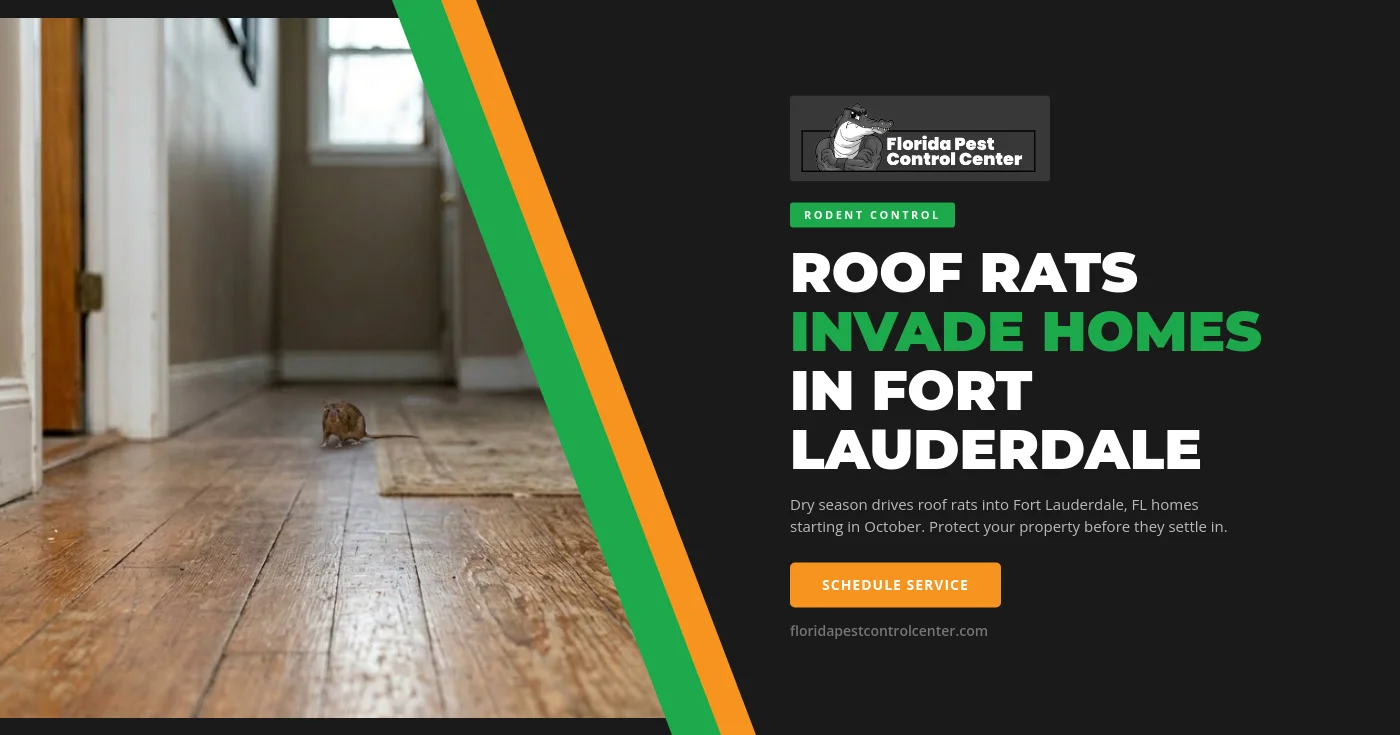
Why Roof Rats Move Into Fort Lauderdale, FL Homes at the Start of Dry Season
At Florida Pest Control Center, our rodent inspection calendar fills up fast once the first week of October arrives in Fort Lauderdale, FL. The timing is not a coincidence. South Florida's wet-to-dry transition begins in early October, and the shift from September's daily storms to drier air pushes roof rats off the tree canopy and into attics, soffits, and wall voids across Broward County. Homeowners who respond in October usually catch an infestation before it reaches wiring, insulation, or ceiling drywall. Those who wait until November or December often find themselves calling us for emergency rodent control Fort Lauderdale FL homeowners did not budget for.
This guide covers why October marks the start of rodent season here, how to tell roof rats from Norway rats, where they enter, what health risks they bring, how to spot an early infestation, and what professional rodent-proofing involves.
Why October Marks the Start of Rodent Season in Fort Lauderdale, FL
Fort Lauderdale sits in a tropical savanna climate with two seasons rather than four: a wet season from late May through mid-October and a dry season from mid-October through late May. The transition is not gradual. Afternoon storms taper off, humidity drops from the saturated 80 to 90 percent of August into the drier 60 to 70 percent range, and overnight temperatures slide into the low 70s. For roof rats living in the tree canopy and palm fronds of Fort Lauderdale's older neighborhoods, that shift triggers an immediate behavior change.
Three overlapping pressures drive the move indoors. Outdoor water sources shrink — puddles, saturated mulch, and clogged bromeliad cups dry up within days, and roof rats need water every 24 to 48 hours. The fruit crop that fed foraging rats through September — mango, avocado, calamondin citrus — thins out. And cooler overnight temperatures make attic spaces that were punishingly hot in August feel comfortable. All three pressures converge as the wet-to-dry transition gets underway in early October, which is when we see the sharpest increase in Fort Lauderdale rodent control calls.
Our neighborhoods east of I-95 — Victoria Park, Colee Hammock, Rio Vista, Coral Ridge — are especially exposed because mature oak and ficus canopy forms highways across property lines. A rat family in your neighbor's attic can reach yours in a single night.
Roof Rats vs. Norway Rats: Which Ones Are in Your Fort Lauderdale Home?
Two rat species show up regularly in Broward County, and they behave differently enough that prevention aimed at the wrong species accomplishes very little.
Roof rats (Rattus rattus), also called black rats or palm rats, are the dominant species in residential Fort Lauderdale attics. According to the University of Florida IFAS Extension, roof rats are the number-one rodent pest statewide. They average 6 to 8 inches in body length with a hairless tail longer than the body (13–14 inches total), dark brown to glossy black fur with a lighter underside, large ears, and a pointed nose. They are nimble climbers that prefer elevated routes — tree limbs, utility lines, fence tops, roof peaks — and nest above ground level in attic insulation, wall voids, and dead palm fronds. Droppings are spindle-shaped with pointed ends, about half an inch long.
Norway rats (Rattus norvegicus) are heavier-bodied and blunt-snouted, 7 to 10 inches with a shorter bicolored tail. They are ground-dwelling burrowers, most common in Fort Lauderdale around canal banks and fence-line burrows. Their droppings are blunt capsules about three-quarters of an inch. Attic activity in a Fort Lauderdale home is almost always a roof rat, not a Norway rat.
Identification matters because sealing ground-level burrows does nothing to stop an arboreal species using your fascia as a highway. Effective rodent control for a Fort Lauderdale home has to address the elevated routes roof rats use.
How Roof Rats Enter Fort Lauderdale Properties Through Rooflines and Landscaping
Roof rats can squeeze through any opening about half an inch wide. The entry points we find most often in Fort Lauderdale cluster around the roofline and the landscaping that gives rats a route to it.
- Soffit gaps and damaged vent screens. Soffits are the single most common entry point in Fort Lauderdale homes. Construction gaps, warped panels after storm season, and aluminum vent screens corroded by salt air create openings a roof rat finds within minutes. The 19-gauge galvanized hardware cloth we install resists gnawing.
- Fascia-to-shingle gaps and tile roof eave openings. Aging flashing where fascia meets shingles creates a narrow entry point. Barrel tile roofs in Fort Lauderdale's older neighborhoods have open eaves — many homes we inspect have missing eave closures.
- A/C line-set and plumbing penetrations. The gap around the refrigerant line-set is often sealed only with aging foam. Rats widen it easily and travel up the wall cavity into the attic.
- Overhanging branches and tall palms. Any branch within three feet of the roofline gives roof rats a direct route. Royal palms, queen palms, and untrimmed ficus are the usual offenders in Broward County. Keep branches four to six feet from the roof.
Health Risks of Rodent Infestations in South Florida Homes
Rodent activity inside a Fort Lauderdale home is not just a nuisance. The CDC associates rats and mice with more than 35 diseases transmissible to humans. The three risks most relevant to South Florida homeowners:
- Leptospirosis. A bacterial infection spread through contact with water, soil, or surfaces contaminated by rodent urine. Fort Lauderdale's heavy wet-season rainfall and flooding raise outdoor exposure risk, and once rats move indoors, contact with urine-contaminated attic insulation, cabinets, and pantry surfaces becomes the main concern.
- Salmonella. Rodent droppings and urine commonly contain Salmonella bacteria that contaminate kitchen surfaces, pantry food, and cooking utensils once rats are foraging indoors.
- Allergens and asthma triggers. Accumulated rodent droppings, urine, and dander can become airborne when disturbed and aggravate allergies and asthma — which is why attic cleanouts after a rat infestation should be performed by trained technicians using proper protective equipment, not by homeowners with a shop vacuum.
Beyond disease, roof rats cause measurable property damage. The National Pest Management Association cites rodent gnawing on electrical wiring as a contributing factor in residential fires with undetermined ignition sources. In Fort Lauderdale homes we routinely find chewed thermostat wiring, damaged A/C communication cables, shredded attic duct insulation, and gnawed PVC plumbing lines above ceilings.
Signs You Have Roof Rats in Your Fort Lauderdale Attic or Walls
Roof rats are nocturnal and secretive, so the first evidence is almost always indirect. The signs we look for during an inspection — and that Fort Lauderdale homeowners can watch for — include:
- Nighttime scratching or scurrying in ceilings or walls between 10 p.m. and 4 a.m. Scratching that stops when you tap and resumes a minute later is a strong indicator.
- Spindle-shaped droppings about half an inch long with pointed ends on attic rafters, inside kitchen cabinets, along pantry baseboards, or near pet food storage in the garage.
- Grease and rub marks along rafters, pipes, and attic hatch edges where rats travel the same route.
- Gnaw marks on wood, drywall, PVC, or electrical insulation. Fresh gnawing shows light-colored wood or exposed copper.
- Damaged soffit vents or chewed foam around utility penetrations visible from the ground.
- Partially eaten fruit under backyard trees with distinctive bite marks and seeds carried away — a strong late-season warning sign.
- Pet behavior changes. Dogs and cats that stare at a ceiling corner, pace a wall, or sniff at the attic hatch are often reacting to activity you cannot yet hear.
Professional Rodent-Proofing Strategies for Fort Lauderdale Properties
Hardware-store traps and off-the-shelf poison baits can reduce the number of rats currently inside a home, but they do nothing to stop more rats from entering through the same openings next week. Effective rodent control in Fort Lauderdale, FL combines three elements: structural exclusion, population reduction, and landscape modification.
Structural exclusion is the heart of the program. During our inspection we document every roofline gap, soffit opening, vent screen, and utility penetration. Each opening gets sealed with the right material — galvanized hardware cloth for vents, copper mesh and polyurethane sealant for utility penetrations, new soffit panels where corrosion has consumed the original, and new tile eave closures where barrel tile roofs have lost theirs. Done correctly, exclusion permanently closes the pathways roof rats use.
Population reduction targets the rats currently inside using the method appropriate for the location, family, and pets. In attic spaces we use snap-trap systems along active travel routes; in garages and exterior zones we may use tamper-resistant bait stations placed to protect pets, children, and the hawks, owls, and snakes that are natural rodent predators in Broward County. We never recommend loose rodenticide in accessible areas.
Landscape modification addresses what drew rats to the structure in the first place — branches that need trimming back, piles of coconut debris or palm fronds providing ground harborage, bird feeders creating a seed buffet, and fruit trees whose fallen produce should be picked up weekly through the dry season.
Follow-up inspections at two and six weeks confirm trap activity has reached zero. Most Fort Lauderdale homes clear fully within four to eight weeks.
Why Florida Pest Control Center Is the Right Call for Fort Lauderdale Homeowners
Our team has handled rodent control in Fort Lauderdale and across Broward County for years, and that local experience shows in each inspection. We know which neighborhoods see the heaviest October roof rat pressure, which roofline styles create the most predictable entry points, and which exclusion materials hold up to Fort Lauderdale's salt air, humidity, and storm cycle. That knowledge separates a lasting exclusion job from a treatment that fails next season.
When you schedule a rodent inspection with us, you get a licensed technician performing a full exterior and attic walk-through, written documentation of every finding, and a transparent treatment plan. We serve Fort Lauderdale, Pompano Beach, Hollywood, Plantation, Davie, Sunrise, Oakland Park, Lauderhill, Margate, Tamarac, Miramar, Pembroke Pines, Cooper City, Wilton Manors, Lauderdale Lakes, and North Lauderdale. The first two weeks of October are the window where exclusion prevents a dry-season infestation entirely.
Frequently Asked Questions About Rodent Control in Fort Lauderdale, FL
How quickly can a roof rat infestation damage my attic?
A single pair of roof rats can produce 20 to 40 offspring in a year under Fort Lauderdale's year-round breeding conditions. Within two to three months you can have a colony of 10 to 20 rats actively chewing wiring, shredding insulation, and contaminating ductwork. Early October detection saves most of that damage.
Are DIY traps and store-bought poison enough for a Fort Lauderdale rat problem?
DIY products can kill individual rats but will not seal the entry points that let the next generation in. Loose poisons in accessible attic spaces also create risk for pets and for the hawks, owls, and snakes that serve as natural predators in Broward County. Professional exclusion is the foundation of every real solution.
Will trimming my trees really make a difference?
Yes. Roof rats use overhanging branches, ficus hedges that touch the roofline, and tall queen palms as travel corridors into attics. Trimming back four to six feet removes the easiest route and forces rats to find a harder path, which many abandon.
Can roof rats come back after exclusion work is done?
If every entry point is sealed with the right material and landscape pressure is addressed, re-entry is uncommon. We offer follow-up inspections to catch any new openings from storm damage.
Is professional rodent control gentle around pets and children?
Our plans are built around the family and pets living in the home. We use tamper-resistant bait stations, snap traps in enclosed attic spaces pets cannot reach, and avoid loose rodenticide anywhere accessible to children, animals, or wildlife.
How soon can Florida Pest Control Center schedule an inspection?
We prioritize active infestations and typically schedule initial visits within a few business days. During the October dry-season transition, demand peaks sharply — reaching out early gives you the best chance of catching the problem before it reaches drywall or wiring.
Rodent Control for Fort Lauderdale, FL Homes as Dry Season Begins
Every October, as South Florida's dry season replaces the daily afternoon storms of September, roof rats across Fort Lauderdale leave the tree canopy for attic shelter. The timing is predictable because the pressure is predictable: outdoor water sources shrink, backyard fruit crops thin out, and overnight temperatures slide into a range that makes attic spaces comfortable again. By the second week of October, our rodent control calendar fills with Fort Lauderdale homeowners reporting the first scratches in the ceiling.
At Florida Pest Control Center, every rodent engagement starts with a licensed inspection of the full attic perimeter, roofline, soffit vents, and utility penetrations. We document every entry point, seal each one with the right material — 19-gauge galvanized hardware cloth for vents, copper mesh and polyurethane sealant for A/C line-sets, new tile eave closures for barrel roofs — and address the current infestation with trap placement chosen for the family and pets living in the home. Loose rodenticide is never recommended in accessible areas.
We serve Fort Lauderdale, Pompano Beach, Hollywood, Plantation, Davie, Sunrise, Oakland Park, Lauderhill, Margate, Tamarac, Miramar, Pembroke Pines, Cooper City, Wilton Manors, Lauderdale Lakes, and North Lauderdale. Read the full article for the biology behind dry-season roof rat movement, the entry points we find most often on Broward County homes, and the exclusion steps that stop reinfestation.