

Why Roof Rats Move Into Lauderdale Lakes, FL Attics as Summer Ends
Why Roof Rats Move Into Lauderdale Lakes, FL Attics as Summer Ends
At Florida Pest Control Center, we see a reliable increase in rodent control calls from Lauderdale Lakes homeowners every year as summer approaches its end — and the timing is not coincidental. Roof rats, the most prevalent rodent species in Broward County, respond to specific late-summer conditions that draw them from the tree canopy and into residential attics. Understanding what drives that movement is the first step toward keeping them out.
This guide covers the biology behind late-summer roof rat activity in Lauderdale Lakes, FL, how to distinguish the species from other common Florida rodents, where they enter homes in Broward County, and what steps to take before an infestation causes lasting structural or health damage.
Why Roof Rats Head Indoors in Lauderdale Lakes as Summer Ends
Florida's summer peaks in August and September — temperatures stay above 90 degrees Fahrenheit through most of the day, humidity rarely drops below 80 percent, and afternoon thunderstorms move through Lauderdale Lakes almost daily. For roof rats (Rattus rattus), also called black rats or palm rats, these conditions create overlapping pressures that push them toward the shelter of residential structures.
First, food availability. Lauderdale Lakes has a high density of fruit-bearing trees — mango, avocado, citrus, and royal palm — throughout residential neighborhoods. By late summer, many of these trees are producing ripe or overripe fruit, creating a concentrated outdoor food source that draws roof rats into established territories directly adjacent to homes. Once rats are foraging consistently near a structure, the transition to attic entry is a short step.
Second, thermal pressure. Roof rats cannot regulate their body temperature across wide temperature swings the way humans can. Extended exposure to Broward County's August heat drives them to seek cooler, stable microclimates. As late-summer temperatures begin dropping slightly and fruit ripens overhead, attic spaces that were too hot in July become more hospitable entry points.
Third, seasonal population pressure. Roof rats breed year-round in South Florida, but population pressure peaks in late summer as litters born in spring mature and compete for established territory. Young rats dispersing from mature colonies are more likely to explore new structures and establish new nesting sites. Lauderdale Lakes, with its dense tree canopy connecting property lines, provides corridors that make that dispersal easy.
Roof Rats vs. Norway Rats: What's in Your South Florida Attic
Two rat species are regularly encountered in Broward County — roof rats and Norway rats — and they require different prevention approaches because they live, travel, and enter structures differently.
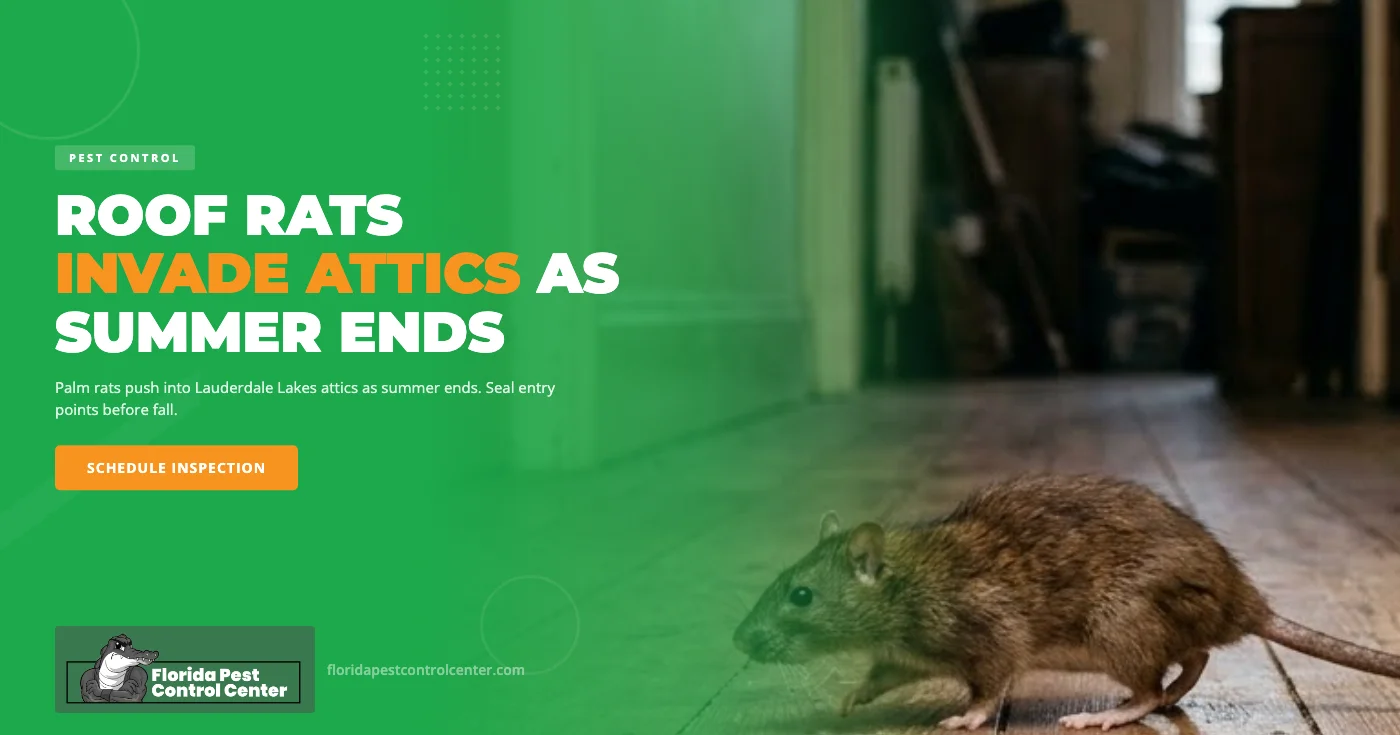
Roof rats (Rattus rattus) are the species almost universally responsible for attic infestations in Lauderdale Lakes. They average 6 to 8 inches in body length with a tail longer than the body. Their coloring is typically dark brown to black on the back with a lighter underside. Roof rats are agile climbers that prefer elevated routes: tree branches, utility lines, vines, and rooflines. They nest in attic insulation, wall voids, and dense vegetation above ground level. Their droppings are spindle-shaped with pointed ends, approximately 12 millimeters long.
Norway rats (Rattus norvegicus) are heavier-bodied and blunt-snouted, with a tail shorter than the body. They are burrowers, not climbers — Norway rats are far more common in commercial areas, storm drains, and ground-level spaces than in residential attics. In Lauderdale Lakes, Norway rats are most often found under slabs, in exterior burrows near trash areas, and in commercial kitchen environments. Attic activity in residential homes is almost always roof rats, not Norway rats.
The distinction matters because prevention measures that target ground-level entry points do very little to stop an arboreal species using your roofline as a highway. An effective rodent control program for a Lauderdale Lakes home needs to address the elevated routes roof rats use — not just the perimeter at ground level.
Common Entry Points on Broward County Homes
Roof rats can squeeze through any opening larger than a quarter — approximately 20 millimeters in diameter. On Broward County residential structures, the most common entry points in late summer include:
- Soffit gaps and damaged vent screens. The soffits that run along the underside of your roofline are among the most common entry points in Lauderdale Lakes. Construction gaps, warped wood, and damaged vent screens all create openings that roof rats locate quickly. Rodents can gnaw through standard aluminum screen material in minutes. Inspect the entire soffit perimeter from the ground with binoculars before and after summer storm season.
- Roof-to-fascia gaps. Where roofing material meets the fascia board, small gaps often open over time due to Florida's heat cycles and occasional storm damage. These gaps are typically hidden from street view but sit at precisely the height roof rats travel along rooflines.
- Tree branches touching the roof. Roof rats routinely use tree branches as bridges onto rooflines. In Lauderdale Lakes, where mango, avocado, and mature shade trees frequently overhang residential structures, any branch making contact with — or passing within 18 inches of — the roof is a potential entry route. Trimming is one of the most effective preventive steps available to homeowners.
- Utility line entry points. Where electrical conduit, cable lines, and plumbing pipes enter the structure through exterior walls, small gaps around the penetrations provide enough space for roof rats to squeeze through. Standard expanding foam is not a durable deterrent — rodents chew through it readily without a physical barrier behind it.
- A/C line-set penetrations. South Florida homes have air conditioning line-sets passing through exterior walls that are rarely sealed with rodent-proof material. This is one of the most frequently overlooked entry points during a rodent inspection in Lauderdale Lakes.
- Attic vents with corroded or missing screens. Turbine vents, gable vents, and ridge vents all represent potential entry points if the screening is missing, torn, or corroded. Stainless steel mesh or hardware cloth is the only durable material for these locations in Florida's humid coastal climate.
Early Signs of a Roof Rat Infestation in Your Attic
Roof rat infestations frequently go undetected for weeks or months because the primary activity occurs inside attic insulation and wall voids, away from daily living spaces. Recognizing the early indicators can prevent a minor problem from becoming a significant structural and health issue.
- Scratching and running sounds in the ceiling at night. Roof rats are nocturnal. Homeowners most often notice activity between midnight and 4 a.m. — a pattern of light scratching, running, and occasional thumping through attic insulation. These sounds are often dismissed as settling or nearby trees — check for the other indicators below before concluding the source.
- Droppings in the attic or along wall plates. Spindle-shaped pellets (approximately 12 mm, tapered at both ends) clustered in specific areas — along rafters, near entry points, or adjacent to food caches — are definitive evidence of roof rat activity. Fresh droppings are moist and dark; older droppings dry and crumble. Unlike cockroach frass, rat droppings are uniform in shape and considerably larger.
- Chewed insulation and nesting material. Roof rats shred fiberglass batts, pull material from soffit cavities, and collect debris — palm fronds, paper, fabric — to build structured nests in attic corners and along joists. Disturbed or compacted insulation with visible tunneling is a strong indicator of an established colony.
- Gnaw marks on electrical wiring. This is the most serious indicator. Roof rats gnaw on wire insulation continuously — not because they eat it, but because rodent incisors grow continuously and must be worn down. Exposed wire in an attic is a fire hazard. The National Pest Management Association estimates that rodent gnawing on electrical wiring is a contributing factor in a significant portion of residential fires with undetermined causes.
- Grease marks along travel routes. Roof rats follow consistent paths night after night. The oil and dirt in their fur leaves dark smudge marks along rafters, pipes, and wall plates. Grease marks on structural elements are evidence of a well-established, regularly traveled route.
- Outdoor evidence: gnawed fruit and palm tree activity. Partially consumed mangoes, avocados, and citrus found beneath trees — often with the skin chewed through rather than damage consistent with birds or squirrels — indicate roof rat foraging activity on your property. Sustained activity in palm fronds directly above a roofline should be treated as a precursor to attic entry.
Health and Property Risks of Ignoring Rodents
Roof rats are not simply a nuisance pest. The risks associated with an active infestation extend beyond property damage into direct health concerns for Lauderdale Lakes residents.
Leptospirosis is the most significant rodent-associated disease risk in South Florida. The bacterium Leptospira is shed in the urine of infected rodents and can contaminate soil, standing water, and surfaces — including attic insulation. Human exposure occurs through contact with contaminated material, often through skin abrasions or mucous membranes. Broward County's frequent post-storm flooding conditions elevate leptospirosis exposure risk compared to drier climates. Severe cases can cause kidney and liver failure; the Florida Department of Health notes recurring cases throughout the state each year.
Salmonellosis is transmitted through rodent feces contaminating food preparation surfaces. While rodents in an attic are physically distant from a kitchen, they can travel through wall voids to reach pantry spaces, and their droppings and urine contaminate any surface they contact.
Secondary parasite transfer is a less-discussed but real concern. Roof rats carry fleas, mites, and ticks that readily transfer to household pets and, from there, to humans. Cat fleas — the most common flea species on domestic pets in Florida — are maintained in part by rodent host populations in and around residential structures.
Structural and electrical damage compound over time. Gnawed insulation loses its R-value, increasing cooling costs in a South Florida home year-round. Chewed electrical wiring creates fire risk that is invisible from below. HVAC ductwork in attics is a frequent target for rodent gnawing and nesting, with repairs ranging from duct sealing to full replacement. A roof rat infestation discovered at year one typically results in far lower remediation costs than one discovered after two or three breeding cycles have expanded the population.
How to Rodent-Proof Your Lauderdale Lakes Home
Exclusion — physically blocking every entry point — is the most durable component of any rodent control program. Combined with reduction of outdoor attractants, it addresses the conditions that draw roof rats to a structure in the first place.
- Trim tree branches to maintain at least 18 inches of clearance from the roof. Any branch overhanging or touching the roofline is a potential bridge. In Lauderdale Lakes, mango, avocado, oak, and large ornamental trees are the most common culprits. Schedule a trim before late summer, when fruit production peaks and roof rat pressure increases.
- Seal utility penetrations with rodent-proof material. Steel wool or copper mesh packed into gaps around conduit, pipes, and line-sets — secured with hardware cloth or sheet metal — prevents gnawing through the seal. Expanding foam alone is not adequate. Use it only to fill behind a physical barrier.
- Replace soffit vent screens with 20-gauge hardware cloth. Standard aluminum screen degrades in Broward County's heat and humidity and can be chewed through in minutes. Hardware cloth installed over vent openings provides lasting protection. Inspect the entire soffit perimeter annually after storm season.
- Harvest fruit before it falls or overripens. Fallen or overripe fruit beneath trees is one of the primary food sources that establishes roof rat activity near a structure. Regular harvest and disposal — bagged and removed, not composted at ground level — significantly reduces the attractant.
- Eliminate exterior harborage sites. Dense ground cover immediately adjacent to the foundation, stacked lumber, palm fronds in contact with the structure, and cluttered storage areas under elevated structures all provide cover. Roof rats are primarily arboreal but will use ground-level cover when foraging routes require it.
- Secure garbage and pet food. Outdoor garbage cans without tight-fitting lids and pet food left outside overnight are reliable roof rat attractants. Bring pet food indoors after feeding times and use cans with locking lids for trash stored outdoors.
When to Call a Professional Rodent Control Team
Call a licensed pest control company without delay if you observe any of the following: scratching or running sounds in the attic or ceiling at night, droppings in the attic or along wall plates, gnaw marks on visible wiring, unexplained electrical failures in attic circuits, grease smudge marks along rafters or pipes, or sustained fruit gnawing beneath trees close to your roofline.
Retail snap traps and bait stations address individual rodents but do not resolve active infestations. They provide no exclusion to prevent re-entry, and exterior rodenticide bait in unsecured stations poses a secondary poisoning risk to the raptors and owls that serve as natural predators of roof rats throughout Lauderdale Lakes. A population-level solution requires a licensed applicator who can treat the current infestation and seal the structure against reinfestation simultaneously.
At Florida Pest Control Center, our process starts with a full inspection — attic access points, soffit perimeter, active travel routes, and evidence of current or prior activity — followed by a documented exclusion plan and targeted population reduction. We identify every structural entry point, seal them with rodent-proof materials, and address the active infestation with placement appropriate for the structure and any pets or children present. Follow-up visits confirm that exclusion work has held and that population pressure has resolved.
Frequently Asked Questions About Rodent Control in Lauderdale Lakes, FL
Are roof rats the same as palm rats in Florida?
Yes. Roof rats (Rattus rattus) are commonly called palm rats in Florida because of their preference for nesting in palm fronds above ground level. They are the same species — the common names reflect their climbing behavior and their frequent presence in residential palm trees throughout Broward County. In Lauderdale Lakes, "palm rat" and "roof rat" refer to the same attic-invading species.
How do I know if I have roof rats or squirrels in my attic?
Squirrels are diurnal — active during daylight hours, particularly in the morning and early evening. If you hear attic activity during the day that stops after dark, squirrels are the more likely source. Roof rats are nocturnal, with activity peaks between midnight and dawn. Droppings also differ: squirrel droppings are round and larger; roof rat droppings are spindle-shaped with pointed ends and approximately 12 millimeters in length. A professional inspection can identify the species definitively from droppings, gnaw patterns, and entry point evidence.
Can roof rats in the attic reach my living spaces?
Yes. Roof rats routinely use gaps around plumbing pipes, HVAC returns, and utility penetrations that pass through ceilings and walls to move between the attic and living areas. They are most commonly found in kitchens and pantries once they establish routes from the attic to food sources below. Addressing an attic infestation promptly prevents it from expanding into living spaces where contamination risk is considerably higher.
Is it better to use traps or bait for roof rats in Lauderdale Lakes?
In a residential setting with pets or children, licensed professionals typically prefer snap traps in locked, tamper-resistant stations for interior and attic placement. Exterior rodenticide bait in secured stations can be appropriate in some situations, but secondary poisoning risk to raptors and local wildlife is a real concern in Lauderdale Lakes. The most important component of any program is exclusion — sealing all entry points — because trapping without exclusion reduces the population temporarily but does not prevent reinfestation from neighboring trees and properties.
Schedule Your Rodent Inspection with Florida Pest Control Center
Lauderdale Lakes homeowners who act early — before a roof rat population establishes multiple nesting sites and gnaws through wiring or HVAC ductwork — face a fraction of the remediation cost and disruption of those who wait. Late summer is the highest-pressure window: fruit trees are producing, young rats are dispersing, and attic temperatures are beginning to moderate as fall approaches.
We serve Lauderdale Lakes, Fort Lauderdale, North Lauderdale, Margate, and the surrounding Broward County area. In addition to rodent control, we also offer Bed Bug Inspection and a full range of residential pest services for comprehensive property protection year-round.
Contact Florida Pest Control Center today to schedule your rodent inspection in Lauderdale Lakes, FL.