

Why September Is Still Peak Mosquito Season in North Lauderdale, FL — and How to Protect Your Yard
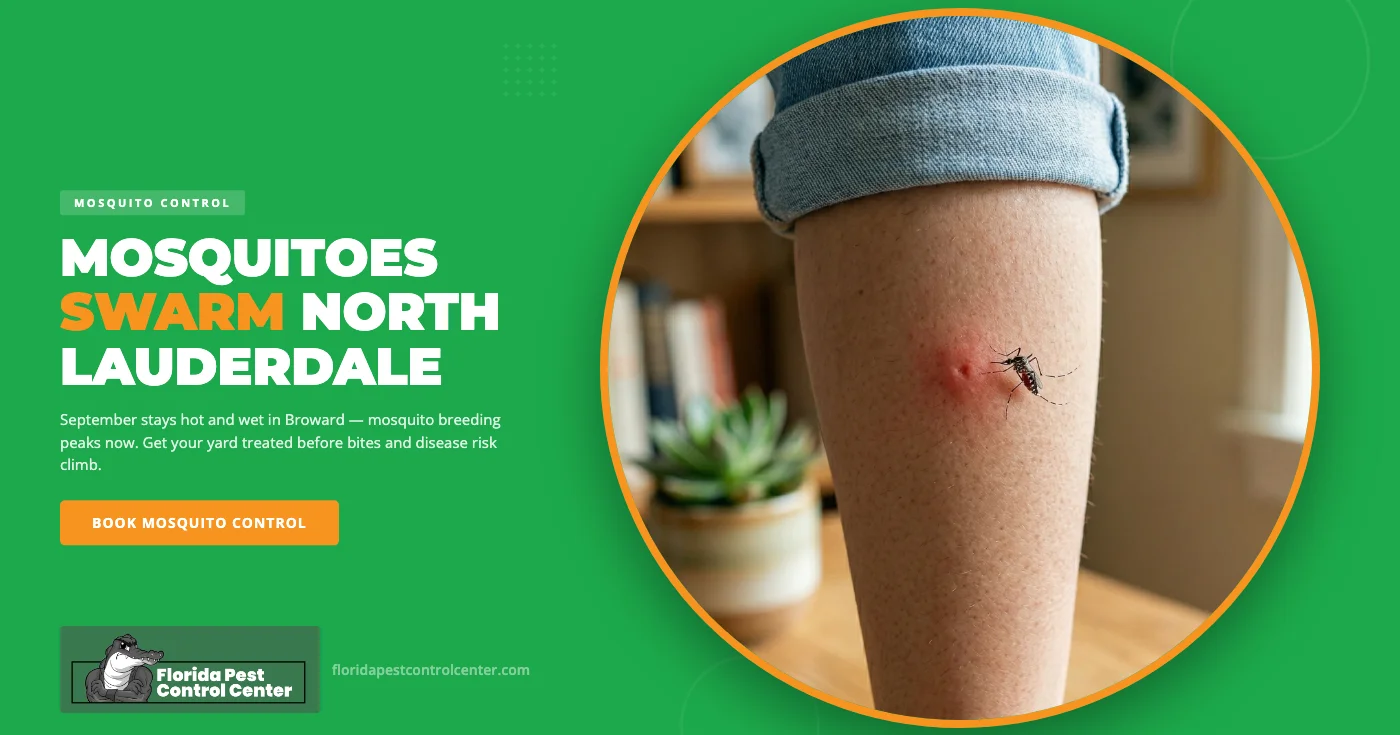
Why September Is Still Peak Mosquito Season in North Lauderdale, FL — and How to Protect Your Yard
At Florida Pest Control Center, September is our busiest mosquito month across North Lauderdale — and it happens for the same reasons every year. Rainy season is still delivering afternoon storms, nighttime temperatures stay above 75°F, and the container-breeding Aedes mosquitoes that dominate our region hit peak population right as dengue activity ramps up across the state. In 2026 alone, the Florida Department of Health has issued locally-acquired dengue advisories in Palm Beach, Miami-Dade, and Orange counties. Here is what drives peak mosquito season in North Lauderdale, why the mosquitoes biting your family probably came from your own yard, and how professional mosquito control actually breaks the breeding cycle.
Why Mosquitoes Peak in September in South Florida
South Florida's mosquito season never really ends, but pressure hits its highest sustained levels in late August and September. Three overlapping factors converge across North Lauderdale and the surrounding Broward County area during these weeks.
- Rainy season is still delivering water. May through October is our wet season, and by September the ground is fully saturated. Every yard already holds dozens of temporary breeding pools — plant saucers, sagging tarps, clogged gutters, and standing water in patio furniture — that refill after every afternoon thunderstorm.
- Warm nighttime temperatures speed up the life cycle. Aedes aegypti eggs can hatch, pupate, and emerge as biting adults in as few as seven days when nighttime lows stay above 75°F. September in North Lauderdale rarely drops below that threshold, so each rain event produces a fresh adult generation within a week.
- Peak dengue transmission window. Florida's dengue activity concentrates in late summer and early fall, and 2026 has been an active year. Any container-breeding mosquito emerging in a South Florida yard right now has a nonzero chance of carrying dengue if it fed on a viremic person nearby.
Those factors compound. A yard with any missed standing water in early September will produce biting adults every five to ten days for the rest of the month — which is why our mosquito control North Lauderdale FL call volume more than doubles between mid-August and the end of September every year.
Common Mosquito Breeding Spots Around North Lauderdale Homes
The mosquitoes biting most homeowners in North Lauderdale — Aedes aegypti (yellow fever mosquito) and Aedes albopictus (Asian tiger mosquito) — are container breeders. They lay eggs on the inside walls of any small standing-water source, and eggs can survive dry conditions for months before hatching after the next rain. That means most of the mosquitoes biting a family in the backyard were produced by that same yard, not by a swamp down the road. Both species fly less than 500 feet in their entire lifetime.
These are the breeding hotspots we find on nearly every North Lauderdale property during a September inspection.
- Ornamental bromeliads. University of Florida IFAS research documented that bromeliad tanks in South Florida yards are among the most productive urban breeding sites for Aedes aegypti. Landscapes with bromeliads need weekly flushing during wet season.
- Plant saucers, drip pans, and potted plant trays. Even a bottle-cap depth of water is enough. Every saucer under a potted plant on a lanai or patio needs to be emptied after each rain.
- Clogged gutters and downspout extensions. Roof debris blocks flow, leaving standing water along the gutter run for days after a storm — a classic Aedes production line most homeowners never inspect.
- Sagging pool covers, tarps, and boat covers. Any low spot holding rainwater for more than three days is producing mosquitoes.
- Birdbaths, fountains, and decorative water features. Fine on their own — problematic when circulation stops.
- Kiddie pools and outdoor toys. Toy trucks, buckets, sandpit shovels, and wagons collect rain and hold water for weeks.
- Trash and recycling bin lids. Rim channels trap rainwater, and open recycling bins let water collect inside every can.
- AC condensate drains and unscreened rain barrels. Steady water sources across the entire warm season.
- Uneven pavers and drainage low spots. Any low area holding water for more than four days after rain needs regrading or a French drain.
- Corrugated pipe under driveways. Standard corrugated drainage pipe under paver driveways is a hidden Aedes breeding chamber unless it drains fully — most do not.
Health Risks of South Florida Mosquitoes in Late Summer
South Florida is one of only a handful of U.S. regions where mosquito-borne illness transmission happens locally most years, not just in travelers returning from tropical countries. In 2026, the Florida Department of Health has confirmed locally-acquired dengue cases in Palm Beach County, Miami-Dade County, and Orange County — and county health departments have issued mosquito-borne illness advisories urging residents to eliminate standing water and use EPA-registered repellents.
- Dengue fever. Transmitted primarily by Aedes aegypti, which bites during the day (especially early morning and late afternoon). Symptoms include high fever, severe headache, joint and muscle pain (the historical name "breakbone fever" reflects the intensity), and rash. Severe dengue can cause plasma leakage, hemorrhage, and shock — always requires immediate medical evaluation.
- West Nile virus. Transmitted by Culex mosquitoes, which bite at dusk and after dark. Most infections are asymptomatic, but roughly one in 150 progresses to severe neurological illness. Florida reported multiple human West Nile cases across the state in August 2026.
- Zika virus. Also transmitted by Aedes aegypti. Local transmission in South Florida is periodic; symptoms are typically mild, but Zika during pregnancy can cause serious birth defects.
- Eastern Equine Encephalitis (EEE). Rare but often fatal — transmitted by Culiseta mosquitoes primarily in freshwater swamp habitat.
- Dog heartworm. Not a human risk, but Broward County has one of the highest dog heartworm infection rates in the country, and transmission runs on the same mosquito bites that produce human dengue exposure.
The takeaway for a North Lauderdale family: mosquito bites in September are not just a nuisance. Every bite is a transmission opportunity, and reducing the number of biting mosquitoes on the property through DIY prevention or professional mosquito control North Lauderdale FL residents can schedule year-round is the single most effective step a homeowner can take.
DIY Prevention Steps That Actually Reduce Mosquito Populations
The single most effective mosquito prevention step for any North Lauderdale property is eliminating standing water — the container-breeding Aedes mosquitoes producing most of the bites cannot reproduce without it. These actions reliably drop bite pressure by half or more within two weeks.
- Walk the property every week. A 15-minute walk-around — before or after mowing — is the highest-yield mosquito prevention step available. Tip, drain, or invert every container holding water.
- Empty and scrub bromeliads and plant saucers every seven days. Weekly rhythm matches the Aedes life cycle and removes eggs stuck to the container wall along with active larvae.
- Treat any persistent water source with BTI mosquito dunks. Bacillus thuringiensis israelensis is a naturally-occurring soil bacterium that kills mosquito larvae without affecting fish, wildlife, pets, or people. Ideal for rain barrels, ornamental ponds, birdbaths that cannot be dumped weekly, and drainage low spots.
- Clean gutters twice a year. Once in late spring and once in early fall. Clogged gutters produce more Aedes than any other single source on most South Florida properties.
- Fix outdoor drainage. Regrade low spots, install French drains where water pools for more than four days, and make sure downspouts discharge onto sloped ground.
- Screen every window and door. A single half-inch tear lets in every mosquito hitting the window at dusk.
- Use EPA-registered repellents outdoors. DEET, picaridin, IR3535, and oil of lemon eucalyptus are the repellents CDC identifies as effective. Wristband and clip-on devices show no meaningful effect in independent testing.
When DIY Isn't Enough: Signs You Need Professional Treatment
DIY prevention works when a homeowner can control every breeding source within the property line. It stops working when mosquitoes are coming from an adjacent property, when the yard has hidden breeding sites, or when the population is already established at the adult stage. These are the indicators we consistently see on properties calling for professional mosquito control North Lauderdale FL homeowners rely on us for.
- Bites in the first 60 seconds outside. Adult Aedes populations high enough to make the yard unusable — children cannot play outside, the pool goes unused, and adults get bitten before they finish walking to the mailbox.
- Persistent bites after eliminating standing water. Two weeks of walk-around and container clearing have not dropped mosquito pressure. That usually means an adjacent property is producing adults, or a hidden breeding source exists on the property itself.
- Daytime biting activity. Aedes mosquitoes bite during the day, and a homeowner getting bitten between 10 a.m. and 4 p.m. is dealing with a container-breeder population that requires barrier treatment on the resting foliage.
- Recurring welts and clusters of bites. Multiple bites within minutes on exposed skin means adults are actively resting on the property's shrubs, hedges, and shaded foliage — the exact locations where professional residual barrier applications shut down the population.
- Adjacent lot with vacant pool or abandoned property. An untreated neighboring source overwhelms any single-yard DIY effort. Professional barrier treatment on the perimeter gives a defensible edge.
How Professional Mosquito Control in North Lauderdale, FL Works
Every mosquito control visit at Florida Pest Control Center starts with a licensed inspection. We walk the property with the homeowner, identify every current and potential breeding source, and note the shaded resting locations where adult mosquitoes spend the day. Only then do we apply treatment — the goal is to break both the larval and adult stages of the mosquito life cycle, not to spray insecticide indiscriminately.
Our mosquito control North Lauderdale FL service includes three components.
- Source reduction and larvicide. We work with the homeowner to eliminate obvious standing water, then treat any water source that cannot be drained — bromeliads, ornamental ponds, drainage low spots, rain barrels, corrugated pipe under driveways — with an EPA-registered BTI or methoprene larvicide that stops mosquito eggs and larvae from developing into biting adults.
- Adult barrier mosquito spraying in North Lauderdale FL yards. Adult Aedes mosquitoes rest in shaded foliage during the day — the underside of shrubs, dense hedges, ground cover, and palm fronds. We apply a residual barrier treatment to those resting locations using EPA-registered products. A well-applied barrier remains effective for 21 to 30 days in our climate.
- Structural and landscape guidance. Every visit includes specific recommendations that reduce the property's ability to produce mosquitoes on its own — regrading a persistent low spot, replacing a corrugated driveway pipe, changing the discharge location of an AC condensate line, or removing a bromeliad landscape feature.
Our pest control services use only EPA-registered products, and every application is documented per Florida Department of Agriculture licensing requirements.
Year-Round Mosquito Management for South Florida Homeowners
Because South Florida never gets a hard freeze, mosquito pressure never fully resets. Rather than treating mosquitoes reactively after every peak, most homeowners get better results with a year-round mosquito prevention North Lauderdale program that adjusts intensity by season.
- January through March. Lower baseline — quarterly inspection with source-reduction guidance.
- April through June. Rainy season begins — monthly barrier treatments with larvicide at any persistent water sources.
- July through September. Peak pressure — service every 21 to 30 days, aggressive larvicide use, and inspection of neighboring properties (with permission) to identify off-site sources.
- October through December. Population winds down but never disappears — monthly service transitioning back to quarterly.
Homeowners with pool areas or medical sensitivities often benefit from an in-line automated misting system in addition to barrier treatments. These systems dispense a metered spray of pyrethrin at scheduled times and integrate with our monthly service.
Frequently Asked Questions About Mosquito Control in North Lauderdale, FL
How long does mosquito control in North Lauderdale, FL last after treatment?
A well-applied barrier treatment remains effective for 21 to 30 days in North Lauderdale conditions. Heavy rainfall, aggressive landscape pruning that removes treated foliage, and periods of sustained above-90°F heat can shorten that window. During peak season (July through September), most of our customers move to a 21-day service interval to maintain continuous coverage.
Are mosquito treatments harmful to pets, children, or beneficial insects like bees?
We use only EPA-registered products applied at labeled rates, and applications concentrate on the shaded resting sites where adult mosquitoes gather — not on blooming flowers where pollinators feed. Larvicide treatments use BTI, a naturally-occurring soil bacterium that targets mosquito and blackfly larvae specifically. We recommend keeping pets and children off treated areas until the product has dried (typically 30 to 60 minutes), and we time applications outside of active pollinator hours whenever possible.
What can I do about a neighbor's untreated property producing mosquitoes?
Broward County Mosquito Control accepts reports of neglected properties and abandoned pools, and can inspect and treat when residents cannot or will not. Our barrier treatments on the property line create a defensible boundary that reduces the number of adult mosquitoes flying in from an untreated adjacent source. Many of our North Lauderdale customers have neighboring vacant lots, and we adjust barrier application accordingly.
Schedule Your Mosquito Control Service with Florida Pest Control Center
September is our peak mosquito month across North Lauderdale, and every week without treatment produces another five-to-ten-day generation of biting adults. Homeowners who address the population now — before the last major rain events of the season fill every remaining container in the yard — get their outdoor space back for the fall entertaining season and reduce dengue exposure risk for their family.
We serve North Lauderdale, Fort Lauderdale, Lauderdale Lakes, Lauderhill, Tamarac, Margate, Sunrise, Plantation, Oakland Park, Pompano Beach, and the surrounding Broward County area. Alongside mosquito control, we also offer a full range of residential pest services for year-round property protection.
Contact Florida Pest Control Center today to schedule your mosquito control inspection in North Lauderdale, FL.