

Why August Humidity Sends Spiders Indoors in Oakland Park, FL — and How to Keep Them Out
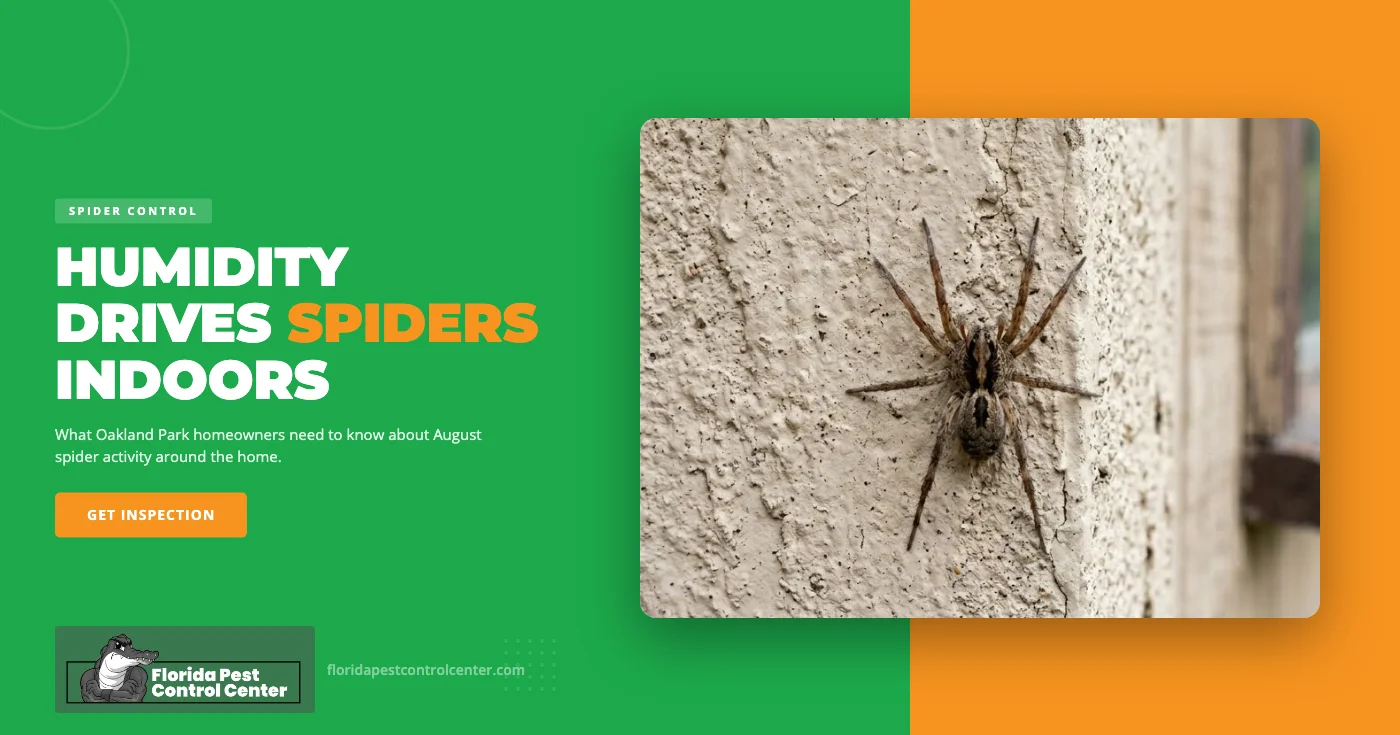
Why August Humidity Sends Spiders Indoors in Oakland Park, FL — and How to Keep Them Out
At Florida Pest Control Center, we field a consistent surge of spider control calls from Oakland Park homeowners every August. South Florida's late-summer humidity, the seasonal indoor migration of prey insects, and the approach of peak spider mating season all converge in Broward County during the same six-week window. Understanding what drives that surge is the first step toward keeping spiders out of your Oakland Park home.
Why South Florida's August Humidity Creates Ideal Spider Conditions
August in Oakland Park is one of the most humid months of the year in Broward County. Daytime highs sit in the low 90s Fahrenheit, overnight lows rarely drop below 78 degrees, and relative humidity holds above 85 percent through most of the day. Afternoon thunderstorms move through almost daily. For spiders, these conditions create three overlapping pressures.
Prey abundance. Late-summer rain drives cockroaches, ants, mosquitoes, gnats, and small flies into sheltered interior spaces. Spiders follow their food. Any Oakland Park home dealing with a summer cockroach or ant issue is almost certainly also drawing spiders.
Mating and dispersal. September marks peak mating season for many South Florida spider species, and males begin actively wandering in August looking for females. This is when Oakland Park homeowners suddenly notice spiders in living areas, showers, and closets that had been spider-free through spring and early summer.
Habitat disruption. Broward County's routine August storms saturate leaf litter, wash out ground-level webs, and flood the shallow burrows where ground-dwelling species live. When exterior habitat becomes unstable, spiders move toward drier structures — which in most Oakland Park neighborhoods means the perimeter, garage, and lower interior of the nearest home.
Most Common Spiders Found in Oakland Park, FL Homes
Not every spider Oakland Park homeowners encounter is a threat, and correct identification is the foundation of any effective spider control response. These are the species we see most often in Oakland Park homes during August and September.
- Common house spider (Parasteatoda tepidariorum). Small, tan to brown, with a messy cobweb in ceiling corners, garages, and storage areas. Not medically significant, but webs and egg sacs multiply quickly in undisturbed spaces.
- Cellar spider (Pholcus phalangioides). "Daddy long-legs." Pale, delicate, long-legged. Favors damp locations — bathrooms, laundry rooms, around A/C condensate drains.
- Wolf spider (Hogna and Rabidosa). Large, hairy, ground-dwelling hunters that do not spin webs. Enter through garage doors, sliding-glass door tracks, and gaps around utility penetrations. Frequently mistaken for brown recluses, but wolf spiders have eight eyes and are noticeably hairier.
- Huntsman spider (Heteropoda venatoria). Very large, flat, and fast — can span five to six inches leg-tip to leg-tip. Non-aggressive; prefers to flee.
- Jumping spider (Salticidae). Small, compact, boldly patterned, with distinctive forward-facing eyes. Diurnal and curious. Rarely a problem indoors.
- Golden silk orb-weaver (Trichonephila clavipes). The banana spider — large yellow-and-black web-builders that construct massive golden webs between trees and eaves. Not medically significant, but sometimes builds across pathways and entryways.
- Southern black widow (Latrodectus mactans). The most medically significant spider in Oakland Park. Glossy jet-black with a red hourglass under the abdomen. Found in outbuildings, meter boxes, garages, and undisturbed lanai corners.
- Brown widow (Latrodectus geometricus). An invasive species increasingly common in Broward County. Tan to dark brown with an orange hourglass and a distinctive spiked egg sac. Displacing the southern black widow in some Oakland Park neighborhoods.
Warning Signs of a Spider Infestation in Your Home
Spider infestations often go unnoticed for weeks because activity happens in low-traffic areas — garages, attics, storage rooms, and behind furniture. Recognizing the early indicators lets Oakland Park homeowners address the underlying conditions before the population spreads into living areas.
- Multiple webs in corners and along the ceiling. One or two cobwebs are normal. Five or more active webs in the same room — especially with visible small prey wrapped inside — indicates a productive food supply and an established spider presence.
- Egg sacs in undisturbed areas. Common house spider egg sacs are small tan spheres. Brown widow egg sacs are unmistakable: cream-colored spheres covered in soft spikes, roughly marble-sized, often clustered in groups of three to five in garages, patio furniture, or under overhangs. Any spiked egg sac in an Oakland Park garage should be treated as a brown widow indicator.
- Sudden appearance of wandering spiders indoors. An uptick in wolf spiders or huntsman spiders in living areas during August signals disrupted exterior habitat or a prey insect issue drawing them in from the perimeter.
- Spider activity concentrated around lights. Porch, garage, and lanai lights draw the flying insects spiders eat. Consistent web construction near lighting fixtures concentrates spider activity around every nearby doorway and window.
- Shed exoskeletons. Spiders molt as they grow, leaving pale translucent skins that look like small dead spiders. Multiple sheds in one area indicate an established resident population.
- Prey remains beneath webs. Wrapped or drained insect carcasses beneath an active web mean the spider has been in place long enough to work through multiple meals.
Are These Spiders Dangerous? Identifying Venomous Species in South Florida
The vast majority of spiders Oakland Park homeowners encounter are medically insignificant — their fangs cannot penetrate human skin, or their venom produces nothing worse than mild irritation. Only a small number of species in South Florida present real medical risk.
Southern black widow (Latrodectus mactans). The Florida Department of Agriculture and Consumer Services lists the southern black widow as the most medically significant spider in the state. Females are glossy jet-black with a red hourglass under the abdomen and measure 8 to 15 millimeters in body length. Males are smaller and non-hazardous. Black widow venom is a potent neurotoxin — bites produce intense localized pain, abdominal muscle cramping, sweating, and elevated blood pressure that can persist three to five days without medical treatment. In Oakland Park, black widows are most commonly found in undisturbed exterior structures: meter boxes, storage sheds, pool pump enclosures, wood piles, and neglected garage corners. They are not aggressive and bite defensively only when pressed against skin.
Brown widow (Latrodectus geometricus). An invasive species now widespread across South Florida. Lighter tan to dark brown with an orange or yellow hourglass. Their venom is chemically similar to the southern black widow's but generally injected in smaller quantities, producing a less severe systemic response — though painful localized reactions still occur, and the same three-to-five-day discomfort window applies. Brown widows regularly build webs in patio furniture, grill covers, mailbox undersides, and garage door tracks in Oakland Park.
Brown recluse (Loxosceles reclusa). A common source of confusion. Brown recluses are not native to Florida, and established populations in South Florida homes are extremely rare. Nearly every "brown recluse" reported by an Oakland Park homeowner is actually a wolf spider, southern house spider, or huntsman. Recluses have six eyes arranged in three pairs (most other spiders have eight), uniformly light brown unmarked legs, and a violin-shaped marking on the cephalothorax.
If a bite produces spreading redness, an ulcer developing over 24 to 72 hours, systemic symptoms, or severe pain, seek medical evaluation without waiting to identify the spider.
DIY Spider Control: What Works and What Doesn't
Some DIY spider control measures meaningfully reduce indoor pressure in Oakland Park. Others are ineffective at best and counterproductive at worst.
What works:
- Address the prey insect population first. Spiders are indicators of an underlying insect issue. Cockroach, ant, and small-fly control typically produces a noticeable reduction in spider activity within two to three weeks.
- Vacuum webs, egg sacs, and spiders aggressively. Physical removal is the most effective single homeowner action. Vacuum ceiling corners, window frames, garage rafters, storage areas, patio furniture, and grill covers. Empty the canister into a sealed outdoor bag immediately — brown widow egg sacs can survive vacuuming and hatch inside.
- Reduce exterior lighting or switch to yellow bug bulbs. White porch and garage lights attract the flying insects spiders eat. Yellow bug bulbs or amber LEDs reduce insect attraction, and spider activity around exterior doors and windows drops in turn.
- Seal entry points. Weatherstripping under garage doors, door sweeps on exterior doors, mesh over dryer and bathroom vents, and caulk around wall penetrations reduce wandering spiders entering from the perimeter.
- Clear vegetation and debris from the foundation. Dense ground cover, leaf litter, mulch piled against the foundation, and stacked items along exterior walls all provide harborage. Maintain a clear 12-to-18-inch band around the foundation.
What doesn't work:
- Peppermint oil, chestnuts, and other folk remedies. No controlled study supports the claim that essential oil sprays, chestnuts, or vinegar meaningfully repel spiders.
- Ultrasonic pest repellers. Independent studies from multiple university entomology programs have consistently shown no measurable effect on spider or insect populations.
- Consumer bug bombs and total-release foggers. These spread pesticide across horizontal surfaces where spiders rarely walk. Spiders live in webs and elevated positions and receive minimal exposure. Foggers also contaminate food-preparation areas and reduce natural predators keeping other pest populations in check.
When to Call a Professional Spider Exterminator in Oakland Park
Call a licensed pest control company when you observe any of the following: a confirmed or suspected black widow or brown widow indoors, spiked widow egg sacs in a garage or on outdoor furniture, sustained spider activity that has not responded to two to three weeks of vacuuming and exterior maintenance, spider activity concentrated in a room where children or pets spend significant time, or an underlying insect issue driving spider populations that has not resolved with DIY treatment.
Effective spider control in Oakland Park, FL addresses three layers at once: the current spider population inside the home, the prey insects drawing them in, and the exterior perimeter conditions producing continuous pressure. At Florida Pest Control Center, our spider control Oakland Park FL service starts with a licensed inspection of every active harborage area, entry route, and prey insect issue contributing to the infestation. We treat the interior with residual products labeled for spider species, remove webs and egg sacs mechanically, and apply a perimeter treatment focused on the conditions driving spiders toward the structure — soffit lines, garage door tracks, meter boxes, and any harborage against the foundation.
Our pest control services for Oakland Park homes include follow-up inspections to confirm the population has resolved and to catch any new activity before it establishes. Follow-up matters because spider populations respond to prey availability, and any change in the surrounding insect population can bring a new generation of wandering spiders into the same structure within weeks.
Frequently Asked Questions About Spider Control in Oakland Park, FL
Are the big brown spiders in my Oakland Park garage brown recluses?
Almost certainly not. Brown recluses are not native to Florida, and confirmed populations in South Florida homes are extremely rare. The large brown spiders Oakland Park homeowners find in garages are almost always wolf spiders, southern house spiders, or huntsman spiders — none medically significant to humans. Recluses have six eyes (most other spiders have eight) and uniformly light brown, unmarked legs.
Why do I have so many spiders indoors in August?
August combines three conditions that spike indoor spider activity in Oakland Park: peak humidity drives prey insects indoors, males of many spider species wander in advance of September mating season, and routine afternoon storms push ground-dwelling spiders toward drier structures. That combination is why August and September are the busiest months for spider control calls in Broward County.
Do I need to worry about brown widow spiders on my patio furniture?
Yes. Brown widows have spread widely across South Florida and now regularly build webs in patio furniture, grill covers, mailbox undersides, garage door tracks, and children's outdoor toys in Oakland Park. Their venom produces painful localized reactions and, in some cases, systemic symptoms lasting several days. The distinctive spiked egg sacs are the fastest identifier — if you find one, avoid contact and schedule a spider control inspection to identify additional harborage.
How long does professional spider control take to work in Oakland Park?
Homeowners typically see a significant reduction in visible spider activity within one to two weeks of professional treatment, with continued improvement as prey insect populations decline. A single treatment addresses the current population; ongoing spider control requires attention to the underlying prey insect population and the exterior perimeter. Most Oakland Park homes benefit from a quarterly service interval.
Schedule Your Spider Inspection with Florida Pest Control Center
Oakland Park homeowners who address spider pressure early — before egg sacs hatch and before the underlying prey insect population expands — face a fraction of the effort and disruption of those who wait until spider activity has spread across multiple rooms. August and September are the highest-pressure months of the year for spiders in South Florida, and the conditions driving indoor movement do not resolve on their own.
We serve Oakland Park, Fort Lauderdale, Wilton Manors, Lauderdale Lakes, Pompano Beach, and the surrounding Broward County area. Along with spider control, we also offer a full range of residential pest services for year-round property protection.
Contact Florida Pest Control Center today to schedule your spider control inspection in Oakland Park, FL.