

Mosquito Control in Miramar, FL: Standing Water Hotspots
Mosquito Control in Miramar, FL: Standing Water Hotspots
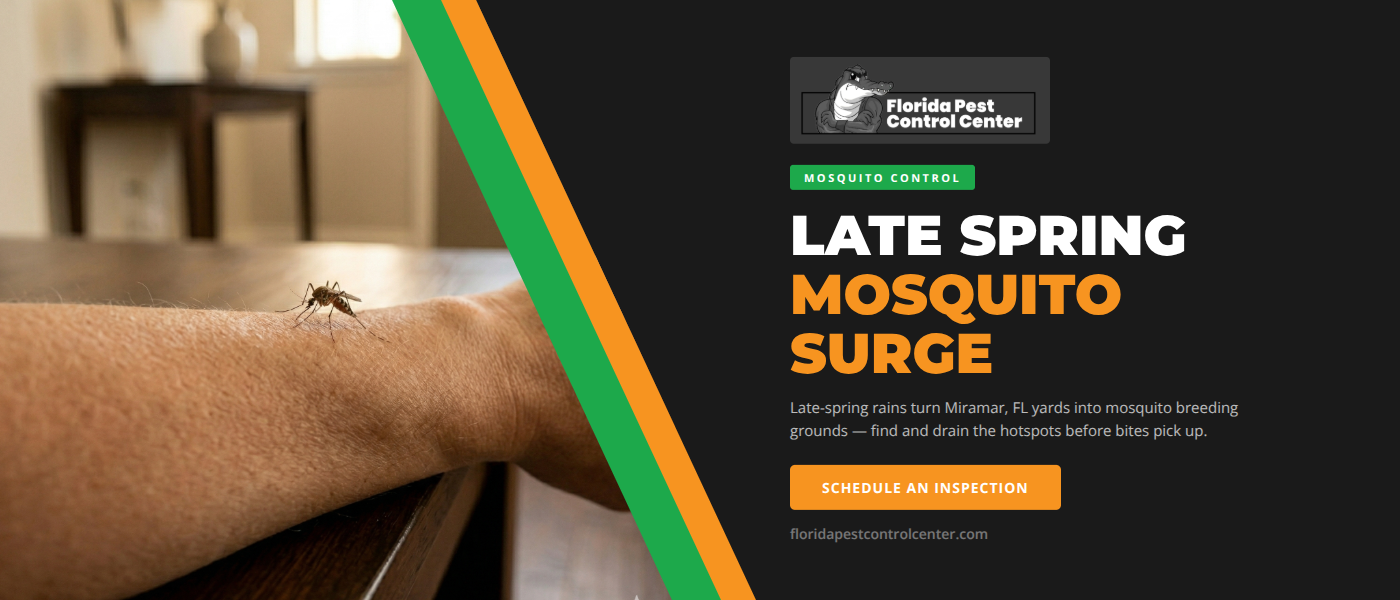
The first heavy rains of late May are a turning point for South Florida yards, and here in Miramar we know what comes next: a sudden wave of biting mosquitoes that seems to appear overnight. One Sunday the patio feels normal. The next Saturday, you can't sit out past dusk. The trigger is almost always the same — water that started pooling somewhere a week earlier has hatched its first generation of bloodfeeders.
At Florida Pest Control Center, we've been treating Miramar properties through enough rainy seasons to know effective mosquito control in Miramar, FL starts long before the swarms show up. It starts with the standing water hotspots most homeowners walk past every day.
Why Late Spring Triggers a Mosquito Surge in Miramar, FL
South Florida's mosquito year is driven by rainfall, not temperature. Our winters are mild enough that the eggs of container-breeding species like Aedes aegypti and Aedes albopictus stay viable in the yard, waiting on the calendar. What changes in late May and early June is moisture — seasonal rains begin, every container in the yard tops off, and dormant eggs glued to the inside of those containers finally meet water.
According to the CDC, Aedes eggs "can survive drying out for up to 8 months" and "can even survive a winter in the southern United States." A single rainy weekend in Miramar can produce a population explosion within ten days — the eggs were already scattered across dozens of small water-holders, just waiting for the cue.
Broward County's Mosquito Control Section runs reactive truck-mounted spraying through cities in our area, including operations across Hollywood, Miramar, Pembroke Park, and West Park earlier this year. Those overnight sweeps knock back adult populations on the wing, but they don't visit your yard or empty the bromeliad in your front bed. Property-level prevention is where the real reduction lives.
The Standing Water Hotspots Most Miramar Homeowners Miss
When we walk a property after a rainy week, the obvious offenders — a kid's pool, an open trash can — are rarely the real breeding sites. Aedes mosquitoes prefer small, sheltered, organic-rich pockets of water. Here is what we find producing larvae over and over again:
- Bromeliads. The center cup of any bromeliad holds a few tablespoons of rainwater, and that's plenty. The University of Florida's IFAS Extension confirms bromeliad axils support breeding for native Wyeomyia species along with the invasive container generalists Aedes aegypti and Aedes albopictus — the same species that can transmit dengue and Zika.
- Plant saucers. The tray under every potted plant on the lanai becomes a nursery within 48 hours of a downpour.
- Clogged gutters and downspouts. A roofline with a couple of pinch points holds standing water in 6-foot pockets for weeks — invisible from the ground.
- Pool covers, tarps, and grill covers. Any vinyl or canvas pulled across an object collects a sagging puddle in the low spot.
- Irrigation valve boxes and meter pits. The green plastic lid in the front yard often hides a deep box that fills with rainwater and never drains.
- Wheelbarrows, buckets, kiddie pools, and toys left upright behind the shed or alongside the garage.
- Birdbaths and decorative fountains. Water sitting more than five days without movement or replacement is a breeding site.
- Boat covers, stored kayaks, and tree holes. Concave hulls in the side yard, old palm boots, and rotted-out cavities at branch unions.
- Discarded tires. The most productive breeding container ever studied — one tire can produce thousands of mosquitoes.
- AC condensate trays and yard depressions. Drip pans and any low spot holding water 5+ days produce Culex species, which carry West Nile virus and St. Louis encephalitis.
Broward County's mosquito control office urges Miramar-area residents to dump small water-holding containers twice a week — that cadence isn't arbitrary, it's tied to how fast the life cycle runs.
How Quickly Mosquitoes Can Breed in Just a Tablespoon of Water
The reason Miramar yards go from clean to swarming in a single week is biological math. Per the CDC's life cycle data, "a mosquito egg takes 7–10 days to develop into an adult mosquito," and "mosquitoes only need a small amount of water to lay eggs." The CDC lists bowls, cups, fountains, tires, barrels, and vases as suitable nurseries.
A thunderstorm on a Sunday can produce a fresh, biting adult population by the following Wednesday from water you would never identify as a problem. A tablespoon in a saucer or the cup of a bromeliad is enough for a female to lay 100-plus eggs above the waterline.
There's one more wrinkle. A female Aedes aegypti doesn't lay all her eggs in one place — she distributes them across multiple containers, a strategy called "skip oviposition." Eliminating one bromeliad doesn't break the cycle; the same female has likely seeded the saucer, the birdbath, the gutter, and the kiddie pool on the same flight. Systematic, property-wide source elimination always beats spot treatment.
Yard Drainage and Landscaping Fixes for Miramar Properties
Once we've identified hotspots on a Miramar property, the durable fixes fall into four buckets. The first three you can handle on a weekend; the fourth is where we come in.
1. Eliminate every container you can. Walk the house perimeter twice — once dry and once 24 hours after a rain. Anything that holds water and doesn't need to gets stored upside down, drilled, or moved indoors. Tipping plant saucers and emptying birdbaths twice a week is the highest-impact habit you can build.
2. Fix gutters and yard low spots. Have gutters cleaned at the start of June, before daily afternoon storms set in. Sagging sections that hold water need re-pitching. For yard depressions that hold water more than five days, swale grading or French-drain installation is the lasting fix.
3. Manage bromeliads and water-holding plants. You don't have to rip out your bromeliads. The University of Florida and Collier Mosquito Control District both recommend flushing each bromeliad's central tank with a strong hose stream once a week (washes out eggs and larvae before they mature), or treating the central tanks with a Bti-based larvicide. Bti is a naturally occurring bacterium that targets mosquito larvae specifically. Traveler's palms benefit from the same routine.
4. Layer in barrier and larvicide treatments. Source elimination cuts the population dramatically, but adult mosquitoes drift in from neighboring yards, canals, and the wider Miramar landscape. Targeted residuals on the underside of foliage and shaded resting sites — combined with larvicide in any remaining standing water — close the gap between "much better" and "actually enjoyable on the patio."
When Professional Mosquito Treatments Make Sense in South Florida
We're honest about when DIY is enough and when it isn't. Small yard, no bromeliads, disciplined twice-a-week container dumping — a citronella candle may carry you through. Professional mosquito control in Miramar, FL pays off in these situations:
- Lush, plant-rich yards with bromeliads, traveler's palms, dense foundation plantings, or shaded canopy. The habitat is producing mosquitoes faster than you can outwork it.
- Properties near canals, wetlands, or retention ponds. Miramar's canal network and Everglades buffer mean adult mosquitoes are constantly arriving from off-property.
- Allergic reactions or young children. When the cost of every bite is high, the calculus changes.
- Outdoor events and routine entertaining. A scheduled treatment 48 hours before a graduation party produces a noticeably different experience.
- Confirmed disease pressure. When Broward County announces increased Aedes or West Nile activity, a residential barrier program is a reasonable response.
Disease risk in South Florida is real. Aedes species can transmit dengue and Zika, and Culex species carry West Nile virus and Eastern equine encephalitis — threats Broward County's public-health team monitors actively.
What to Expect from a Mosquito Control Visit in Miramar
When you book a first visit, a Florida Pest Control Center technician walks the entire property with you — front and back yards, side runs, the AC pad, irrigation boxes, the pool equipment area. We document every breeding hotspot and walk you through source-elimination steps before treating anything.
A typical Miramar mosquito service includes:
- Larvicide application in standing-water sites that can't be drained — bromeliad tanks, ponds, valve boxes — using Bti or similar low-impact products designed for mosquito larvae.
- Targeted barrier treatment on the underside of dense foliage, fence lines, and shaded resting sites where adult mosquitoes hide between blood meals.
- Bromeliad and water-holding plant protocol tailored to the species in your yard, with a flush-and-treat schedule you can continue between visits.
- Recurring visits on a 21- to 30-day rotation through the rainy season, because barrier residuals lose strength and new generations arrive constantly.
- Pre-event treatments 48 to 72 hours before outdoor gatherings.
- Follow-up reporting on new hotspots and plan adjustments as the season progresses.
Our products are applied per label, in line with University of Florida IFAS Extension and Florida Department of Agriculture guidance, and our technicians minimize impact on pollinators by timing applications, avoiding blooming plants, and using directed equipment rather than broadcast fogging where possible.
Frequently Asked Questions About Mosquito Control in Miramar
How long does it take to see results from a professional mosquito treatment?
Most Miramar homeowners notice a significant drop in biting pressure within 48 to 72 hours of the first visit. Residual barrier products keep working for roughly three weeks, and we time the next service before that drops off. The program gets more effective over the first two to three months as source elimination compounds.
How often should I empty plant saucers and birdbaths during the rainy season?
Twice a week is the right cadence in Miramar from mid-May through November. That matches the 7-to-10-day egg-to-adult timeline so larvae never complete development. Pair it with the trash day routine — tip everything when the cans go to the curb, and again midweek.
Are mosquito treatments gentle around pets and pollinators?
We choose products and application methods designed to be gentle around pets, kids, and beneficial insects. Bti larvicides target mosquito larvae specifically. Barrier residuals go on shaded foliage and resting surfaces, not blooming plants where bees forage. We ask homeowners to keep pets indoors for a short window after application; once it dries, the treated areas are fine for normal use.
Will mosquito control hurt my bromeliads or other landscaping?
No. The treatments we use are designed for use in and around water-holding plants. Bti is a naturally occurring soil bacterium that doesn't harm plants, and the foliar barrier products are formulated for ornamentals. The bigger landscaping risk is leaving bromeliads untreated and watching the mosquito population climb week after week.
Why does my Miramar yard still have mosquitoes if my neighbor doesn't?
Usually undetected standing water unique to your property — a clogged gutter, a bromeliad-heavy bed, an irrigation valve box, or a sagging tarp. Microclimate plays a role too: dense canopy, shaded foundation plantings, or a wind-blocking fence creates the still, humid resting habitat Aedes mosquitoes prefer. A property walk-through almost always identifies the difference.
Does Broward County spraying handle the problem on its own?
Broward County's truck-mounted spraying is a useful tool against adult populations on the wing, but it doesn't reach interior yards, doesn't treat the larvae in your specific containers, and runs on a reactive schedule. County spraying plus property-level prevention is the combination that produces a livable yard in Miramar through the rainy season.
Late spring is the right moment to get ahead of the mosquito wave. Every week of source elimination and barrier treatment before the rains peak in July saves weeks of catch-up later. If the bites are already starting and you're tired of giving up the lanai by sunset, our team is ready to walk the property, identify every breeding hotspot, and build a plan tuned to your yard. Learn more about our mosquito control in Miramar, FL program at Florida Pest Control Center, or reach out to schedule an inspection. We've been protecting South Florida homes through every rainy season the calendar throws at us, and we'd be glad to do the same for yours.