

Summer Pigeon Control in Margate, FL
Summer Pigeon Control in Margate, FL
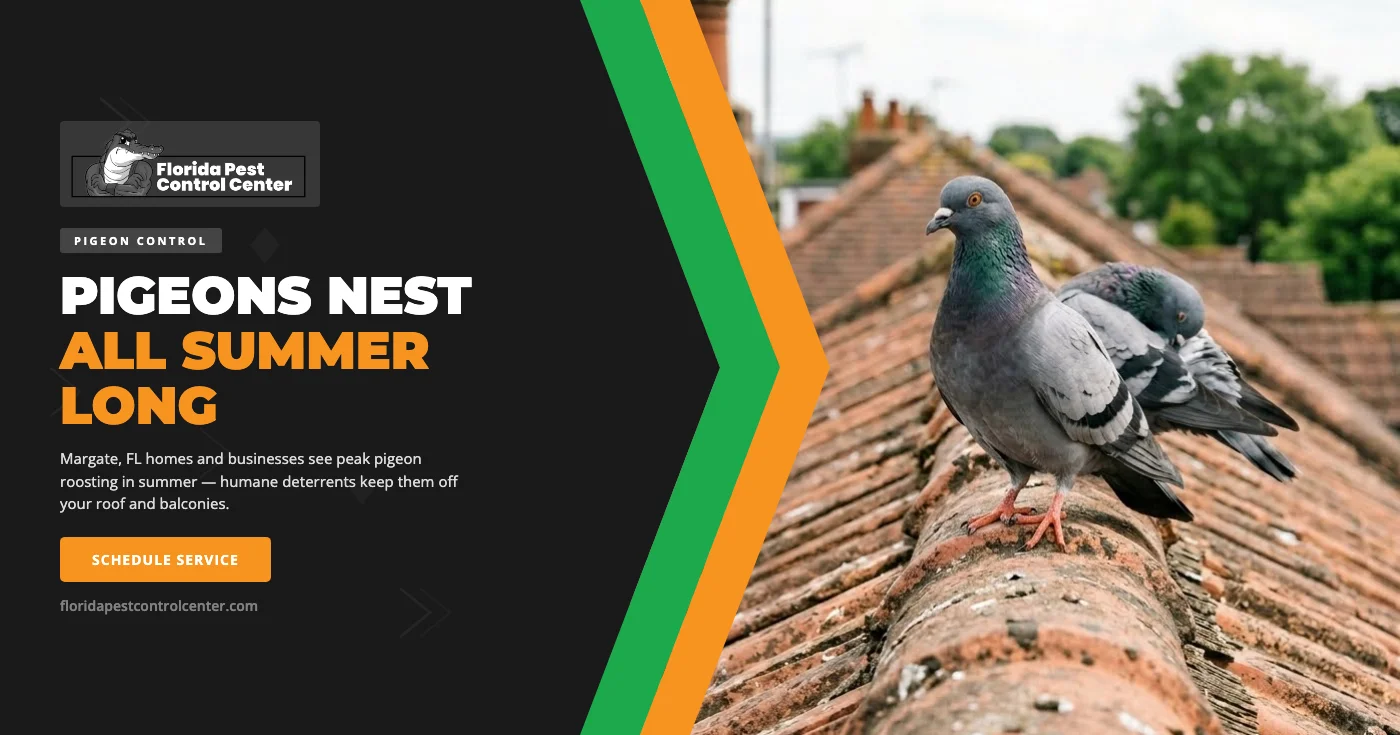
At Florida Pest Control Center, late spring and early summer are our busiest weeks for pigeon control in Margate, FL. The warm humid stretch from May through August turns nearly every flat-tiled roof, eave, and air-conditioner platform into prime real estate for rock doves looking to nest. Once a flock claims your roofline, the droppings keep coming, the structural damage compounds, and the cleanup gets messy and expensive — fast. We see the same pattern every year on homes near Margate Boulevard, around the lakes, and on commercial parapet walls all over Broward County. In this guide, our team walks you through how we identify the early signs of a pigeon problem, why most DIY solutions fall apart in our climate, and the humane methods we use to keep birds off Margate properties for the long haul.
Why Summer Is Peak Pigeon Nesting Season in Margate, FL
Pigeons — technically rock doves (Columba livia) — are non-migratory residents of South Florida. According to UF/IFAS extension research, the species was introduced to North America by European settlers and has thrived in urban areas where buildings mimic the cliffs of their original Mediterranean habitat. While they can nest year-round in our climate, breeding activity ramps up dramatically once average daytime temperatures climb above 80°F and daylight hours stretch past 13 hours — both of which describe Margate from late April through September.
A single mated pair can produce three to six broods per year, and they reuse the same nest site repeatedly. That means a few birds spotted on your roof in May can turn into a colony of 20 or more by August. Each clutch is two eggs, with incubation taking only 17 to 19 days in our warm climate. By the time you realize the cooing has gotten louder, the second generation is already feeding alongside the first.
Add abundant standing water from afternoon thunderstorms, exposed garbage cans, and food scraps around parking lots and shopping plazas, and our city becomes one of the easier places in Florida for pigeons to multiply.
Common Roosting Spots on South Florida Homes and Businesses
Pigeons prefer flat surfaces tucked under an overhang, where they're shielded from sun and predators but have a clear flight path. On Margate homes, we routinely find them under:
- The gaps between barrel tile roofing where the tiles meet the eave — a classic South Florida nesting cavity almost custom-built for pigeons.
- Air-conditioning condenser platforms and the ledges above them.
- Soffit returns with damaged screens or missing vent covers.
- The space above hurricane shutters that have been left in their stored position.
- Solar panel arrays — the warm shaded space underneath is one of the fastest-growing pigeon habitats we see in Broward.
- Screen enclosures with torn mesh near the top.
On commercial properties around Margate Boulevard, State Road 7, and Sample Road, the hot spots shift. There it's parapet walls on flat roofs, exhaust hood ledges, loading dock canopies, illuminated sign cabinets, and rooftop HVAC units that gather warm air and offer easy nest-building footing. Multi-family condo buildings have their own pattern — pigeons quickly learn that breezeway light fixtures and stairwell ledges go unmonitored.
The common thread is height plus shelter plus a flat landing surface. Wherever that combination exists on your property, pigeons will find it within days of arriving in the area.
Health and Property Risks of Pigeon Droppings
Pigeon droppings cause more property damage than the birds themselves. The droppings contain uric acid, which dissolves the binders in asphalt shingles, eats through painted finishes, corrodes the aluminum coils on AC condensers, and degrades the rubber gaskets around skylights and rooftop equipment. We've inspected Margate homes where a single season of pigeon activity left a four-figure AC unit needing replacement and a roof underlayment exposed to moisture intrusion.
The droppings also raise health concerns when they accumulate and dry out. The CDC notes that Histoplasma, the fungus that causes histoplasmosis, lives in soil and spreads in bird and bat droppings that mix in soil. People become infected by inhaling the spores when dried droppings are disturbed. Other conditions linked to pigeon droppings include cryptococcosis and psittacosis. These illnesses are uncommon, but the risk climbs sharply for anyone with asthma, COPD, or a compromised immune system — and the disturbance step (sweeping, pressure-washing, scraping) is exactly what most homeowners try first.
There's a secondary problem few people anticipate: pigeons host their own population of mites, lice, and bed-bug-relative parasites. Once a nest is established, those ectoparasites migrate inward through attic vents and soffit gaps, ending up in living spaces. We've traced more than one mystery bite-mark complaint back to a pigeon roost above the bedroom.
How to Tell If You Have a Pigeon Problem vs. Other Birds
Several birds get blamed for pigeon-style damage in Margate, but identifying the species correctly changes the treatment plan. Here's how we distinguish them in the field:
- Pigeons (rock doves): 11–14 inches long, plump body, iridescent green-and-purple neck patch, low rolling "coo-coo-coo" call, white-and-gray pellet droppings clustered in heaps, and sparse twig nests in protected nooks.
- Mourning doves: smaller, slender, pointed tail, mournful drawn-out coo, and droppings far less concentrated. Rarely cause structural damage.
- European starlings: smaller still, glossy black plumage with a yellow beak in summer, droppings more liquid and streaky, calls metallic and rattling.
- Common grackles: longer tail, taller stance, dark iridescent body, sharp call. They forage on the ground more than on roofs.
Other tells that confirm pigeons specifically: feathers and dander caught in cobwebs near roof penetrations, white streaks running down stucco below a ledge, and the distinctive "ghost prints" where repeated landings have worn the dirt off a perch line. When in doubt, our inspectors confirm the species during the free first visit before recommending any control work.
Why DIY Bird Deterrents Often Fail in Humid South Florida
Most retail bird-control products were designed for drier climates and milder pest pressure than what we deal with in South Florida. Here's what we routinely find when homeowners call us after trying it themselves:
- Plastic owls and reflective tape. Pigeons habituate within three to five days. Without movement or scent cues, the deterrent becomes part of the scenery.
- Sticky bird gel. It softens in our 90°F roof-surface temperatures, traps debris that creates a perfect new landing pad, and washes thin in afternoon thunderstorms.
- Ultrasonic devices. Pigeon hearing range overlaps with ours, so most ultrasonic units have little measurable effect, and there's little peer-reviewed evidence supporting them.
- Off-the-shelf spikes. Spaced too far apart, they become a trellis. We've seen pigeons nest between improperly installed strips.
- Bird netting installed without proper tensioning. Sags within a season in humid air, traps birds inside, and pulls fasteners out of stucco.
The deeper issue is that pigeons in Margate aren't easily startled — they share the city with people year-round and have already filtered out most threats. Lasting results require physically excluding birds from the space, not just discouraging them.
Humane, Effective Pigeon Control Methods for Margate Properties
Our Pigeon and Bird Control program is built around three principles: exclude the birds from the structure, modify the surrounding habitat so they have less reason to come back, and decontaminate any droppings or nesting material left behind. We never use methods that injure or kill the birds — both because Florida law restricts what can be done to native and naturalized species, and because lethal control simply doesn't work for pigeons. New birds move in to fill the vacancy within weeks.
Exclusion is where the lasting results come from. Depending on the structure, our team installs:
- UV-stabilized polyethylene netting tensioned against stainless cable, sized for our humidity and salt-air exposure.
- Stainless-steel ledge spikes spaced and angled to leave no landing surface — installed with marine-grade adhesive that holds in 95°F sun.
- Ledge-modification systems (angled aluminum sheeting) that turn flat roosting surfaces into 45-degree slides.
- Bird wire-tension systems for visible architectural surfaces where netting would look out of place.
Habitat modification covers the gentler side of the program — sealing damaged soffits and gable vents, screening AC condenser cages, advising on trash-enclosure latches, and replacing missing tile caps. We finish each project by removing existing nests with full respiratory and dermal protection, then sanitizing the surface with an enzymatic treatment that neutralizes uric acid residue and ectoparasite eggs. The result is a building that pigeons no longer recognize as habitat.
When to Call Florida Pest Control Center for Bird Control
By the time most homeowners notice pigeons, the colony has already been there for weeks. We recommend reaching out as soon as you see any of these signs on a Margate, Coral Springs, Coconut Creek, North Lauderdale, or Pompano Beach property:
- Four or more pigeons regularly perching on the same ledge, roofline, or AC unit.
- White streaks or chalky build-up running down a wall or window below a ledge.
- Visible nesting material in soffit returns, gutters, or between barrel tiles.
- Cooing noises coming from the attic or eave space.
- A family member or coworker with asthma reporting worsening symptoms with no obvious indoor cause.
We've been controlling pigeons across South Florida for decades, and we know the building types, climate patterns, and bird behavior specific to our region. Every property gets a free first inspection where our technician identifies the species, maps every active roost, and gives you a written plan with a clear scope. There's no charge for the visit, and we don't pressure anyone into work that isn't needed.
Frequently Asked Questions About Pigeon Control in Margate, FL
How long does it take to get rid of a pigeon flock in Margate?
For a typical single-family home with one active roost, our exclusion installation takes one to two visits over a few days, and you should see pigeon activity drop sharply within a week. For commercial properties with multiple roosting zones, the project may stretch to two or three weeks. Stubborn cases involving established colonies of 30 or more birds sometimes call for a phased exclusion as we close one zone at a time.
Are pigeons protected by law in Florida?
Pigeons (rock doves) are a non-native, non-migratory species and are not protected by the federal Migratory Bird Treaty Act. Florida state law allows their removal as a nuisance species. That said, mourning doves and other native doves are federally protected — which is one reason we always confirm species identification before any control work begins.
Will pigeons come back after they're removed?
Not when exclusion is done correctly. Pigeons are highly site-faithful and remember roosting spots for years, so simply scaring them off rarely lasts. Permanent physical exclusion — netting, properly installed spikes, ledge modification — removes the option. Most of our Margate clients see no return activity for the multi-year service life of the installed products.
Is it okay to clean pigeon droppings yourself?
We don't recommend it. The CDC notes that dried bird droppings can release fungal spores into the air when disturbed, and the right respirator, gloves, eye protection, and disposal protocol matter. Our team handles the cleanup as part of our exclusion service, including enzymatic sanitization that neutralizes uric acid residue and parasite eggs.
If you've noticed pigeons settling onto your Margate property this summer, the smartest move is to act before the next nesting cycle starts. Our Pigeon and Bird Control team can be on-site for a free inspection within a few days, give you a clear plan for humane exclusion, and have your building bird-free in time for next season. Reach out and we'll take it from there.