

Bed Bug Control in Miramar, FL
Bed Bug Control in Miramar, FL
Summer travel pulls Miramar families into hotels, short-term rentals, and cruise cabins across South Florida — and every one of those stays is a chance for bed bugs to ride home in a suitcase. The species does not fly and does not jump. It walks, clings to fabric, and waits. By the time most homeowners realize what came back with them, the colony has moved from a duffel bag into a mattress seam, and a single mated female is laying one to three eggs a day.
At Florida Pest Control Center, our bed bug calls climb every June and stay high through August. The pattern across southwest Broward County is consistent: a family returns from a trip, sleeps a few nights, and starts finding bites in a line on the arms or shoulders. By that point, professional bed bug control in Miramar, FL is the right next step — not a drugstore spray. This guide explains how summer travel spreads the species and why a bed bug inspection beats DIY every time.
Why Summer Travel Season Is Peak Bed Bug Spread in South Florida
Bed bug pressure rises every summer because the species spreads by hitchhiking, and summer is when South Florida moves the most luggage. Florida welcomed roughly 143 million visitors in 2024, and the hotels, motels, vacation rentals, and cruise turnarounds that absorb that traffic are where bed bugs find their most consistent feeding population. The National Pest Management Association reports more than half of pest professionals receive their peak bed bug complaints during summer, and hotels and motels rank third nationally on the list of properties where the species is found.
Miramar sits twenty minutes from Fort Lauderdale–Hollywood International Airport and thirty minutes from Miami International Airport, absorbing returning travelers from Orlando theme-park trips, Caribbean cruises, and family visits across the country.
Climate adds a second layer. The U.S. Environmental Protection Agency notes that under favorable conditions a bed bug's egg-to-egg life cycle takes only four to five weeks, and each female can produce 200 to 500 eggs over a six- to twelve-month lifetime. Miramar's warm, humid interiors hit that range nearly every month, so a colony arriving in a July suitcase does not slow down in fall — by the time it is found, it is usually weeks ahead of the homeowner.
How Bed Bugs Hitchhike From Hotels and Short-Term Rentals to Miramar Homes
Bed bugs do not infest people directly — they infest the things people carry. In a hotel or vacation rental, the species hides in the seams of the mattress, the tufting of the box spring, the cracks behind the headboard, and the upholstered seams of any chair near the bed. The EPA points out that any crack that can hold a credit card can hide a bed bug, which puts furniture joints, picture frames, and outlet plates in play. The species travels five to twenty feet to feed, and a single blood meal takes only three to twelve minutes.
When a guest puts a suitcase on the luggage rack, drapes a jacket over the bed, or sets a backpack on an upholstered chair, bed bugs walk into the fabric and ride home. Eggs are even easier to miss — about a millimeter long, pearl-white, and glued in clusters into seams and screw holes where vacuuming and visual inspection both fail. Every Miramar bed bug case we close traces back to one of three entry points: returning from a hotel, returning from a short-term rental, or bringing in secondhand mattresses, box springs, or upholstered headboards from another household.
5 Inspection Tips for Hotel Rooms Before You Unpack
A five-minute inspection at check-in is the most useful prevention step a traveler can take.
- Park the luggage in the bathroom. Bed bugs almost never harbor on hard, smooth tile. Set suitcases inside the tub or on the tile floor — never on the bed, the upholstered chair, or the carpet.
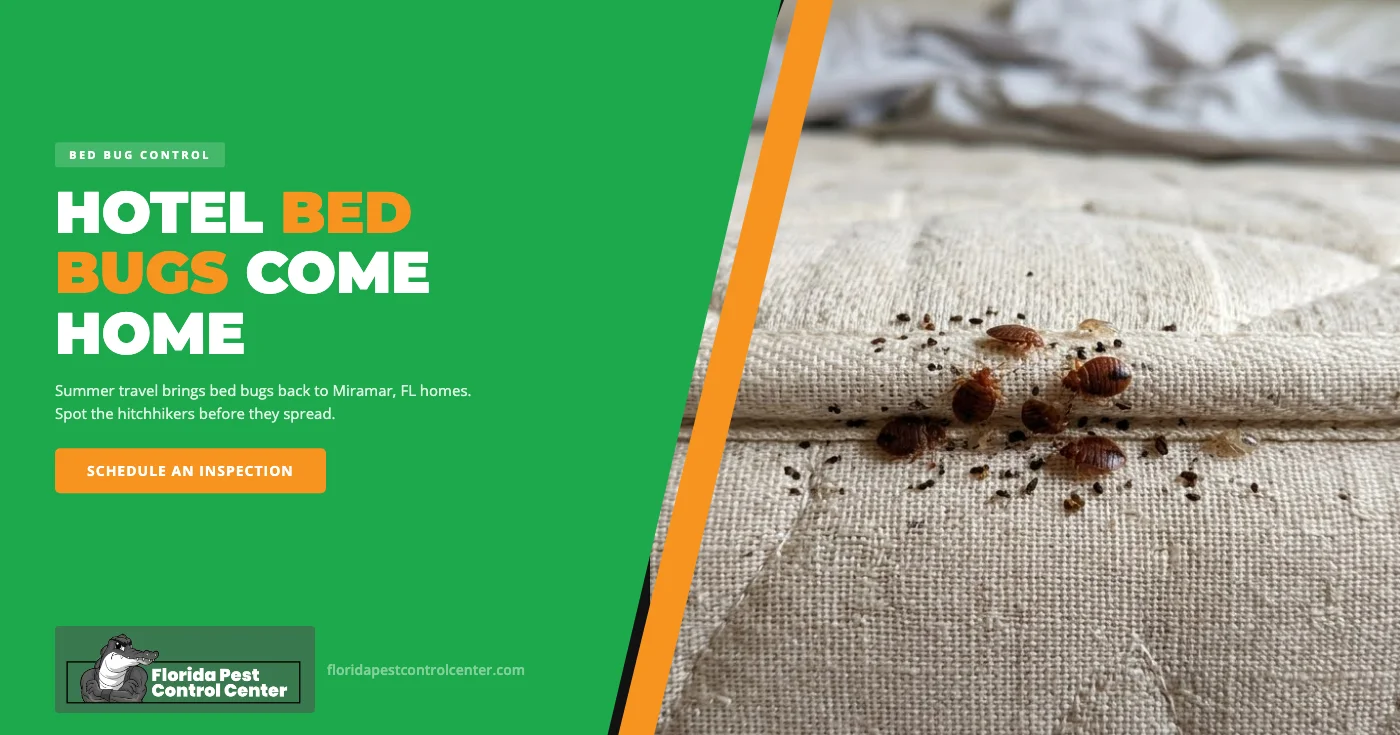
- Pull back the bedding and inspect the mattress and box spring. Strip the fitted sheet at the head of the bed and run a flashlight along the piping, seams, and tufts. Look for apple-seed-sized bugs, pearl-white eggs in clusters, translucent shed skins, and rust-colored fecal dots.
- Check the headboard and the wall behind it. Most hotel headboards lift off two wall-mounted brackets — a careful lift exposes the single most common bed bug harborage in a hotel room.
- Inspect upholstered furniture and the nightstand drawer. Bed bugs migrate from the bed to nearby chairs and dressers as a population grows. Check the seams of any upholstered piece within ten feet of the bed.
- If you find evidence, request a room in a different section of the property. Bed bugs spread along electrical conduit and shared wall voids, so a room directly above, below, or next door is not a meaningful change.
Early Signs of a Bed Bug Infestation in Your Miramar Home
Bites are usually the last sign, not the first — and they are unreliable on their own because reactions vary dramatically from person to person. By the time a Miramar homeowner notices welts, the colony has typically been feeding for several weeks. Earlier evidence is physical, not biological. The signs we look for during a Miramar bed bug inspection, in roughly the order they appear:
- Rust-colored fecal dots on the fitted sheet, mattress piping, box-spring tape, or wall beside the headboard. The dots smear if rubbed with a damp tissue.
- Tiny blood spots on the sheets — no bigger than a freckle, often clustered near the pillow line.
- Translucent shed skins in mattress seams, headboard joints, and box-spring corners.
- Pearl-white eggs in clusters glued into mattress tufting, screw holes, and bed-frame joints.
- Live bugs — adults are reddish-brown, flat, oval, about the size of an apple seed.
- Bites in a line or cluster on arms, shoulders, neck, or ankles, appearing in the morning along the side of the body that touched the mattress.
If any two of those signs appear together, the answer is a professional inspection before the population doubles again.
What to Do Immediately After Returning From Travel
The window between a trip ending and bed bugs settling in is short, but it exists — and the right steps in the first hour close it.
Unzip every suitcase on a hard surface — a driveway, garage floor, or patio — not on a bed and not on carpet. Hard surfaces let any hitchhiking bugs become visible instead of disappearing into fibers. Move travel laundry directly to the washer-dryer; heat is what kills bed bugs and their eggs, while washing alone does not reliably do it. Run every clothing item from the trip — including clothes that were not worn — through the dryer on high heat for at least thirty minutes. Store empty suitcases in a garage or attic, not the bedroom closet.
Then watch the master bed for four to six weeks — pull the fitted sheet back once a week and inspect the seams and box-spring tape with a flashlight. Populations double rapidly, so what looks like nothing the first week can show fecal dots and shed skins by week three. Early detection is the biggest factor in whether the resulting treatment is a one-day job or a months-long battle.
Why DIY Bed Bug Treatments Almost Always Fail
Drugstore foggers, off-the-shelf pyrethroid sprays, and home remedies fail on bed bugs for reasons that are not the homeowner's fault. The species' biology and field-level resistance simply do not give DIY products a real path to a closed-out infestation.
Eggs survive most of what kills adults — they are glued into seams and protected by their shell, which is why even thorough chemical applications need follow-up visits ten to fourteen days later to catch nymphs hatching after the first round. Pyrethroid resistance is widespread: most off-the-shelf sprays sold at hardware stores rely on pyrethroid chemistry, and field-collected Florida bed bug populations have shown measurable resistance to that class for over a decade. Foggers do not penetrate harborages — a "bug bomb" settles on horizontal surfaces while bed bugs hide inside seams, behind headboards, and in wall voids. Worse, foggers can drive the population deeper into wall cavities, spreading the infestation. Home space heaters do not reach the sustained 118°F that kills adults or the 122°F that kills eggs across an entire mattress and adjacent wall void — that takes industrial heaters, air movers, and wireless sensors.
How Florida Pest Control Center Eliminates Bed Bugs in Miramar
Every Florida Pest Control Center bed bug job in Miramar starts with an inspection — never a treatment quote without confirmation. Our technicians pull back mattress seams and box-spring tape, lift headboards, check behind framed art and outlet plates, and use a flashlight at low angle to spot live bugs, cast skins, fecal staining, and viable eggs. We confirm species, map the spread, identify the entry point, and recommend heat, chemical, or a hybrid program.
For active infestations spread across multiple rooms, we run whole-home heat treatment: industrial electric heaters and air movers bring the interior to 135 to 145°F for several hours, with wireless sensors inside mattresses, behind headboards, and in dresser drawers to confirm every harborage reaches the egg-lethal threshold. Heat kills adults, nymphs, and eggs in a single visit, and bed bugs cannot evolve resistance to temperature.
For early, localized infestations and apartment-style buildings where heat is not practical, we run layered chemical programs — a residual liquid at cracks, baseboards, headboard frames, and upholstered seams, a non-repellent contact spray for tufting, and a desiccant dust into wall voids and outlet boxes. Visits are spaced ten to fourteen days apart because residual products do not reliably kill eggs, and the follow-up catches nymphs hatching from any eggs the first treatment missed. After either program, we install bed-bug-rated encasements on every mattress and box spring in treated rooms to trap survivors and flag any reintroduction after a future trip.
Frequently Asked Questions About Bed Bug Control in Miramar, FL
How do I know if I brought bed bugs home from a hotel?
Watch the master bed for four to six weeks after a trip. Pull the fitted sheet back at the head of the mattress and inspect the piping, seams, and box-spring tape with a flashlight. Early evidence is physical — rust-colored fecal dots, tiny blood spots on sheets, translucent shed skins, and pearl-white eggs in clusters. Bites alone are not reliable because reactions vary widely from person to person.
How long does it take for bed bugs to spread after coming home from travel?
Under favorable conditions, a bed bug's egg-to-egg life cycle takes four to five weeks, and a single female can lay one to three eggs a day for the next six to twelve months. A single mated female brought home in July can produce a visible infestation by mid-August if nothing intervenes — which is why the first month after travel is the most important time to inspect the master bed weekly.
Do hotels in Florida have bed bugs?
Florida cities including Miami, Tampa, and Orlando regularly appear on national bed bug city lists, and hotels and motels rank third on the list of properties where pest professionals find bed bugs nationally. A five-minute inspection at check-in protects Miramar travelers regardless of the property's brand or star rating.
Can I stay in my Miramar home during bed bug treatment?
No. For heat treatment, the home is brought to 135 to 145°F — far too hot for occupants and pets. For chemical visits, the household leaves during application and returns after products have dried per the EPA-registered label, typically two to four hours.
Summer travel will keep moving bed bugs through Miramar all season, and the homes that close out fastest are the ones that catch the problem early. Learn more about our bed bug control program for Miramar, FL or reach out to schedule an inspection.