
Why Davie, FL Homes Are at Risk for Subterranean Termites After Summer Rain Season
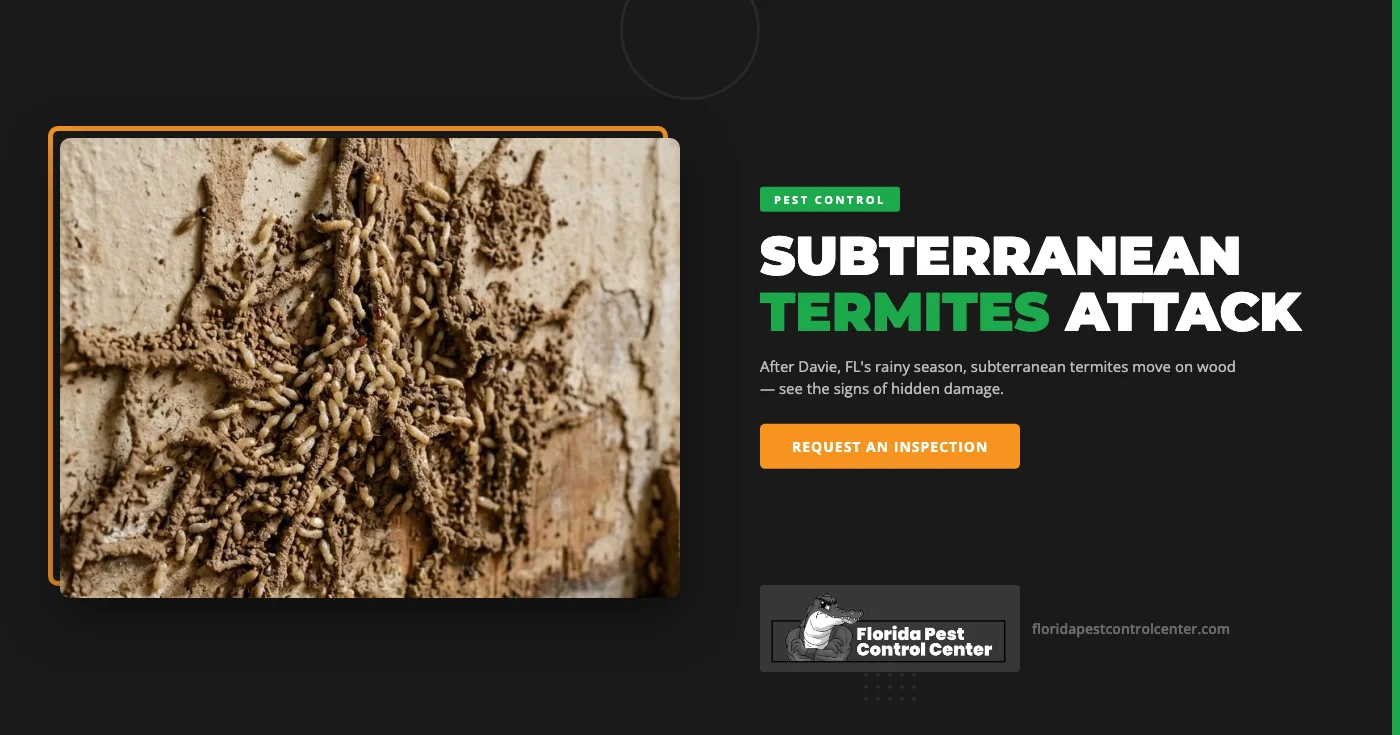
Why Davie, FL Homes Are at Risk for Subterranean Termites After Summer Rain Season
At Florida Pest Control Center, termite calls in Davie surge in the weeks following the end of hurricane season — and it happens for reasons that are baked into South Florida's climate. Year-round humidity keeps soil moisture at levels that support massive subterranean termite colonies, September and October rains push those colonies to expand and forage aggressively, and 2026 University of Florida research confirms that invasive Formosan and Asian subterranean termites are established across most coastal counties, including Broward. Here is what makes termite damage such a persistent threat for Davie homeowners, how to spot the early warning signs before structural damage becomes catastrophic, and how professional termite control actually breaks the colony rather than just treating the surface.
Why Davie, FL's Year-Round Humidity Makes Termite Damage a Persistent Threat
Davie sits in the heart of Broward County, where sustained humidity above 70 percent and average soil moisture that never fully dries out create ideal conditions for subterranean termite colonies. Unlike northern parts of the country where termite activity slows dramatically in winter, Davie termite colonies stay active every month of the year. That means a colony discovered in October has likely been feeding on the home's structural framing since the previous autumn, and the damage compounds silently every season.
Three climate factors combine to make termite control in Davie a year-round concern.
- Soil moisture never resets. Winter dry season in South Florida still delivers enough rainfall to keep soil moisture in the range subterranean termites prefer. In much of the country, freeze cycles or true dry winters push colonies deeper underground and slow their metabolism. In Davie, colonies stay near the surface and continue foraging at full pace.
- Warm nights speed the life cycle. Subterranean termite reproductive cycles accelerate when nighttime temperatures stay above 65°F. Davie almost never drops below that threshold for sustained periods, so colonies grow to full size faster than they would in the Panhandle or the interior of the state.
- Invasive species pressure is climbing. A 2026 University of Florida study documented that both the Formosan subterranean termite and the Asian subterranean termite have established populations across most coastal counties in Florida — Broward County included — and researchers project roughly half of structures in urban South Florida face infestation risk from one or both invasive species by around 2040.
Because native and invasive subterranean termites are active every month, the traditional idea of a distinct "termite season" does not really apply in Davie. There are periods of higher visibility — swarm season, post-hurricane forage surges — but the colonies never take the winter off.
Post-Hurricane Season: How September Rains Trigger Termite Activity in Broward County
Late-summer and early-fall rains do more than saturate the yard. They actively expand termite pressure across Broward County in three specific ways that most Davie homeowners are not aware of.
- Soil termiticide barriers get disturbed. UF/IFAS publication IN1277 notes that a washing rain, especially the kind delivered during hurricane season, can disrupt the treated soil around a home and compromise the barrier's effectiveness. A property that was fully protected in June may have exposed sections along foundation walls by October — and neither the homeowner nor the termites can see the gap from the surface.
- Fallen or storm-damaged trees expose hidden colonies. Any tree brought down or seriously damaged during a storm may reveal a subterranean termite colony that had been feeding on it silently for years. Those colonies do not disappear when the tree comes down — they redirect their foraging tunnels toward the next available cellulose source, which is often the closest structure.
- Water-damaged wood becomes a magnet. Subterranean termites are strongly attracted to wood that has absorbed moisture. Storm-related roof leaks, wind-driven rain intrusion behind stucco, or minor flooding in low-lying garages can create wet framing that termites detect and target within days of the storm passing.
The result is a measurable uptick in professional termite inspection calls across Broward County from mid-September through November every year. Davie homeowners who noticed no termite signs in summer often find swarmer wings on window sills or mud tubes on foundation walls within four to eight weeks after the first major storm event of the season.
Subterranean vs. Drywood Termites: What Davie Homeowners Need to Know
Not all termites behave the same way, and treatment strategy depends heavily on which type is present. Davie homeowners contend primarily with two categories: subterranean termites (native Eastern subterraneans plus invasive Formosan and Asian species) and drywood termites.
Subterranean termites live in the soil and travel to the structure through mud tubes they build along foundations, piers, and any surface that gives them a moist covered pathway. They require soil contact to survive. Because they cannot cross exposed open ground without drying out, they typically enter through cracks in the foundation slab, plumbing penetrations, expansion joints, and any wood-to-ground contact along the perimeter. Formosan colonies can span between one and one-and-a-half acres, and a single colony can contain several million individuals — enough to cause structural damage within six months of establishing inside a home.
Drywood termites live entirely inside the wood they consume and require no soil contact at all. They fly in as reproductive swarmers, chew a small entry hole, seal themselves inside a piece of framing or furniture, and start a new colony from scratch. Drywood colonies grow more slowly than subterranean colonies but are much more likely to end up inside attic framing, wall studs, or furniture that never touches the ground.
Treatment strategy diverges sharply. Subterranean termite infestations are best addressed with either a soil termiticide barrier or a colony-elimination bait system such as Sentricon (novaflumuron) or Trelona (novaluron). Drywood infestations require either localized foam or dust injection into infested framing, or whole-structure tent fumigation when the infestation has spread across multiple sections of the home. A proper Davie termite inspection identifies which type is present before any treatment is applied.
Early Warning Signs of Termite Damage in Your Davie Home
Subterranean termites live cryptic lives — the University of Florida notes that early detection is challenging and most homeowners only notice them once damage is already extensive. That makes it worth learning the specific warning signs Davie homeowners are most likely to see before structural damage becomes catastrophic.
- Discarded wings on window sills, in bathtubs, or near exterior lights. Reproductive swarmers shed their wings shortly after leaving the colony. Piles of small, translucent wings — often collected against a screen door or window frame — are one of the earliest visible signs of an established colony nearby.
- Mud tubes on foundation walls, piers, or garage walls. Subterranean termites build pencil-thick soil tunnels to travel between the ground and the wood they are feeding on. Any mud tube on a foundation, patio slab edge, or garage wall is a live infestation until proven otherwise.
- Hollow-sounding or paper-thin wood. Tapping structural framing, baseboards, or door jambs and hearing a hollow response indicates internal galleries. In advanced cases, painted wood surfaces feel thin or crumble under pressure.
- Small round holes in wood with fine sand-like pellets nearby. Drywood termites push their fecal pellets — called frass — out of the galleries through tiny kick-out holes. Frass looks like fine sand or coffee grounds and often accumulates below infested framing.
- Doors and windows that suddenly stick. Termite damage to the framing around openings can shift the frame just enough to make doors and windows bind, especially in humid conditions when the wood expands.
- Bubbling, peeling, or blistered paint. Moisture generated inside termite galleries can push through painted surfaces, producing bubbles or blisters that look like water damage but are actually a symptom of active feeding underneath.
Any of these signs on a Davie property warrants a professional termite inspection before treatment decisions are made. Guessing at the species or the extent of the infestation almost always underestimates the problem.
Why Most Termite Damage in South Florida Goes Undetected for Months
The single biggest reason termite damage becomes catastrophic in South Florida homes is that the colony is invisible until it is not. Several structural factors combine to hide subterranean termite activity for months or years in a Davie home.
- Slab-on-grade construction. Most Davie homes are built directly on a concrete slab with plumbing penetrations that run through the slab. Any hairline crack in the slab, gap around a plumbing chase, or expansion joint gives subterranean termites a hidden entry point into wall framing that never sees daylight.
- Concealed access along stucco walls. Termites can travel behind the stucco face of a home for years without leaving any visible trail on the exterior. The first sign is often interior damage far from any visible mud tube.
- Spray foam insulation. UF/IFAS notes that many termite companies will not warranty homes with spray foam insulation because the foam obscures inspection access and allows termites to travel concealed through foam-adjacent framing.
- Recent stucco or drywall repairs. A homeowner who patches a small crack thinking it is settlement may unknowingly seal an active termite entry point that then continues to expand behind the repair.
- Framing behind kitchen cabinets, bathroom vanities, and closets. Interior framing that is never opened up during normal maintenance is where the most severe hidden damage typically accumulates. Colonies feed silently for years before the damage reaches a surface a homeowner would notice.
The compounding effect is that by the time a Davie homeowner sees the first visible sign, the colony has often been feeding for 12 to 36 months. Damage repair estimates in the tens of thousands of dollars are not unusual for properties where the infestation was first discovered during a real estate transaction rather than during a routine annual termite inspection.
Professional Termite Inspection and Treatment Options in Davie, FL
Every termite control service at Florida Pest Control Center starts with a licensed inspection. We walk the entire structure with the homeowner — foundation perimeter, crawl spaces or slab penetrations where accessible, attic, garage, and any auxiliary structures — and identify current infestations, past infestations, conditions that promote termite activity, and any compromises to existing termiticide barriers. Only then do we recommend a treatment approach that matches the species, the extent of the infestation, and the home's construction type.
Our termite treatment options for Broward County properties include three primary strategies.
- Soil-applied termiticide barrier. A liquid termiticide is applied to the soil around the foundation perimeter and injected through drilled ports beneath slabs and expansion joints. Modern non-repellent termiticides create an undetected treated zone that eliminates termites as they attempt to cross it. Best suited for pre-construction treatments, active subterranean infestations with clear entry points, and any home where a hurricane may have disturbed a prior application.
- Colony-elimination bait system. Bait stations installed around the perimeter deliver an insect growth regulator such as Sentricon (novaflumuron) or Trelona (novaluron) that is carried back to the colony by foraging workers. Because the queen and the rest of the colony rely on those workers for food, the whole colony collapses. Monitoring stations continue to detect any new colonies attempting to establish nearby.
- Drywood-specific treatments. Localized foam or dust injections targeted at accessible drywood infestations, or whole-structure tent fumigation when drywood termites have spread across multiple areas of the home. A professional drywood inspection determines whether local or whole-structure treatment is warranted.
Every treatment plan comes with an ongoing renewal inspection contract because South Florida termite pressure never fully resets. Annual re-inspections catch new activity early and confirm that the existing treatment remains intact after storm events.
How to Protect Your Davie Home from Future Termite Infestations
Beyond professional treatment, several homeowner-controlled steps meaningfully reduce termite risk on a Davie property. These are the recommendations we consistently make during inspections.
- Maintain a six-inch clearance between soil or mulch and the bottom of exterior wall siding. UF/IFAS specifically recommends this clearance to reduce moisture accumulation and eliminate wood-to-ground contact points that give subterranean termites concealed access to framing.
- Redirect landscape irrigation and downspout discharge away from foundation walls. Sprinkler zones that saturate soil directly against the house create the moist conditions termite colonies prefer. Downspouts that discharge at the base of the wall move water exactly where you do not want it.
- Store firewood, lumber, and cellulose debris away from the house. Any wood pile within 20 feet of the structure acts as a satellite feeding station that helps a colony grow to the size needed to threaten the home itself.
- Repair roof leaks and stucco cracks promptly. Water-damaged framing is a termite magnet, especially in the weeks following a hurricane. Same-week repairs prevent moisture from building up in concealed wall cavities.
- Turn off exterior lights during peak swarm periods. May and June evenings — and warm calm nights in September and October — are when reproductive swarmers are most active and strongly attracted to porch and floodlight fixtures. Reducing light exposure reduces the number of colonies attempting to establish on the property.
- Schedule an annual professional termite inspection. Even with every prevention step in place, professional annual inspections remain the single most reliable way to catch new activity early — before the colony causes damage that requires structural repair rather than treatment alone.
Frequently Asked Questions About Termite Control in Davie, FL
How often should Davie homeowners schedule a termite inspection?
Once per year at minimum. UF/IFAS recommends professional annual renewal inspections by licensed inspectors as the core prevention strategy for South Florida homes. Properties within a mile of a known Formosan infestation, homes with prior termite damage, and any home built on a slab with plumbing penetrations should generally follow the more frequent inspection schedule their treatment provider recommends. After any tropical storm or hurricane event, an out-of-cycle inspection is strongly recommended to confirm the existing soil termiticide barrier remains intact.
How much does professional termite treatment cost in Davie, FL?
Treatment cost depends on the species involved, the extent of the infestation, and the home's construction type. A perimeter bait system for a typical single-family home falls in a different price range than a soil-applied termiticide barrier around a two-story home, which is in turn different from whole-structure tent fumigation for widespread drywood activity. Every quote we provide is based on the actual inspection findings — never on square footage alone — and includes the ongoing renewal inspection commitment that keeps the treatment effective.
Can I treat termites myself with store-bought products?
Store-bought termite products can kill visible termites on contact but do not eliminate the colony, which is typically underground and out of reach. Professional soil termiticides and colony-elimination bait systems require licensed application because they involve regulated products and specific application techniques required by Florida Department of Agriculture licensing. DIY treatment of a suspected infestation almost always allows the colony to continue expanding while giving the homeowner a false sense of protection — meanwhile the colony continues its work.
Schedule Your Termite Control Service with Florida Pest Control Center
Termite pressure in Davie is a year-round threat, and the weeks following hurricane season are the highest-risk stretch of the year for new activity. Homeowners who schedule an inspection in October or November catch storm-related barrier disruptions and post-storm forage surges before the damage becomes structural — and lock in ongoing renewal protection before the winter dry-season slowdown.
We serve Davie, Fort Lauderdale, Plantation, Sunrise, Cooper City, Pembroke Pines, Miramar, Hollywood, and the surrounding Broward County area. Alongside termite control, we also offer a full range of residential pest services for year-round property protection.
Contact Florida Pest Control Center today to schedule your termite inspection in Davie, FL.