

Why Wasp and Yellow Jacket Nests Peak in Lauderhill, FL in September — and How to Stay Safe
Why Wasp and Yellow Jacket Nests Peak in Lauderhill, FL in September — and How to Stay Safe
At Florida Pest Control Center, September is the busiest month of the year for wasp and bee control calls from Lauderhill homeowners. Colonies that started as pencil-tip paper cones in April now hold thousands of workers, natural food is dropping off, and yellow jacket aggression hits its annual peak during the same six-week window every fall. Here's what drives that surge — and what actually happens when a homeowner tries to knock down a mature stinging insect nest in Lauderhill, FL.
Why September Is Peak Season for Wasp and Bee Activity in South Florida
South Florida's climate lets social wasp colonies grow for almost seven months without a hard freeze. In Lauderhill, overwintered queens start new colonies in April, and by late August each colony reaches its maximum size — for yellow jackets, 3,000 to 5,000 workers in a single underground or wall-void nest; for paper wasps, 100 to 200 workers in exposed combs.
Three September shifts push wasp aggression sharply upward across Lauderhill and the surrounding Broward County area. Natural prey drops off, so workers travel farther and scavenge more aggressively at outdoor food. Late-season colonies are defending their largest-ever population of larvae, pupae, and stored resources, and yellow jackets release alarm pheromones that recruit dozens of workers to sting within seconds of any disturbance. Peak worker turnover keeps the nest at its most crowded and most defensive. That convergence is why our wasp bee control Lauderhill FL call volume spikes in the first three weeks of September every year.
Common Stinging Insects Found Around Lauderhill Homes and Yards
Correct species identification is the foundation of any effective wasp and bee control response in Lauderhill.
- Southern yellow jacket (Vespula squamosa). The most medically significant social wasp in South Florida. Half-inch bodies, yellow and black bands, ground or wall-void nests holding thousands of workers by September. Extremely defensive — will pursue threats 20 to 30 feet from the nest and sting multiple times.
- Florida paper wasp (Polistes major) and red paper wasp (Polistes carolina). Slender, long-legged wasps that build open umbrella-shaped combs under Lauderhill eaves, in soffits, and on porch ceilings. Less aggressive than yellow jackets but will sting when the nest is jostled.
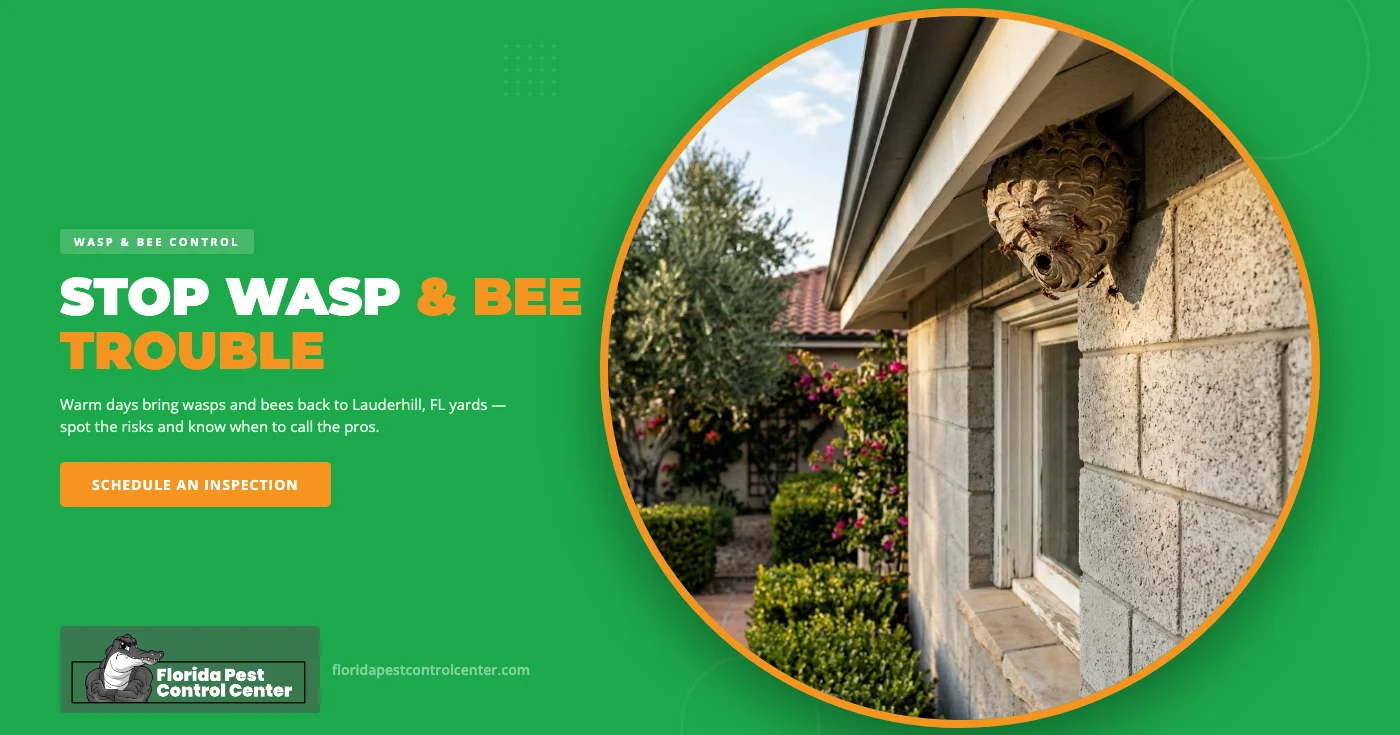
- Bald-faced hornet (Dolichovespula maculata). A large yellow jacket relative — glossy black with white face markings. Builds football-shaped gray papery nests in trees, on walls, and under eaves. Highly defensive.
- Black and yellow mud dauber (Sceliphron caementarium). Solitary spider-hunter that builds hard mud tubes on soffits and pool cages. Almost never stings, but its presence signals a spider population worth addressing.
- European and Africanized honey bees (Apis mellifera). Fuzzy, golden-brown pollinators that occasionally colonize wall voids, chimney chases, and hollow trees. Africanized bees have been established in Broward County since 2005 and are visually indistinguishable from European bees but far more defensive — any wall-void honey bee colony should be professionally identified before any removal attempt.
Where Wasps and Yellow Jackets Build Nests on Your Property
Late-season nest locations in Lauderhill follow predictable patterns tied to species biology and to construction features common in South Florida homes.
- Underground burrows. Southern yellow jackets use abandoned rodent burrows and voids under concrete slabs. The only visible sign is a steady stream of workers at a single small opening in the yard.
- Wall voids and soffits. Yellow jackets and honey bees enter through cracks in stucco, gaps around plumbing penetrations, and torn screen vents. Sustained daytime buzzing inside a wall is the most reliable indicator.
- Attic vents and gable ends. Paper wasps and yellow jackets exploit any unscreened attic ventilation, and interior nests can go undetected for months.
- Eaves, porch ceilings, and door frames. Classic paper wasp habitat — umbrella-shaped combs hanging from a single stalk under any horizontal overhang.
- Palm frond bases and dense shrubs. Paper wasps build inside the sheltered crown of untrimmed palms and dense hedges — hidden until pruning exposes them.
- Meter boxes and utility enclosures. Small dark voids that yellow jackets colonize aggressively — anyone stung while checking a water meter has almost certainly disturbed a nest inside.
- Grill covers, patio furniture, and children's playsets. Paper wasps build inside grill covers, under patio umbrellas, and in playset tube frames — the most common source of accidental stings on Lauderhill properties.
Signs You Have a Wasp or Bee Nest That Needs Professional Removal
Stinging insect nests often go undetected because activity concentrates in low-traffic areas. These indicators mean a nest on your Lauderhill property has crossed from a manageable early-season colony to a mature fall nest that warrants professional wasp and bee control.
- Consistent inbound and outbound traffic at a single point. More than one wasp per second entering and exiting the same crack or ground hole indicates an established colony.
- Ten or more wasps visible in one area. A concentration of foragers within a small radius almost always traces back to a nest within 50 feet.
- Ground swarms triggered by mowing or foot traffic. Any Lauderhill homeowner swarmed while mowing a specific patch of grass has walked over a yellow jacket ground nest — every future pass escalates the response.
- Daytime humming or vibration inside a wall or ceiling. Active colonies produce a constant sound that intensifies on warm afternoons; honey bee colonies eventually show wax staining bleeding through drywall.
- Visible combs, mud tubes, or football-shaped gray envelopes. Any exposed nest larger than a golf ball on a Lauderhill property in September needs professional removal.
- Multiple stings from the same yard area within a short time. Two or three stings from the same corner within a week indicates a nest actively defending territory.
Why DIY Nest Removal Is Dangerous — Especially During Fall Peak Season
DIY wasp and bee nest removal produces the largest share of sting-related emergency room visits we hear about from Lauderhill families every fall. A mature September yellow jacket colony can deploy hundreds of stinging workers within seconds, and each worker can sting repeatedly — unlike honey bees, which lose their stinger after a single sting. A homeowner spraying a hardware-store aerosol at dusk can absorb 15, 20, or more stings before making it back to the house.
- Consumer aerosols reach only the exterior of the nest. Foaming aerosol kills workers directly hit but leaves the queen, brood, and thousands of interior workers untouched. Survivors emerge angrier and the colony rebuilds within a week.
- Ground-nest disturbance triggers mass swarming. Kicking, spraying, or pouring anything into a yellow jacket ground entry releases alarm pheromones that recruit workers from 20 to 30 feet away.
- Gasoline and burning approaches destroy structures. Every fall, Broward County sees at least one house fire started by a homeowner trying to burn out a wasp nest. Never appropriate.
- Anaphylaxis risk is unpredictable. The American Academy of Allergy, Asthma & Immunology notes that anyone previously stung without incident can still develop a severe systemic reaction. Trouble breathing, swelling of the face or throat, hives, dizziness, or rapid pulse typically appear within 30 minutes and require immediate epinephrine and a 911 call.
- Ladder work compounds the risk. A single defensive sting on the face or hand while ladder-mounted routinely produces falls and broken bones on top of the sting injuries.
Professional wasp and bee control in Lauderhill, FL is faster, more thorough, and dramatically lower risk to the homeowner and family.
How Florida Pest Control Center Professionally Removes Stinging Insect Nests
Every stinging insect job at Florida Pest Control Center starts with a licensed inspection to confirm species, locate the nest, identify any satellite nests, and map the sting-risk zone. Species matters — the treatment for a wall-void yellow jacket nest differs sharply from the response to a honey bee colony that should be relocated live by a beekeeper.
Our technicians then deploy full protective equipment — bee suits, veils, gloves, boot covers — and treat the colony using products and application methods matched to species and location. For yellow jackets and paper wasps, that typically means a residual dust or aerosol injected directly into the nest cavity, followed by physical nest removal once the colony is neutralized. For honey bees in wall voids, we coordinate live removal with a local beekeeper whenever possible; when live removal is not, we handle the colony and arrange for full comb and honey removal to prevent secondary pest issues.
After the primary treatment, we apply a perimeter treatment focused on eaves, soffits, meter boxes, palm crowns, and any voids showing evidence of exploratory nest-building. Every wasp and bee control job in Lauderhill includes follow-up guidance and a scheduled check-in. Our pest control services also address the underlying prey insect pressure that draws wasps to a property in the first place.
Preventing Future Wasp Nests on Your Lauderhill Property
Prevention starts in early spring, when overwintered queens are actively searching for nest sites. A short list of routine seasonal actions dramatically reduces the number of mature colonies a Lauderhill property has to deal with by September.
- Walk the exterior every two weeks from March through June. Early-season nests are pencil-tip small and hold a single queen with a handful of eggs. Knocking one down at that stage takes seconds and prevents a fall-peak colony entirely.
- Screen every attic vent, gable vent, and unused chimney flue. One-eighth-inch hardware cloth blocks wasps and honey bees without restricting airflow.
- Seal wall penetrations, plumbing gaps, and stucco cracks. Any opening larger than an eighth of an inch can admit a founding queen in April.
- Trim palms, hedges, and dense shrubs regularly. Overgrown vegetation offers ideal sheltered nest sites.
- Move patio furniture, grill covers, and playset components weekly. Regular disturbance prevents paper wasps from starting new combs.
- Clean up fallen fruit and secure outdoor trash. Fermenting fruit and open trash draw scavenging yellow jackets from surrounding properties into your yard.
- Fill in abandoned rodent burrows. Empty burrows are the most common yellow jacket nest site in Lauderhill turf.
Frequently Asked Questions About Wasp and Bee Control in Lauderhill, FL
Are yellow jackets more aggressive in September than earlier in the year?
Yes, and the difference is dramatic. Southern yellow jacket colonies in Lauderhill peak in population between late August and mid-September — a single nest can hold 3,000 to 5,000 workers by then. Declining natural prey and defense of stored resources push worker aggression to its annual maximum, which is why September accounts for a disproportionate share of sting-related emergency visits from Lauderhill families every year.
How do I tell a wasp nest from a honey bee colony on my Lauderhill property?
Wasps are slim, hairless, and shiny; honey bees are fuzzy and golden-brown. Paper wasps build open umbrella combs, yellow jackets build enclosed papery envelopes hidden in voids or underground, and honey bees build wax comb inside a permanent cavity. Correct identification matters because honey bee colonies should be relocated live by a beekeeper whenever possible, while wasp and yellow jacket nests are treated and removed.
What should I do if my child or pet is stung multiple times?
Move immediately away from the nest area — wasp alarm pheromones recruit additional stinging workers for several minutes after the first sting. Wash the stings, apply cold compresses, and monitor for systemic reaction: swelling beyond the sting site, hives, trouble breathing, dizziness, vomiting, or drop in alertness. Call 911 immediately if any systemic symptoms appear. Any child under 40 pounds who receives 10 or more stings should be evaluated by a physician regardless of symptoms.
Schedule Your Wasp and Bee Nest Inspection with Florida Pest Control Center
Lauderhill homeowners who address a mature wasp or bee nest quickly — before workers are actively defending the property, before the first sting to a child or guest — avoid the emergency-room outcomes and property-damage risks that come with waiting or attempting DIY removal. September and early October are the peak-pressure weeks of the year for stinging insects in South Florida.
We serve Lauderhill, Fort Lauderdale, Plantation, Sunrise, Tamarac, Lauderdale Lakes, North Lauderdale, Oakland Park, Pompano Beach, and the surrounding Broward County area. Alongside wasp and bee control, we also offer a full range of residential pest services.
Contact Florida Pest Control Center today to schedule your wasp and bee nest inspection in Lauderhill, FL.